
Crypto Market Resilience Amid Geopolitical Shocks: Risk Management and Capital Reallocation in a Fractured World
The cryptocurrency market has emerged as both a lightning rod and a laboratory for understanding capital behavior during geopolitical turbulence. Between 2020 and 2025, major events-from U.S. presidential elections to U.S.-China trade wars-have tested the resilience of digital assets, revealing a complex interplay of volatility, investor psychology, and institutional adaptation. While cryptocurrencies like BitcoinBTC-- (BTC) and EthereumETH-- (ETH) have shown moments of strength, their role as safe-haven assets remains contested, particularly against traditional benchmarks like gold and the U.S. dollar.
Geopolitical Catalysts and Market Reactions
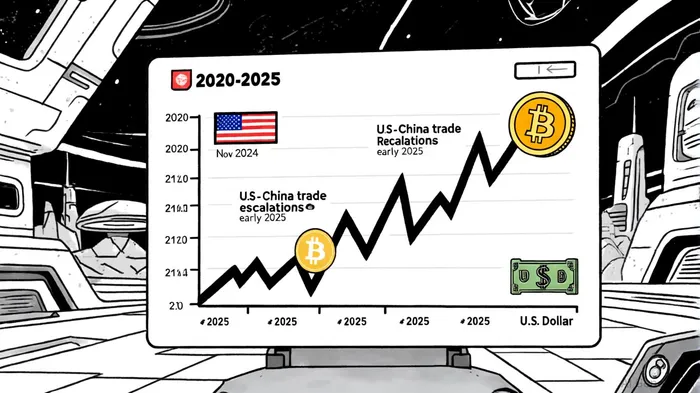
The 2024 U.S. Presidential Election served as a textbook example of how political outcomes can reshape crypto markets. Following Donald Trump's victory, Bitcoin surged to an all-time high of $89,000, driven by optimismOP-- over potential pro-crypto regulatory reforms, according to a FinancialContent analysis. Conversely, escalations in the U.S.-China trade war in early 2025 triggered a sharp sell-off, with Bitcoin dropping below $78,000 as investors recalibrated risk appetites; that analysis attributes the move to rapid risk-off positioning and liquidity pressures. These swings underscore the dual nature of crypto as both a speculative asset and a barometer for global uncertainty.
The Russia-Ukraine conflict further highlighted crypto's fragility. In June 2025, amid U.S. and Israeli military actions in the Middle East, Bitcoin plummeted by over 15% in a single week, a reaction detailed in the FinancialContent piece. Yet, during the same period, stablecoins like DAI absorbed systemic risk, acting as liquidity buffers for traders fleeing volatile assets, according to the same analysis. This duality-where some crypto assets amplify shocks while others mitigate them-has become a defining feature of the post-2020 market landscape.
Risk Management: From Retail Hesitation to Institutional Discipline
For individual investors, the lessons of 2024–2025 have been stark. A ScienceDirect study confirms that cryptocurrencies remain less effective as safe-havens than gold or the USD, with Bitcoin's volatility rendering it a "double-edged sword" during crises. Retail traders have increasingly adopted stop-loss orders, position sizing, and portfolio diversification to navigate these risks, according to CoinLaw statistics. However, the same cannot be said for governance and DeFi tokens, which transmit risk rather than absorb it, as seen with tokens like MKRMKR-- and UNIUNI-- during market stress; the FinancialContent analysis highlights these contagion dynamics.
Institutional investors, by contrast, have built robust frameworks to manage crypto's inherent risks. By 2025, 78% of global institutional investors had formal crypto risk management strategies, including multi-signature wallets, cold storage, and insurance coverage, data compiled in the CoinLaw report shows. The integration of AI-driven risk assessment tools-adopted by 60% of institutions by early 2025-has further enhanced predictive capabilities, per the same CoinLaw dataset. Regulatory clarity, such as the EU's MiCA framework, has also bolstered confidence, enabling pension funds and sovereign wealth funds to allocate portions of their portfolios to Bitcoin-backed ETFs and digital asset treasuries (DATs), according to a DLA Piper report.
Capital Reallocation: From Hedge to Strategic Diversification
Geopolitical shocks have accelerated capital reallocation into crypto, particularly among non-U.S. investors. Asian and Middle Eastern institutions have increasingly treated Bitcoin as a "supra-sovereign" hedge against dollar devaluation and trade tensions, a trend reflected in the CoinLaw statistics. For example, during the 2025 U.S.-China tariff pause, Bitcoin rebounded 8% while Ethereum gained 12%, reflecting its appeal as a cross-border store of value, a pattern noted by the ScienceDirect study.
The rise of DATs-adopted by over 200 U.S. public companies-has further institutionalized crypto's role in treasury management. These instruments allow firms to generate yields on digital assets while hedging against currency depreciation, a critical advantage during periods of geopolitical-driven inflation, as the DLA Piper report explains. Meanwhile, XRPXRP-- and other cross-border-focused cryptocurrencies have benefited from BRICS de-dollarization efforts, posting year-to-date gains as of October 2025, a development the FinancialContent analysis also documents.
The Path Forward: Balancing Volatility and Opportunity
While crypto markets remain susceptible to geopolitical shocks, their strategic value is undeniable. Investors must balance Bitcoin's volatility with its potential as a decentralized hedge, while institutions should continue refining risk frameworks to align with traditional finance standards. For those willing to navigate the turbulence, the 2024–2025 era has demonstrated that crypto is not just a speculative fad-it is a dynamic, evolving asset class capable of reshaping capital flows in a fractured world.






Comentarios
Aún no hay comentarios