
U.S. Crypto Market Normalization and Its Impact on Institutional Adoption
The U.S. crypto market is undergoing a pivotal transformation as regulatory clarity replaces uncertainty, creating fertile ground for institutional adoption and product innovation. At the heart of this shift is the Commodity Futures Trading Commission (CFTC), whose 2025 regulatory updates are redefining the landscape for digital assets. By modernizing frameworks and aligning with evolving market needs, the CFTC is not only legitimizing crypto as a mainstream asset class but also unlocking new opportunities for institutional players to participate safely and profitably.
Regulatory Clarity: A Foundation for Trust
For years, the absence of clear rules for spot crypto trading left institutional investors wary of regulatory risks. That changed on December 4, 2025, when the CFTC announced that federally registered futures exchanges could now offer spot cryptocurrency products, including leveraged contracts for retail users, under the same rigorous oversight applied to traditional commodities. This move effectively brought spot trading under the CFTC's regulatory umbrella, ensuring investor protections such as transparency, market integrity, and anti-fraud measures.
Acting Chair Caroline Pham described the decision as a "historic milestone," emphasizing its alignment with recommendations from the President's Working Group on Digital Asset Markets. By extending federal standards to spot crypto, the CFTC has addressed a critical gap, reducing ambiguity for market participants and signaling to institutions that the U.S. is committed to fostering a stable, rules-based environment.
Innovation Unleashed: Rolling Back Outdated Barriers
The CFTC's 2025 agenda also prioritized removing regulatory hurdles that stifled innovation. A key example is the rollback of its 2020 guidance on the "actual delivery" of virtual currencies, which had complicated custody and settlement practices. By discarding these outdated rules, the agency has enabled more flexible tokenized market structures, such as fractional ownership and programmable assets, which are essential for scaling institutional-grade products.
This shift reflects a broader recognition that digital assets require a regulatory approach as dynamic as the technology itself. As stated by the CFTC, the changes 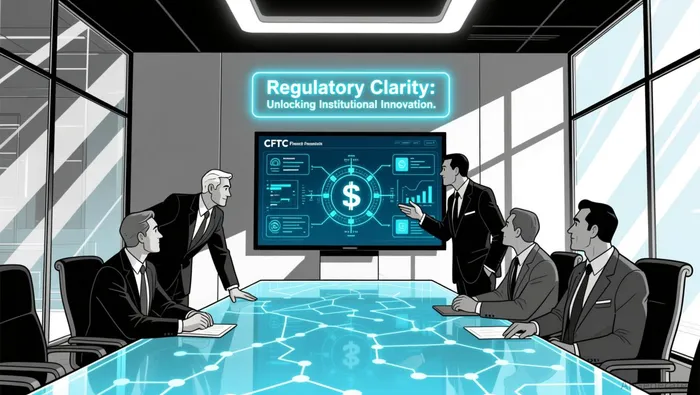 support "innovation in tokenized markets" while maintaining alignment with evolving legal and technological standards. For institutions, this means reduced operational friction and the ability to design novel financial instruments-such as tokenized real estate or carbon credits-without fear of regulatory overreach.
Institutional Adoption: A New Era of Participation
The CFTC's efforts are complemented by legislative momentum. The Senate Agriculture Committee's bipartisan discussion draft, released in late 2025, proposes granting the CFTC exclusive jurisdiction over cash and spot trading in non-security digital commodities. This would establish a unified regulatory regime for exchanges, brokers, and dealers, complete with listing standards, public information requirements, and strict custody rules.
Such clarity is a game-changer for institutions. Historically, the lack of a defined legal framework deterred pension funds, endowments, and hedge funds from allocating capital to crypto. Now, with the CFTC's oversight and the potential for a cohesive legislative framework, these players can engage with digital assets using familiar risk-management tools and compliance protocols. The result? A surge in demand for institutional-grade products, from crypto-backed ETFs to structured derivatives, as firms seek to diversify portfolios in a high-growth asset class.
The Bigger Picture: U.S. Leadership in Digital Finance
These developments are not isolated; they are part of a broader administration strategy to position the U.S. as a global leader in digital finance. As outlined in a 2025 regulatory preview, the administration aims to balance innovation with consumer protection, ensuring that the U.S. remains competitive with jurisdictions like Singapore and the EU according to a State Street analysis. The CFTC's actions directly support this goal by creating a market environment where institutions can thrive, driving liquidity and maturity.
For investors, the implications are clear: the U.S. crypto market is transitioning from a speculative niche to a normalized asset class. Institutional entry will bring not only capital but also the infrastructure-custody solutions, trading platforms, and risk analytics-that underpins long-term growth.
Conclusion
The CFTC's 2025 regulatory modernization marks a turning point in the journey toward a mature digital asset market. By providing clarity, fostering innovation, and attracting institutional capital, the agency is laying the groundwork for a future where crypto operates alongside traditional assets in a fair and transparent ecosystem. For those who recognize the shift early, the opportunities are vast-and the U.S. is now the most compelling stage for them to unfold.







Comentarios
Aún no hay comentarios