
Crypto Market Manipulation and Regulatory Risk: Navigating Short-Term Volatility in 2025
The cryptocurrency market in 2025 has become a battleground of regulatory experimentation, geopolitical tensions, and sophisticated manipulation tactics. Short-term volatility, once a hallmark of crypto's speculative nature, has now been amplified by a confluence of high-profile trading activities, political shocks, and fragmented regulatory frameworks. For investors, understanding these triggers is critical to navigating a landscape where institutional adoption and regulatory clarity coexist with systemic fragility.
Regulatory Shifts: A Double-Edged Sword
The U.S. regulatory landscape in 2025 has been marked by a paradoxical duality. On one hand, the Securities and Exchange Commission (SEC) has adopted a more hands-off approach, dismissing cases against major players like Ripple, CoinbaseCOIN--, and Kraken, according to a Markets report. This shift, coupled with the Trump administration's executive order banning Central Bank Digital Currencies (CBDCs) and mandating a federal regulatory framework for digital assets, as reported by Analytics Insight, has created a veneer of clarity. However, this clarity is undermined by the Department of Justice's (DOJ) aggressive enforcement of anti-manipulation laws. For instance, the SEC's suspension of QMMM Holdings Ltd. (NASDAQ: QMMM) in Q3 2025 over social media-driven manipulation, as reported by Markets, signaled a renewed focus on curbing deceptive practices.
Meanwhile, global regulatory divergence has introduced new risks. The EU's Markets in Crypto-Assets (MiCA) framework, with its stringent licensing requirements, contrasts sharply with Singapore and Hong Kong's innovation-friendly regimes, according to a Chainalysis post. This fragmentation has led to arbitrage opportunities and regulatory arbitrage, further destabilizing markets. For example, the launch of SolanaSOL-- futures by the CME Group in 2025 reflected institutional hedging against regulatory uncertainty, as noted in Coinpedia's Q3 report.
Market Manipulation: Algorithms and Altcoin Scams
Algorithmic wash trading and pump-and-dump schemes have emerged as dominant volatility triggers. The FBI's investigation into NexFundAI, which implicated market makers like ZM QuantQNT-- and CLS Global in manipulating DeFi platforms like UniswapUNI--, revealed a $2.57 billion worth of suspected wash trading in 2024, according to Chainalysis. These activities, often executed through rapid-fire transactions on decentralized exchanges (DEXs), create artificial liquidity to lure retail investors. Similarly, the $HAWK memeMEME-- coin crash-where a 90% price drop wiped $151K from investors-exemplifies the destructive potential of pump-and-dump schemes.
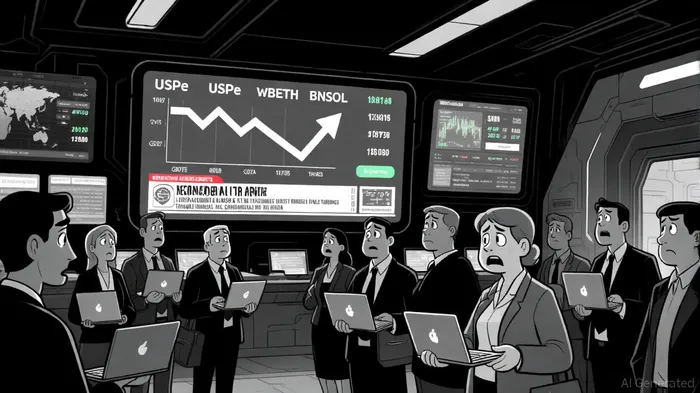
The October 2025 oracle manipulation attack, which exploited vulnerabilities in USDeUSDe--, wBETH, and BNSOL, underscores a new frontier of systemic risk. By manipulating price feeds, attackers triggered a $19.3 billion market value wipeout within hours. This incident exposed the fragility of decentralized finance (DeFi) infrastructure, where transparency and security remain aspirational rather than operational.
Political Events: Tariffs, Memecoins, and Market Meltdowns
Geopolitical tensions have proven to be a wildcard in crypto volatility. The October 10–12 2025 announcement of a 100% tariff on Chinese imports by U.S. President Donald Trump triggered one of the largest liquidation events in crypto history. BitcoinBTC-- plummeted from $125,000 to below $102,000, with $730 billion in market value erased and $19 billion in forced liquidations. The event was compounded by speculation of insider trading, as a trader reportedly profited $88 million by shorting Bitcoin 30 minutes before the announcement.
Politically themed memecoins, such as $TRUMP and $MELANIA, further illustrate the intersection of politics and market sentiment. While these tokens reflect the influence of political narratives, they remain highly speculative, with their value tied to fleeting social media trends.
The Path Forward: Stability or Chaos?
While regulatory clarity is expected to attract institutional capital in the long term, the short-term outlook remains fraught. The Bybit hack in February 2025, which exacerbated volatility by eroding investor confidence, and the surge in wallet-based attacks in Q3 2025-despite a 37% decline in total losses-highlight the evolving nature of security threats.
For investors, the key lies in hedging against both regulatory and operational risks. The passage of the GENIUS and CLARITY Acts in the U.S. provides a glimmer of hope, but their implementation will require vigilance. As one analyst noted, "The crypto market in 2025 is a high-stakes poker game where the rules are still being written."







Comentarios
Aún no hay comentarios