
Crypto Market Fragility in 2025: Leverage, Liquidity, and Systemic Risk
The crypto market in 2025 has emerged as a paradoxical landscape: a maturing asset class burdened by systemic vulnerabilities. Regulatory clarity, institutional adoption, and technological innovation have propelled digital assets into mainstream finance, yet the Q4 2025 leverage reset and liquidity crisis exposed deep-seated fragility. For institutional investors, the challenge lies in balancing the promise of crypto's utility with the risks of overleveraged positions, fragmented infrastructure, and untested regulatory frameworks. This analysis examines the interplay of leverage, liquidity, and systemic risk in 2025, while evaluating how institutional risk management and infrastructure resilience are reshaping the market's trajectory.
Leverage: The Double-Edged Sword of Growth
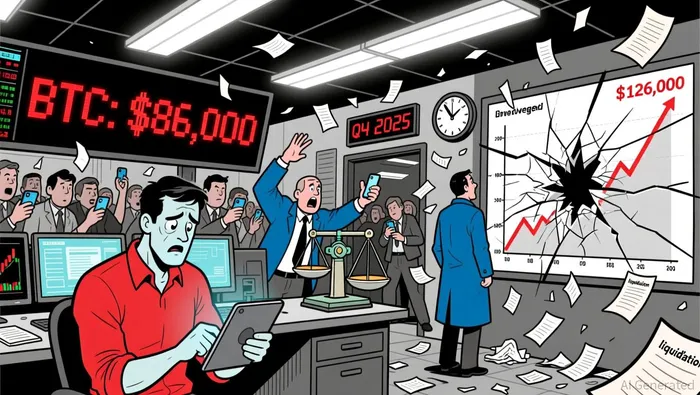
The Q4 2025 market collapse was a stark reminder of leverage's destabilizing potential. As BitcoinBTC-- surged to $126,000 in October, retail and institutional traders alike deployed excessive leverage, with ratios reaching as high as 1,001:1 according to Bitget reports. When macroeconomic pressures and geopolitical tensions triggered a sell-off, cascading liquidations amplified volatility. By late November, Bitcoin had plummeted to $86,000, erasing $20 billion in assets as perpetual futures-accounting for 78% of trading volume-created a self-reinforcing cycle of forced selling according to market analysis.
This leverage-driven collapse highlighted a critical flaw: crypto's derivatives market lacks the circuit breakers and margin requirements of traditional finance. While institutions began favoring regulated offerings like Bitcoin ETFs, retail traders' reliance on uncollateralized leverage underscored the need for systemic safeguards according to industry experts. Regulatory bodies, including the U.S. SEC and CFTC, responded with joint guidance clarifying that regulated exchanges could list and hold crypto assets under existing rules according to Nasdaq reporting. However, the absence of global standards for leverage limits and margin requirements remains a vulnerability as highlighted by the ECB.
Liquidity: A Market in Perpetual Reset
Liquidity in the crypto market has always been a fragile illusion, and Q4 2025 exposed its fragility. Bitcoin's 30% quarterly drop was exacerbated by fragmented infrastructure, with thin order books and low free float creating a "liquidity vacuum" during downturns according to Alaric Securities. The crisis revealed a pro-cyclical dynamic: as prices fell, both institutional and retail participants exited en masse, accelerating the decline.
Stablecoins, while offering short-term utility, compounded the problem. Their integration into DeFi lending platforms-lacking deposit insurance or capital requirements-created a false sense of security according to BPI insights. When redemption pressures mounted, stablecoin depeg events amplified panic, triggering cross-chain failures and exacerbating the liquidity crunch as detailed in Elliptic's assessment. Post-crisis, the market has shifted toward utility-driven sectors like tokenized assets and on-chain yield instruments, but structural issues such as concentrated ownership and low free float persist according to Alaric Securities.
Institutional Risk Management: From Reactive to Proactive
The Q4 2025 crisis catalyzed a reevaluation of institutional risk management frameworks. The Crypto-asset Operational Risk Management (CORM) framework, proposed by researchers, has gained traction as a blueprint for mitigating operational risks such as hacking, storage loss, and internal control failures according to Bitgo analysis. Institutions now demand custody solutions that meet traditional finance standards, including full asset segregation and institutional-grade key management as reported by Observer.
Regulatory clarity has also played a pivotal role. The EU's MiCA framework and the U.S. GENIUS Act have provided a structured environment for stablecoin oversight and institutional participation according to Chainalysis. For example, JPMorgan Chase's adoption of blockchain for payments and settlements reflects a broader shift toward regulated crypto infrastructure as noted in Nasdaq reporting. Meanwhile, the AIFM model-adapted for crypto fund management-has introduced governance and compliance frameworks aligned with traditional asset classes according to Observer analysis.
Infrastructure Resilience: Building for the Next Crisis
Post-2025, infrastructure resilience has become a priority. Custody solutions, once a niche concern, are now central to institutional adoption. BitGo's national bank charter from the U.S. OCC and its expansion into Germany and Dubai exemplify the rise of institutional-grade custody according to Bitgo reporting. Similarly, the repeal of SAB 121 and the establishment of the Strategic Bitcoin Reserve (SBR) have enabled banks to treat digital assets as liabilities under a risk-based framework as detailed in Bitgo analysis.
Real-time monitoring protocols are also evolving. Platforms like Beacon Network, which facilitate cross-jurisdictional information sharing, are critical in combating illicit activities and enhancing market transparency according to Trmlabs research. These advancements, coupled with the CLARITY Act's impending passage, signal a regulatory environment increasingly favorable to institutional-grade digital asset strategies according to Bitgo analysis.
Conclusion: A Market in Transition
The 2025 crypto market is at a crossroads. While leverage and liquidity crises have exposed systemic weaknesses, they have also accelerated the adoption of robust risk management frameworks and resilient infrastructure. Institutions are no longer passive observers but active participants in shaping a more stable ecosystem. However, the path forward remains fraught with challenges: global regulatory divergence, interoperability issues, and the lingering risks of unregulated infrastructure according to Chainalysis.
For investors, the lesson is clear: crypto's utility and innovation must be balanced with disciplined risk management. As the market matures, the institutions that thrive will be those that treat digital assets not as speculative gambles but as strategic allocations-anchored by resilience, transparency, and regulatory alignment.






Comentarios
Aún no hay comentarios