
Crypto Market Dynamics: Analyzing the Impact of Whale Shorts on Bitcoin and Ethereum
In the volatile world of cryptocurrency, the actions of a few can reverberate across entire markets. In 2025, the influence of "whales"-large holders of crypto assets-on BitcoinBTC-- (BTC) and EthereumETH-- (ETH) has become a defining feature of market dynamics. These actors, often institutional players or ultra-wealthy individuals, wield significant power through short positions, leveraging high multiples to amplify gains during downturns. Recent events, such as a $160 million profit from shorting BTC and ETHETH-- ahead of Trump's 100% China tariff announcement, underscore how whale strategies can drive sharp price corrections and widespread retail liquidations, according to a Beincrypto report.
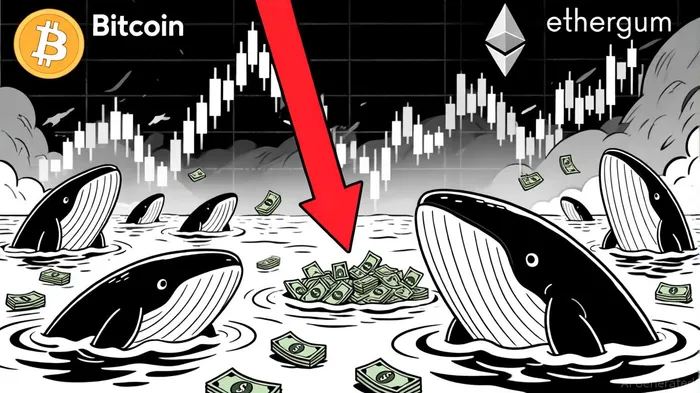
The Mechanics of Whale Shorting
Whales employ a range of tactics to exploit market sentiment and volatility. Spoofing-placing large sell orders to trigger panic-and bear raids, which force cascading liquidations, are common tools, according to an OKX analysis. For instance, a $3.93 billion Bitcoin transfer from dormant wallets in October 2025 caused a 4% price drop and $620 million in liquidations, according to a Markets article. Such moves are often timed to target over-leveraged retail positions, where stop-loss orders cluster predictably.
High leverage amplifies these effects. A trader using 5.38x leverage on Hyperliquid netted $90 million from Bitcoin shorts and $72.33 million from Ethereum shorts in a single day, according to Beincrypto. Meanwhile, others open multi-billion-dollar short positions, as seen with a $600 million BTC and $300 million ETH short bet in October 2025, according to a Cointelegraph report. These strategies exploit funding rates-periodic payments between long and short positions-to further pressure prices downward, as OKX explains.
Market Sentiment and Short-Term Volatility
Whale activity doesn't just move prices; it reshapes investor psychology. A sudden large sell-off can shift sentiment from optimism to fear, triggering a self-fulfilling cycle of panic selling. In one case, whales reversed existing short positions to lock in gains while increasing exposure to BTC, ETH, and SOL, signaling caution and amplifying short-term volatility, according to a Beincrypto report. Retail traders, often caught in the crossfire, face disproportionate losses due to their reliance on leveraged positions.
The ripple effects are acute. When a whale's $3.93 billion Bitcoin transfer caused a 4% drop, it disproportionately impacted traders who had bet on continued price increases. This highlights the fragility of a market where liquidity is concentrated and retail participants are overexposed.
Retail Investor Adaptation
Faced with whale-driven volatility, retail traders are adopting sophisticated strategies to mitigate risks. Tools like Whale Alert and Glassnode track large-volume movements in real time, enabling traders to anticipate corrections, according to a CryptoRobotics analysis. Diversification across assets and hedging with derivatives or stablecoins are becoming standard practices, according to an OKX guide.
Some traders even attempt to "scoop" whales by mimicking their trades after detecting volume spikes. However, this approach requires confirmation from multiple indicators and strict risk controls to avoid falling into manipulation traps, as CryptoRobotics notes. Dynamic stop-loss orders and monitoring exchange inflows for early sell signals are also gaining traction, according to OKX.
The Future of Whale-Driven Markets
As whales continue to shape crypto dynamics, the market is evolving. Decentralized exchanges (DEXs) are gaining popularity for their lower fees and faster transactions, though centralized exchanges (CEXs) remain dominant for liquidity, per OKX. Social media and influencer-driven attention further amplify whale impacts, with high-profile endorsements or criticisms sparking speculative trading, as OKX also observes.
Yet, experts caution against overreliance on whale activity. False signals and crowded trades can lead to misinformation, emphasizing the need for a balanced approach combining technical and fundamental analysis, a point highlighted by CryptoRobotics.
Conclusion
Whale short positions are a double-edged sword in 2025's crypto landscape. While they drive volatility and test retail resilience, they also reveal the market's evolving sophistication. Traders who understand whale behavior-and deploy tools to monitor and hedge against it-are better positioned to navigate the turbulence. As the market matures, the interplay between whale strategies and investor adaptation will remain a critical factor in shaping Bitcoin and Ethereum's trajectories.






Comentarios
Aún no hay comentarios