
Crypto Market Crashes and Safe-Haven Assets in 2025: Evaluating $BEST's Resilience Amid Volatility
The 2025 Crash: A Perfect Storm of Macro and Geopolitical Forces
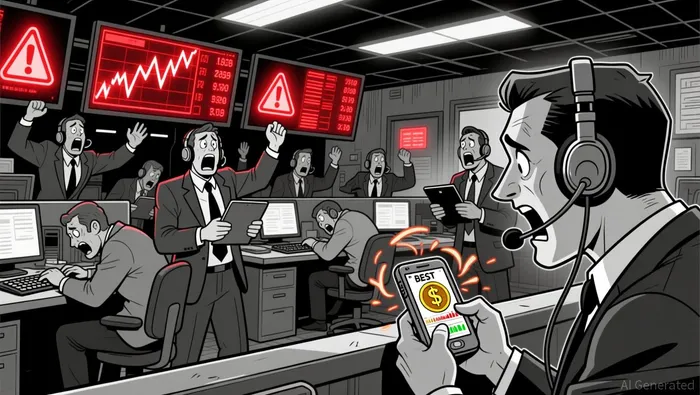
The 2025 crash was not a singular event but a cascade of interconnected crises. The U.S. Federal Reserve's "higher-for-longer" rate policy signaled a prolonged bearish stance for risk assets, prompting massive redemptions from spot Bitcoin ETFs-$1.9 billion in five days-exacerbating selling pressure according to reports. Simultaneously, geopolitical volatility, including Trump's 100% tariff on Chinese imports, triggered a flash crash in October 2025, wiping $19.37 billion in leveraged positions within 24 hours. These factors created a liquidity squeeze that disproportionately impacted altcoins, with high-beta tokens like Solana and DogecoinDOGE-- losing 60–80% of their value.
Altcoin Vulnerability and $BEST's Position
While the provided sources do not explicitly mention $BEST, the crash's impact on similar tokens offers insights. For instance, TNSR-a governance token tied to a rapidly evolving project-experienced an 11-fold surge in 48 hours before collapsing 37.3% in a single day following a Coinbase acquisition. This pattern highlights the volatility of tokens with speculative utility, particularly when core infrastructure is divested or acquired. If $BEST operates in a similar governance or utility model, its price resilience would depend on the stability of its underlying project and institutional support.
The crash also revealed that smaller-cap tokens are more susceptible to liquidity crunches. On-chain data showed that long-term BTC holders held firm, but short-term traders and leveraged positions drove the sell-off. For $BEST, this implies that its recovery hinges on whether whale accumulation or institutional interest offset retail panic. However, without direct on-chain metrics for $BEST, this remains speculative.
On-Chain Metrics and Recovery Dynamics
Post-crash recovery in 2025 was influenced by AI-driven tools and adaptive staking mechanisms. GeekStake's AI-driven staking platform, for example, demonstrated resilience by adjusting validator incentives and monitoring risk indicators during BTC/ETH volatility. While $BEST's specific on-chain activity is unreported, projects with automated reward systems and transparent validator networks historically recover faster. If $BEST integrates similar infrastructure, it could mitigate some crash-related risks.
However, the TNSRTNSR-- case underscores a critical vulnerability: when core assets are stripped (e.g., through acquisitions), governance tokens lose utility and value. TNSR's 92% year-to-date drop post-acquisition illustrates this risk. For $BEST to avoid a similar fate, its project must maintain a clear value proposition and avoid over-reliance on speculative infrastructure.
Is $BEST a Safe-Haven Asset?
The concept of a "safe-haven" asset in crypto remains elusive. During the 2025 crash, even blue-chip tokens like BTC and ETH fell alongside equities and AI-driven stocks, indicating a systemic risk environment. Smaller tokens like $BEST, lacking institutional backing or robust use cases, are unlikely to serve as safe havens. Instead, their survival depends on broader market sentiment and the ability to attract whale or institutional capital post-crash.
Conclusion: Proceed with Caution
While the 2025 crash highlighted the fragility of high-beta altcoins, it also underscored the importance of fundamentals. $BEST's resilience, if any, would stem from its project's adaptability, on-chain security, and alignment with macro trends. However, without direct data on its price performance, on-chain activity, or recovery trajectory, investors must treat $BEST as a high-risk, speculative bet. In a market where leveraged positions and geopolitical shocks dominate, true safe-haven assets remain elusive-until the industry matures beyond its current speculative phase.







Comentarios
Aún no hay comentarios