
Crypto Market Correction and Volatility Drivers in Early December 2025
The Dual Forces at Play
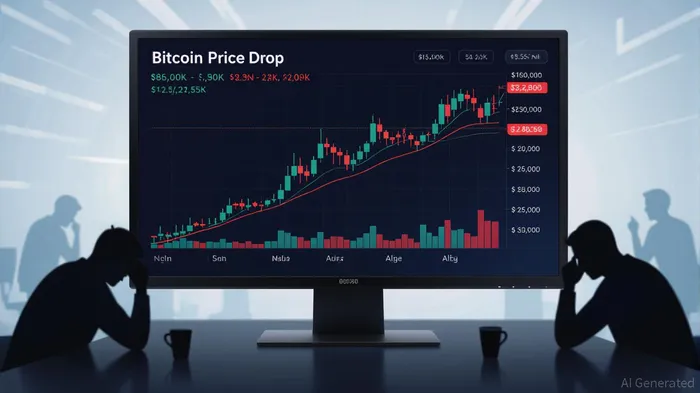
In early December 2025, Bitcoin plummeted over 5% to $86,000, while Ethereum fell more than 6% to $2,815, marking one of the most volatile periods in the crypto market in recent memory. A Yearn Finance exploit triggered a cascade of liquidations, with over $600 million in crypto positions wiped out as ETHETH-- futures unwound aggressively. Simultaneously, macroeconomic factors-particularly Federal Reserve policy and inflation expectations-added to the downward pressure.
Macroeconomic Risks: A Structural Headwind
The Federal Reserve's tightening cycle has long been a critical determinant of crypto market stability. By December 2025, the Fed's quantitative tightening (QT) had reduced its balance sheet to $6.6 trillion, tightening liquidity and pressuring risk assets like Bitcoin. Analysts such as Cathie Wood of Ark Invest and Tom Lee of Fundstrat Capital have highlighted that the Fed's anticipated shift toward a dovish stance during its December meeting could reverse this pressure. However, the path to a rate cut remains uncertain.
Softening inflation and labor market data have increased the likelihood of a December rate cut, with markets pricing in an 85% probability. Yet conflicting signals-such as strong employment reports or rising Japanese bond yields-could delay easing, prolonging the bearish sentiment. The U.S. Personal Consumption Expenditures (PCE) data on December 5 and the FOMC meeting on December 10 will be pivotal in determining whether Bitcoin's $87,000 support level holds.
Speculative Pressures: Panic and Leverage
While macroeconomic risks set the stage, speculative pressures amplified the selloff. Over $19 billion in long positions across the crypto market were liquidated in early December, with Bitcoin alone losing over $1 trillion in market capitalization in six weeks. Leveraged retail investors, particularly in perpetual futures, faced margin calls as prices collapsed. Glassnode metrics revealed an "unhealthy tilt toward high leverage," with short-term holder supply rising sharply.
Whale activity further exacerbated volatility. A dormant 2015 Ethereum ICO wallet moved 40,000 ETH ($120 million), signaling a lack of confidence in near-term price recovery. Meanwhile, thin liquidity allowed small sell-offs to trigger cascading losses, as seen in the sharp drop in XRPXRP-- futures open interest by ~59%.
The Interplay of Macro and Speculative Forces
The December selloff reflects a convergence of structural and speculative risks. On the macro side, the Fed's QT and inflation uncertainty created a fragile environment for risk assets. On the speculative side, leveraged positions and panic selling turned a bearish trend into a crisis.
Trader sentiment data underscores this duality. The Crypto Fear & Greed Index shifted from "Extreme Fear" after 18 days, hinting at cautious optimism. However, on-chain metrics like cumulative volume delta in perpetual futures and rising short-term holder supply suggest a "controlled unwind" rather than a panic-driven collapse.
The Path Forward
December 2025 will be a litmus testTST-- for the crypto market. If the Fed delivers a rate cut, Bitcoin could stabilize near $87,000 and test key resistance at $91,570. Conversely, delayed easing or regulatory headwinds-such as the U.S. Senate's pending crypto bill-could deepen the correction.
Institutional outflows from products like BlackRock's IBIT and Fidelity's FBTC also highlight caution among large players. However, positive inflows into XRP ETFs and historical December performance (an average 4.75% gain for Bitcoin) suggest potential for a rebound.
Conclusion
The December 2025 crypto selloff is best understood as a collision of macroeconomic fragility and speculative excess. While the Fed's policy path remains the dominant long-term driver, leveraged positions and panic selling have magnified short-term volatility. Investors must remain vigilant, balancing macroeconomic signals with on-chain metrics to navigate the uncertainty ahead.







Comentarios
Aún no hay comentarios