
The Crypto Market Correction: Opportunities Amid Volatility
The cryptocurrency market's September 2025 correction, dubbed “Red September,” has reshaped risk paradigms and revealed both vulnerabilities and opportunities. With over $1.7 billion in leveraged positions liquidated—driven by Bitcoin's retreat below $112,000 and Ethereum's 12% weekly plunge—investors are recalibrating strategies amid heightened volatility[1]. This analysis explores how disciplined risk management and contrarian positioning can navigate the turbulence, leveraging technical insights and macroeconomic signals to identify long-term value.
Market Sentiment: Fear, Leverage, and Fragility
The selloff was amplified by cascading liquidations in DeFi and leveraged futures, where excessive leverage (often 10x or higher) and thin liquidity created a “recipe for disaster”[1]. According to a report by Coinpedia, Ethereum's $309 million in liquidations outpaced Bitcoin's $246 million, underscoring altcoin fragility[1]. Meanwhile, the Fear & Greed Index, a barometer of investor psychology, oscillated between “extreme fear” (32) and “neutral” (45), reflecting conflicting signals: historical September weakness versus institutional accumulation trends[2].
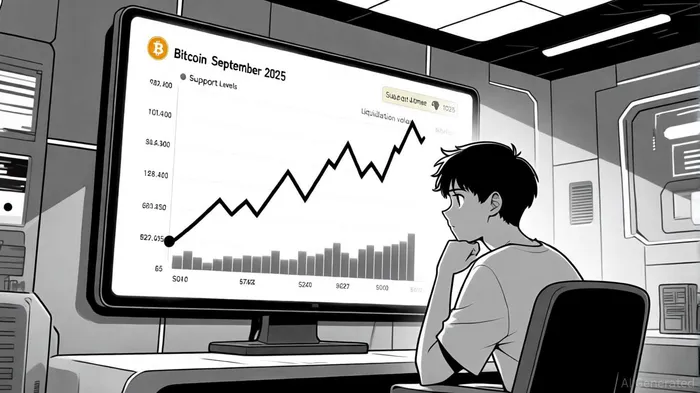
Bitcoin's technical outlook hinges on critical support levels. A breakdown below $111,800 could trigger a test of $108,000–$109,000, with further downside risk to the 200-day moving average at $103,493[3]. Conversely, a rebound above $113,000 would signal short-term resilience. Analysts at The Financial Analyst note that holding these levels could validate a bullish base, setting the stage for a Q4 rally[3].
Risk Management: Mitigating Volatility
Amid the chaos, robust risk frameworks are essential. Cryptolinknet outlines seven strategies to safeguard portfolios[5]:
1. Position Sizing: Adhere to the 1–3% rule to limit exposure to any single asset.
2. Dollar-Cost Averaging (DCA): Systematically invest fixed amounts regardless of price swings, reducing timing risk.
3. Hedging: Use options and inverse ETFs to offset potential losses, particularly in leveraged positions.
4. Portfolio Diversification: Balance exposure across BitcoinBTC--, EthereumETH--, and fundamentally strong altcoins (e.g., SolanaSOL--, Chainlink).
For example, during the September liquidations, DCA allowed investors to accumulate Bitcoin at discounted prices as the Fear & Greed Index hit 32[6]. Similarly, hedging with put options could have protected against Ethereum's 12% drop[1].
Contrarian Entry Points: Buying the Dip
The correction has created asymmetric opportunities for strategic buyers. The Serrari Group highlights that the Fear & Greed Index's “extreme fear” reading is historically a contrarian signal[6]. Additionally, over $4.5 billion in vested tokens entered circulation in September, creating short-term selling pressure but also discounted entry points for long-term holders[6].
Analyst Michaël van de Poppe argues the correction is nearing its end, dismissing bearish forecasts and positioning the dip as a catalyst for an altcoin bull run[6]. Assets like Solana (SOL) and ChainlinkLINK-- (LINK), with strong fundamentals and utility, are prime candidates for outperformance. Institutional sentiment, though mixed, shows resilience: whale accumulation hit record levels in September, while ETF outflows in August reflected caution[3].
Macro Tailwinds and Institutional Signals
Bitcoin's performance in September—its second-best in 13 years—suggests a diverging trend from historical weakness[4]. Anticipated Federal Reserve rate cuts and a weaker U.S. dollar could further bolster Bitcoin's appeal as a macro hedge[3]. Meanwhile, corporate Bitcoin treasuries saw a 76% decline in acquisitions from July to September 2025, signaling short-term institutional caution but not long-term disinterest[5].
Conclusion: Balancing Caution and Opportunity
The September 2025 correction, while painful, has exposed critical lessons for investors. By combining disciplined risk management—position sizing, DCA, and hedging—with contrarian entry points during extreme fear, investors can position themselves to capitalize on Bitcoin's and altcoins' long-term potential. As the market digests macroeconomic shifts and institutional adoption evolves, those who navigate volatility with strategy may find themselves well-placed for the next bull phase.






Comentarios
Aún no hay comentarios