
Crypto Market Bearish Momentum: A Strategic Opportunity for Value Investors?
The cryptocurrency market has long been characterized by its volatility, with bearish phases often triggering panic selling and irrational exodus from risk assets. However, for value investors, these periods of extreme bearish taker flow-measured by metrics like the Taker Buy/Sell Ratio and MVRV Z-Score-can signal contrarian opportunities. Historical and academic evidence suggests that such moments of capitulation frequently precede market recoveries, offering disciplined investors a chance to acquire undervalued assets at discounted prices.
Understanding Bearish Taker Flow as a Contrarian Indicator
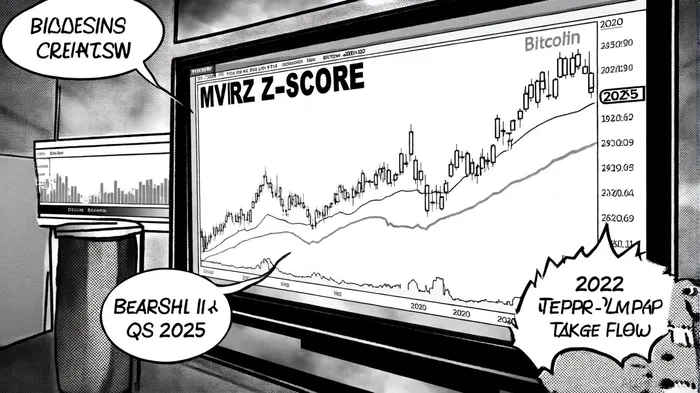
Bearish taker flow refers to the dominance of sell-side volume in market transactions, often reflecting widespread pessimism. In Q3 2025, the Taker Buy/Sell Ratio on Binance dropped to 0.95, indicating a bearish tilt as sellers outpaced buyers, according to a CryptoQuant analysis. This metric, when pushed to extreme levels, has historically acted as a contrarian signal. For instance, during the 2020 pandemic crash, Bitcoin's MVRV Z-Score plummeted to -2.1, a level of on-chain capitulation that preceded a 150% recovery by mid-2024, according to a Bitget report. Similarly, the 2022 Terra-Luna collapse saw derivatives long/short ratios normalize from an extreme bearish 0.44 to 1.03 in August 2025, signaling a shift toward balanced speculative positioning, as the Bitget report notes.
Academic studies reinforce this pattern. A report by Nodiens analyzed January–April 2025 data and found that despite sharp declines in sentiment indicators, price losses remained moderate (-1% to -4%), with resilient assets like BNBBNB-- and TRXTRX-- showing stability or minor gains, according to a Nodiens report. This suggests that bearish taker flow does not always equate to steep crashes, especially when combined with strong fundamentals.
Academic and Historical Validation of Contrarian Opportunities
The interplay between sentiment and price dynamics is well-documented. Research on cryptocurrency returns reveals that investors often exhibit behavioral biases-such as familiarity and disposition effects-leading to mispricings, as found in a 2024 study. During extreme bearish phases, these biases amplify selling pressure, creating entry points for value investors. For example, in Q3 2025, Bitcoin's MVRV Z-Score hit 1.43, a historically bearish threshold, while institutional accumulation of 23.23% of supply in the 1–2 year cohort indicated strategic buying, as noted in the Bitget report.
Historical case studies further validate this approach. The 2020 pandemic crash saw Bitcoin's MVRV Z-Score reach -2.1, followed by a 150% rebound. In 2025, similar patterns suggest a potential bottoming process, particularly as the Federal Reserve's anticipated rate cuts and regulatory clarity could unlock capital inflows, according to the Bitget report.
Value Investing Strategies in Bear Markets
Value investors can leverage bearish taker flow by adopting strategies that mitigate risk while capitalizing on long-term opportunities:
- Dollar-Cost Averaging (DCA): Investing fixed amounts at regular intervals smooths volatility and lowers average costs. During Q3 2025, DCA allowed investors to accumulate blue-chip assets like BitcoinBTC-- and EthereumETH-- at discounted prices, according to a Coindoo guide.
- Diversification: Spreading investments across resilient cryptocurrencies (e.g., BNB, TRX) and non-crypto assets reduces exposure to single-project risks, as the Coindoo guide explains.
- Stop-Loss Orders: Predefined exit points protect capital by automatically selling assets if prices fall below a threshold, per the Coindoo guide.
- Blue-Chip Focus: Prioritizing assets with strong fundamentals, such as Bitcoin and Ethereum, which tend to recover faster than smaller altcoins, is a core recommendation of the Coindoo guide.
For instance, in early 2025, BNB and HBARHBAR-- maintained stability during the bearish phase, while SolanaSOL-- (SOL) underperformed, underscoring the importance of combining sentiment indicators with fundamental analysis, as highlighted in the Nodiens report.
On-Chain and Derivatives Metrics: Navigating the Bottoming Process
On-chain analytics provide critical insights into market psychology. The MVRV Z-Score, which measures the ratio of realized value to market value, dips below -1.5σ during capitulation phases, signaling undervaluation, according to the Bitget report. In Q3 2025, Bitcoin's dominance rose to 64%, reflecting a flight to quality amid uncertainty, as argued in an Arthur Hayes post. Meanwhile, derivatives metrics like the long/short ratio normalized to 1.03, indicating balanced speculative positioning, which the Bitget report also notes.
Arthur Hayes of BitMEX has forecasted a short-term pullback in Q3 2025 due to macroeconomic pressures, but institutional inflows into Bitcoin ETFs and regulatory clarity could counteract bearish momentum, as Hayes wrote in his Substack post.
Forward-Looking Analysis: Institutional Buying and Regulatory Catalysts
The current bearish phase in 2025 aligns with historical patterns where institutional accumulation and regulatory clarity drive recoveries. For example, the 2023–2024 cycle saw Bitcoin ETF inflows and the SEC's approval of spot ETFs catalyze a bull run. With similar catalysts on the horizon-such as the Fed's rate cuts and potential ETF approvals-value investors may find themselves at a strategic inflection point.
Conclusion
Extreme bearish taker flow, while daunting, is a well-documented contrarian indicator in crypto markets. By combining historical precedents, academic insights, and disciplined strategies like DCA and diversification, value investors can navigate bear markets and position themselves for the next bull cycle. As the 2025 bear phase unfolds, the interplay of on-chain resilience, institutional buying, and regulatory developments suggests that patience and strategic entry points may yield substantial long-term rewards.






Comentarios
Aún no hay comentarios