
Crypto Liquidation Risks and Auto-Deleveraging: A Systemic Threat to Leveraged Trading
The rise of leveraged trading in crypto markets has created a paradox: while high leverage amplifies returns, it also magnifies systemic risks during volatility. Over the past five years, three major crises-Black Thursday 2020, the FTX collapse in 2022, and the 2025 liquidation crisis-have exposed the fragility of crypto derivatives ecosystems. These events reveal how auto-deleveraging (ADL) mechanisms, designed to stabilize platforms, can instead exacerbate market instability through cascading liquidations and feedback loops.
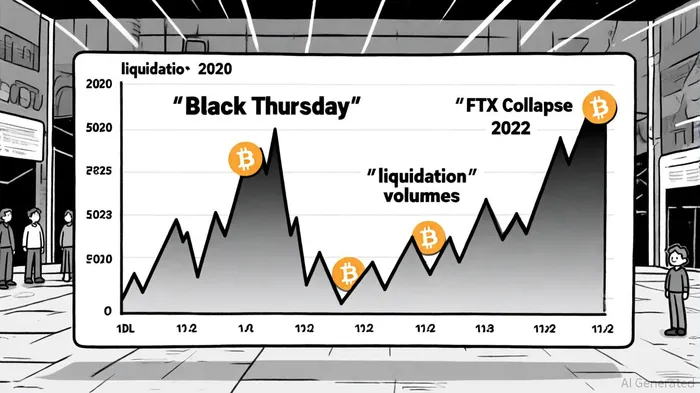
The Anatomy of Systemic Collapse
The 2020 "Black Thursday" crash remains a textbook case of leverage-induced panic. Bitcoin's 50% single-day drop triggered $1 billion in liquidations, driven by thin liquidity and excessive leverage (up to 100x), as reported in a Clometrix analysis. Similarly, the 2022 FTX collapse, rooted in internal mismanagement, erased $200 billion in market value and highlighted how opaque governance can amplify contagion, as that analysis later noted. The 2025 crisis, however, marked a new phase: perpetual futures markets became a self-reinforcing volatility engine. With $161 million in losses, the event underscored how high leverage and ADL mechanisms create recursive cycles of liquidation, where falling prices trigger more selling, further depressing prices, according to a Bitget report.
Auto-Deleveraging: A Double-Edged Sword
ADL is a last-resort mechanism used by centralized exchanges to maintain solvency when liquidation losses exceed insurance fund capacity. When activated, ADL targets profitable traders with high leverage, reducing their positions to offset deficits, as the Clometrix analysis described. While this prevents exchange insolvency, it introduces systemic risks. For example, during the 2025 crisis, ADL prioritized traders with large unrealized profits, forcing them to absorb losses even as prices continued to plummet. This created a feedback loop: as ADL reduced positions, it deepened liquidity shortages, accelerating price declines and triggering more liquidations, per the Bitget report.
Academic analyses confirm that ADL's algorithmic nature-relying on metrics like leverage and unrealized profit-can amplify volatility. Unlike traditional deleveraging tools (e.g., margin calls or circuit breakers), which are slower and more opaque, ADL operates in real-time but lacks safeguards against herding behavior. During the 2025 crisis, algorithmic systems synchronized selling based on shared volatility triggers, compounding the downturn. This contrasts with traditional markets, where circuit breakers halt trading to allow sentiment to reset-a luxury crypto platforms lack, as explained in Bybit's ADL guide.
Systemic Feedback Loops and Trader Behavior
Behavioral finance principles further complicate the picture. During extreme volatility, traders exhibit herding behavior, either chasing trends or adopting contrarian strategies. In crypto, this manifests as algorithmic "momentum cascades," where correlated strategies amplify price swings, as discussed in a VICAPartners piece. For instance, the 2025 crisis saw Bitcoin's 30-day volatility spike to 75%, triggering automated systems to unwind positions en masse, according to the Bitget report. This aligns with research showing that crypto markets are more susceptible to feedback loops than traditional assets, due to their 24/7 nature and lack of centralized clearinghouses, as detailed in a JIFT article.
Regulatory evaluations highlight another issue: ADL's transparency. While platforms like Bybit and Binance notify traders via email before deleveraging, the process remains reactive. Traders often discover their positions reduced only after the fact, leaving little room to adjust strategies, as Bybit's documentation notes. This contrasts with traditional margin calls, which provide advance notice, albeit at the cost of slower execution.
The Case for Predictive Risk Models
The 2020–2025 crises underscore a critical flaw in current risk management: reliance on outdated models. Traditional finance assumes stable correlations and Gaussian distributions, but crypto's volatility defies these assumptions. Academic studies show that tools like the GE CoVaR approach-designed to capture tail risks-yield higher risk estimates in crypto markets than linear models, as the JIFT article argues. Meanwhile, the VDRT (Volatility-Driven Risk Transfer) model, introduced in 2025, attempts to address this by dynamically adjusting leverage limits based on real-time volatility, according to the Bitget report.
Regulatory responses have been mixed. The 2025 GENIUS Act, which mandated 1:1 collateralization for stablecoins, helped stabilize markets by reducing uncertainty around pegs, per the Bitget report. However, fragmented enforcement across jurisdictions-such as the EU's MiCA framework versus U.S. regulatory ambiguity-leaves gaps in systemic risk mitigation, and the Bybit documentation highlights differences in platform-level implementations.
Conclusion: A Call for Prudent Leverage
For investors, the lesson is clear: leverage in crypto is a high-stakes game. While ADL mechanisms aim to protect platforms, they cannot eliminate the inherent risks of hyper-leveraged trading. Strategies like lower leverage ratios, stop-loss orders, and diversification remain essential, as the VICAPartners piece recommends. Regulators and exchanges must also prioritize predictive models and international coordination to address crypto's unique systemic vulnerabilities.






Comentarios
Aún no hay comentarios