
Why Crypto-Linked Stocks Like SharpLink and TeraWulf Pose Elevated Risk in a Downturning Market
The crypto-linked equity market in 2025 has become a high-stakes arena for investors, with companies like SharpLinkSBET-- and TeraWulfWULF-- exemplifying the volatile interplay of speculative growth, regulatory uncertainty, and leveraged expansion. While these firms have capitalized on the crypto boom, their financial structures and exposure to regulatory shifts create a precarious outlook, particularly as macroeconomic headwinds gather. This analysis argues that investors should strategically avoid such stocks due to their inflated valuations, unsustainable debt burdens, and regulatory vulnerabilities.
Valuation Metrics: Built on Sand
SharpLink's Q3 2025 financials highlight a stark disconnect between revenue growth and sustainable value creation. The company reported a 1,100% year-over-year revenue surge to $10.8 million, driven by its ETH treasury strategy and staking activities. However, this growth is largely artificial: its net income of $104.3 million was almost entirely attributable to a $107.3 million unrealized gain on ETH holdings. Such accounting practices mask the fragility of its valuation, which hinges on Ethereum's price trajectory. If ETH corrects-inevitable in a cyclical market-SharpLink's earnings would evaporate, leaving its stock overvalued and exposed.
TeraWulf, meanwhile, faces a different but equally dire issue. While its Q3 revenue rose 87% to $50.6 million, including $7.2 million from HPC lease operations, its valuation lacks the same speculative tailwinds. The company's debt-to-equity ratio of 4.56 dwarfs industry averages (e.g., 0.8702 for Communication Services according to industry data), signaling a reliance on debt-fueled expansion. With total debt exceeding $1.5 billion, TeraWulf's balance sheet is a ticking time bomb, especially as interest rates stabilize post-Fed cuts. Analysts warn that rising operational costs and Bitcoin's price volatility could erode margins, making its valuation unsustainable.
Debt Overhang: A Looming Catalyst
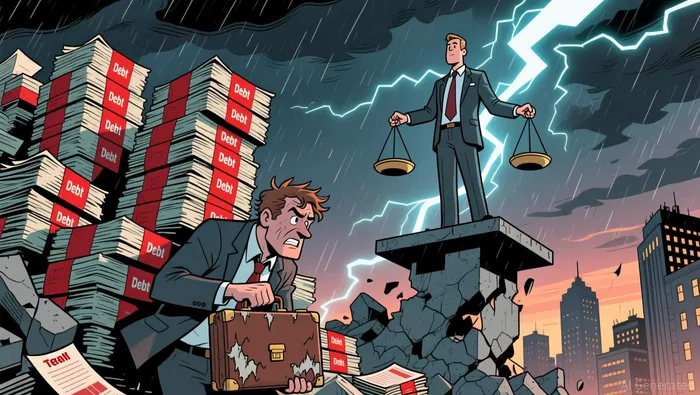
The debt profiles of both firms underscore their vulnerability in a tightening credit environment. TeraWulf's $1.5 billion in outstanding debt, primarily Convertible Notes due in 2030 and 2031, reflects a strategy of aggressive leverage to fund HPC infrastructure. Yet, with a debt-to-equity ratio nearly five times the sector average according to financial analysis, the company's financial flexibility is severely constrained. A downturn in Bitcoin's price-currently at 65% of the global crypto market cap-would directly impact its revenue streams, exacerbating liquidity risks.
SharpLink's debt structure is less explicit, but its reliance on crypto assets for valuation introduces a different kind of instability. The company's $3.0 billion in crypto holdings are illiquid and subject to rapid depreciation. If regulators reclassify ETH as a security, SharpLink could face mandatory compliance costs and operational disruptions, further straining its balance sheet. In either scenario, these firms lack the capital buffers to weather a market correction.
Regulatory Vulnerabilities: A Wild Card
The 2025 regulatory landscape, while offering some clarity, remains a double-edged sword for crypto-linked stocks. The U.S. GENIUS Act and EU's MiCA framework have standardized stablecoin regulations, but they also impose stringent compliance requirements. For SharpLink, the risk of ETH being classified as a security looms large. Such a reclassification would force the company to register as an investment company under the Investment Company Act of 1940, incurring compliance costs that could erode its staking and treasury yields.
TeraWulf's exposure to BitcoinBTC-- adds another layer of complexity. While the U.S. SEC's approval of commodity-based ETPs has boosted institutional adoption, Bitcoin's price remains subject to regulatory scrutiny, particularly in the Senate according to policy analysis. A shift in policy-such as stricter capital controls or bans on crypto derivatives-could destabilize TeraWulf's HPC leasing model, which depends on sustained demand for crypto infrastructure.
Conclusion: Strategic Avoidance is Prudent
Crypto-linked stocks like SharpLink and TeraWulf epitomize the risks of conflating speculative crypto gains with corporate fundamentals. Their valuations are inflated by unrealized crypto profits, debt burdens are unsustainable, and regulatory shifts could trigger abrupt revaluations. As macroeconomic pressures mount and liquidity tightens, these firms are ill-positioned to withstand a downturn. Investors seeking to preserve capital should avoid such high-risk exposures and instead focus on equities with resilient cash flows and balanced capital structures.







Comentarios
Aún no hay comentarios