
Crypto Investment 2025: Why Solana Outpaces Worldcoin and Layer Brett in Utility and Growth Potential
The Case for Solana: A Maturity-Driven Edge
As the crypto market enters 2025, the debate over which blockchain will dominate the next bull run has intensified. While projects like WorldcoinWLD-- and LayerLAYER-- Brett offer compelling narratives—quantum-resistant infrastructure and meme-driven utility, respectively—Solana (SOL) stands out as the most robust investment due to its technical maturity, institutional adoption, and ecosystem resilience.
Technical Innovation: Proven Scalability vs. Emerging Promises
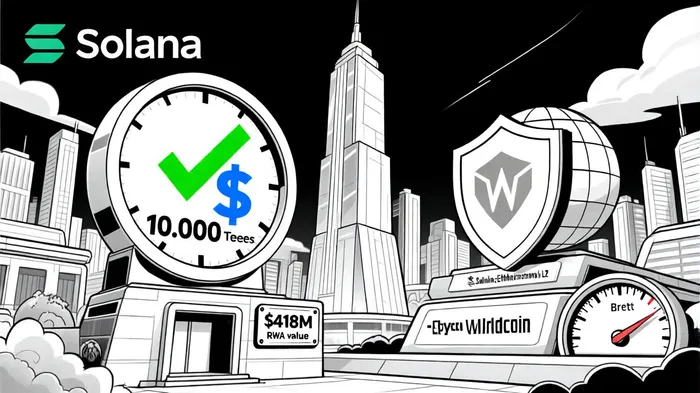
Solana's architecture has consistently outperformed competitors in critical metrics. With 10,000 transactions per second (TPS) and $0.0002 average fees, it remains the fastest blockchain for DeFi, NFTs, and enterprise applications[1]. In contrast, Worldcoin's quantum-secure infrastructure, while innovative, lacks real-world use cases beyond speculative hype[6]. Layer Brett, an EthereumETH-- Layer 2 project, boasts similar TPS and fees but remains untested at scale[3].
Solana's 18-month uptime record and daily processing of 162 million transactions underscore its reliability for institutional-grade applications[5]. Meanwhile, Worldcoin's recent regulatory hurdles in Germany and Layer Brett's reliance on meme-driven virality introduce execution risks that Solana's battle-tested network avoids[6].
Ecosystem Adoption: Developer Momentum and DeFi Dominance
Solana's ecosystem has surged in 2025, attracting 7,625 new developers in 2024 alone and hosting 1,412 hackathon submissions—a record for any blockchain[5]. Its DeFi sector now processes 81% of global DEX volume and holds $8.9 billion in TVL, with projects like Ondo Finance and BlackRock's BUIDL Fund tokenizing $418 million in real-world assets (RWAs)[1].
Worldcoin, despite its 33.5 million verified users, struggles to convert adoption into developer activity. Layer Brett's 792% staking APYs and $0.0058 presale price draw retail interest, but its capped supply of 10 billion tokens and lack of enterprise partnerships leave it exposed to volatility[3].
Institutional Traction: Capital and Confidence
Institutional backing has cemented Solana's dominance. Pantera Capital's $1.25 billion initiative to create the largest SolanaSOL-- treasury, coupled with Galaxy and Multicoin's $1.65 billion investment in a SOLSOL-- Digital AssetDAAQ-- Treasury (DAT), signals a shift toward structured, yield-focused strategies[2]. These efforts are complemented by PayPalPYPL--, ShopifySHOP--, and VisaV-- integrating Solana for cross-border payments and NFTs[1].
Worldcoin's $250 million treasury deal with Eightco HoldingsORBS-- is impressive but pales against Solana's institutional depth[4]. Layer Brett's presale success ($3.7 million raised) lacks the institutional validation seen in Solana's ecosystem[3].
The Risks and Rewards of Alternatives
Worldcoin's quantum-secure APMC system and Layer Brett's meme-driven APYs offer asymmetric upside potential. However, their risks—regulatory scrutiny for Worldcoin and speculative volatility for Layer Brett—make them less attractive for long-term capital. Solana's balance of innovation, adoption, and institutional trust positions it as the safer, higher-conviction bet in 2025.
Conclusion: A Strategic Allocation
For investors, a diversified approach is prudent. Solana's $188.10 price (as of early 2025) and $101.58 billion market cap make it a core holding for long-term growth[1]. Allocating a smaller portion to high-risk plays like Layer Brett or Worldcoin could capture speculative gains, but Solana's ecosystem and institutional tailwinds ensure it remains the cornerstone of a 2025 crypto portfolio.






Comentarios
Aún no hay comentarios