
Crypto Institutional Adoption and Liquidity Trends: Decoding Deposit Patterns as Leading Indicators of Market Cycles
The institutionalization of cryptocurrency markets has fundamentally reshaped Bitcoin's price dynamics and liquidity structure over the past three years. From speculative curiosity to strategic allocation, institutional capital has become a dominant force, with deposit patterns-particularly through ETFs and custodians-emerging as critical leading indicators of market cycles. This analysis unpacks how these flows correlate with Bitcoin's price peaks and troughs, offering actionable insights for investors navigating the evolving crypto landscape.
Institutional Adoption: From Speculation to Strategic Allocation
The surge in institutional adoption since 2023 has been driven by regulatory clarity, macroeconomic tailwinds, and the maturation of crypto infrastructure. By October 2025, Bitcoin's price had surged 260% to $126,296 from $34,667 in October 2023, fueled by the approval of spot Bitcoin ETFs in early 2024. BlackRock's IBIT alone captured 48.5% of the market share, amassing $50 billion in assets under management (AUM) within a year. This institutional influx has compressed Bitcoin's traditional four-year market cycle, aligning its price trajectory more closely with U.S. monetary policy and global liquidity trends.
Institutional confidence has been bolstered by Bitcoin's low correlation with traditional assets and its role as a hedge against inflation and fiat devaluation. By mid-2025, global Bitcoin ETF AUM reached $179.5 billion, with U.S.-listed products dominating the market. This shift has also stabilized Bitcoin's volatility, reducing its long-term volatility from 84% to 43% by 2025.
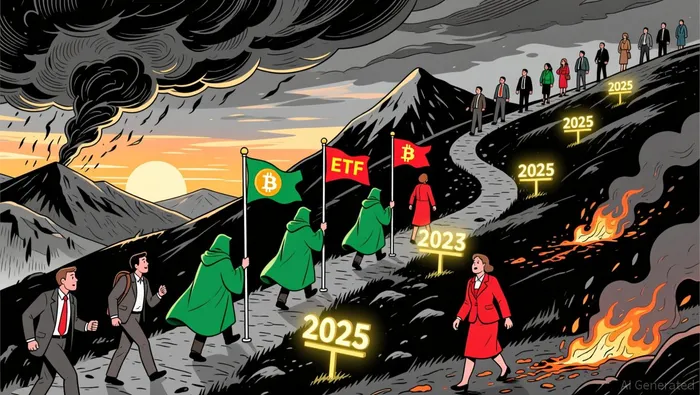
Deposit Patterns as Leading Indicators
Institutional deposit flows-particularly through ETFs and custodians-have proven to be reliable predictors of Bitcoin's market turning points. For instance, a $2.1 billion inflow into Bitcoin ETFs in February 2024 was followed by a 15–20% price appreciation within two weeks. Conversely, net outflows, such as the $1.2 billion recorded in August 2024, preceded a 12% price decline. These patterns suggest that ETF inflows and outflows act as directional signals, with lead times of 1–4 weeks.
Custodian movements further reinforce this dynamic. By Q2 2025, institutional crypto custody AUM had expanded to $33.91 billion from $8.5 billion in early 2024. Major custodians like BNY Mellon and Coinbase Custody now offer insurance coverage up to $320 million, addressing institutional concerns about security and compliance. Large-scale whale activity, such as the deposit of 850 BTC into Paxos, also signals confidence in institutional-grade custody solutions.
Regulatory Clarity and Policy Shifts
Regulatory developments have been pivotal in accelerating institutional adoption. The U.S. SEC's approval of spot Bitcoin ETFs in January 2024 removed a major barrier for institutional participation. Similarly, the Trump administration's GENIUS Act in July 2025 provided a federal framework for stablecoins, reducing compliance risks. These policy shifts have enabled traditional financial institutions to access crypto markets through registered vehicles, with 60% of institutional investors preferring ETFs for exposure.
Corporate treasuries and sovereign wealth funds have also entered the fray. Companies like MicroStrategy have normalized Bitcoin as a corporate reserve asset, while SWFs have allocated portions of their portfolios to BitcoinBTC-- as a hedge against geopolitical instability. This diversification has created persistent buying pressure, decoupling Bitcoin's price from retail sentiment cycles.
Market Cycle Compression and Future Projections
The influx of institutional capital has shortened Bitcoin's traditional market cycle, accelerating price appreciation and volatility. By 2025, Bitcoin's price phases-Reversal, Bottoming, Appreciation, and Acceleration-became more pronounced and predictable. For example, the Appreciation Phase in 2024, marked by low volatility and high profit, was followed by a sharp Acceleration Phase that drove prices to new highs.
Looking ahead, projections suggest Bitcoin could reach $150,000–$200,000 by 2026, driven by ETF-driven demand and tokenized real-world assets. Tokenized U.S. treasuries, which grew from $2 billion in August 2024 to $7 billion by August 2025, are expected to further integrate traditional and digital asset markets, enhancing liquidity and institutional participation.
Conclusion
Institutional deposit patterns-particularly ETF inflows and custodian movements-have become indispensable tools for predicting Bitcoin's market cycles. As regulatory clarity and infrastructure continue to evolve, these flows will likely serve as even more precise leading indicators, enabling investors to anticipate turning points with greater confidence. For those seeking to capitalize on the next phase of crypto's institutionalization, monitoring these patterns is no longer optional-it's essential.







Comentarios
Aún no hay comentarios