
Crypto Hedge Fund Failures and Strategic Investor Adaptation: Lessons in Institutional Risk Management and Market Resilience
The collapse of crypto hedge funds between 2020 and 2025 has exposed critical flaws in institutional risk management while simultaneously revealing the market's capacity for adaptation and resilience. From the fraudulent mismanagement of Cred LLC to the operational failures of Three Arrows Capital, these cases underscore the need for robust governance frameworks. Yet, amid the chaos, institutional investors and regulators have responded with innovations in risk mitigation, custodial security, and regulatory alignment, signaling a maturing market.
The Anatomy of Failure: Case Studies in Institutional Mismanagement
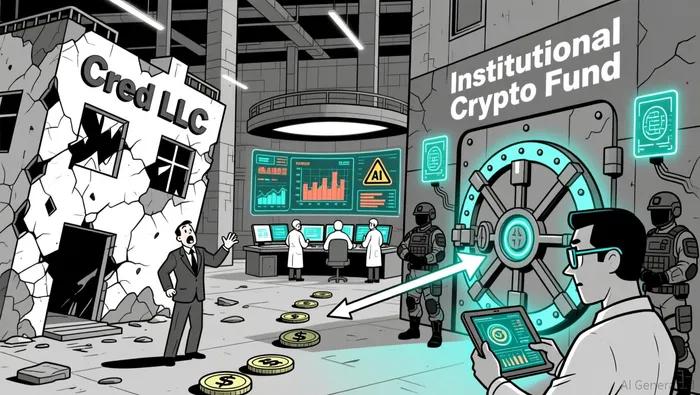
Cred LLC's 2020–2025 collapse remains one of the most egregious examples of institutional negligence in crypto. Executives Daniel Schatt and Joseph Podulka concealed liquidity crises, siphoned customer funds into speculative ventures, and failed to segregate assets, leading to a $1 billion fraud and 88-month prison sentences, according to a Bitget report. This case exposed a lack of oversight, with no approval requirements for asset movements and unchecked third-party risk exposure. Similarly, Three Arrows Capital's operational failures-where only two executives controlled asset transfers-highlighted the dangers of centralized decision-making in volatile markets, as detailed in the same Bitget report.
These failures were not isolated. A mid-sized New York hedge fund lost $50 million in 2021 due to poor custodial practices and inadequate risk controls, according to a Coinlaw report, while global institutions lost $2.3 billion in 2024 from custodial failures and fraudulent counterparties, as the same Coinlaw report found. The common thread? A lack of diversification, real-time compliance monitoring, and secure storage solutions.
Institutional Risk Management: From Reactive to Proactive
The aftermath of these collapses spurred a 72% adoption rate of enhanced risk management frameworks among institutional investors by 2025, according to the Coinlaw report. Key innovations include: - Custodial Security: 81% of funds now use multi-signature wallets and cold storage, as reported by a AIMA press release. - AI-Driven Tools: 60% integrated AI for real-time risk assessment by Q1 2025, as the Coinlaw report notes. - Insurance Coverage: $6.7 billion in crypto-specific policies were underwritten in 2025, a 52% YoY increase, according to the Coinlaw report.
Regulatory alignment also played a role. By 2025, 55% of traditional hedge funds had exposure to digital assets, up from 47% in 2024, as the AIMA press release notes. However, challenges persist: 90% of investors still cite counterparty risk as their top concern, according to the Coinlaw report, and half of traditional funds grapple with regulatory ambiguity, as the AIMA press release states.
Market Resilience: Volatility as a Catalyst for Evolution
Despite a $1 trillion market cap drop in late 2025-driven by geopolitical tensions and leveraged trading-cryptocurrencies demonstrated long-term resilience. BitcoinBTC--, for instance, remained up 300% since BlackRock's 2022 ETF filing, translating to nearly 80% annualized returns, according to a Finbold report. This resilience is partly due to deeper liquidity pools and institutional participation, which helped absorb the October 2025 flash crash more effectively than previous downturns, as the Finbold report notes.
Institutional confidence has also rebounded. Ripple's $500 million funding round from affiliates of Citadel Securities and Fortress Investment Group in 2025 pushed its valuation to $40 billion, according to the AIMA press release, while Kazakhstan announced a $1 billion crypto reserve fund to invest in ETFs and digital-asset firms, as reported in a CoinEdition article. These moves reflect a shift from speculative bets to regulated, utility-driven investments.
Strategic Adaptation: The Road Ahead
The lessons from crypto hedge fund failures are clear: institutional investors must prioritize diversification, transparency, and technological integration. As Bloomberg ETF analyst Eric Balchunas notes, the current downturn is an overreaction to technical factors, not fundamental weakness, according to the Finbold report. Meanwhile, projects like Galaxy Digital's AI-powered data centers and DeepSnitch AI's whale-tracking tools exemplify how innovation is reshaping risk management, as noted in a Seeking Alpha article.
For investors, the path forward involves balancing caution with opportunity. While 54% of institutional investors faced losses exceeding 10% during 2024's downturns, according to the AIMA press release, the market's ability to recover-and even thrive-suggests that strategic, long-term allocations to crypto can coexist with rigorous risk controls.





Comentarios
Aún no hay comentarios