
Crypto Fund Flows Amid Geopolitical Tensions: A New Paradigm for Risk Diversification and Macro-Resilience
The Geopolitical-Crypto Nexus: A Decade of Transformation
The interplay between geopolitical tensions and crypto fund flows has evolved into a defining feature of modern financial markets. From 2023 to 2025, cryptocurrencies have transitioned from speculative assets to strategic tools for hedging against macroeconomic instability. According to a Geopolitical Monitor report, the total cryptocurrency market cap surged to $1.4 trillion in 2023 despite global conflicts and inflationary pressures, driven by optimism around spot BitcoinBTC-- ETFs and Ethereum's Shapella upgrade. By mid-2025, Bitcoin ETFs alone attracted $48.97 billion in inflows, underscoring institutional confidence in crypto's role as a diversifier, as noted in the Crypto.com review.
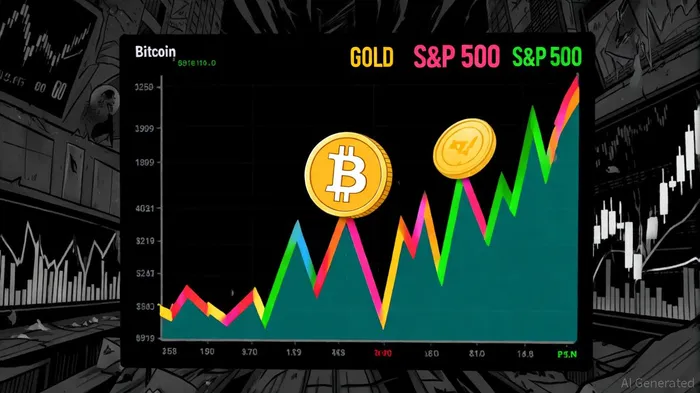
However, this growth has been punctuated by volatility. For instance, Bitcoin's price plummeted below $78,000 in early 2025 amid U.S.-China trade tensions, illustrating its sensitivity to geopolitical dynamics, according to the FinancialContent review. Conversely, during the U.S. presidential election in November 2024, Bitcoin surged to $89,000, reflecting its alignment with risk-on sentiment, as noted in the FinancialContent review. These swings highlight crypto's dual identity: a speculative asset and a potential hedge against traditional market shocks.
Crypto vs. Traditional Assets: Diversification in Practice
The question of whether cryptocurrencies can outperform traditional assets like gold and equities in diversifying risk remains contentious. Data from CCN reveals that during the Russia-Ukraine conflict in 2022, Bitcoin exhibited hedging properties but was accompanied by heightened volatility, with negative news impacting prices more severely than positive developments, according to a MOFSE analysis. In contrast, gold maintained its status as a stable safe-haven asset, gaining 6% over 60 days during the U.S.-Iran escalation in 2020, as the Geopolitical Monitor report documents.
A 2025 study by Mooloo further clarifies this dynamic: Bitcoin's correlation with the S&P 500 averaged 0.65 in 2024, indicating a closer alignment with equities during geopolitical stress, while gold retained a near-zero correlation, as shown in the MOFSE analysis. This suggests that while Bitcoin can diversify portfolios, its risk profile is more akin to equities than to traditional safe-haven assets. Meanwhile, gold's resilience-such as its 10% gain during the 2023 U.S. regional banking crisis-reinforces its role as a counterbalance to crypto's volatility, another point the Geopolitical Monitor report highlights.
Case Studies: Crypto's Role in Geopolitical Crises
The Russia-Ukraine war (2022) and the Israel-Hamas conflict (2023) offer stark examples of crypto's utility in crisis scenarios. During the former, Bitcoin saw increased adoption as investors sought alternatives to devaluing fiat currencies, though its price initially dropped before rebounding 15% over 60 days, according to the Geopolitical Monitor report. Similarly, in the latter, Hamas and affiliated groups leveraged cryptocurrencies for fundraising, with platforms like GazaNow and Tofan al-Aqsa soliciting Bitcoin donations, as documented by the FinancialContent review. These cases underscore crypto's dual nature: a tool for financial sovereignty and a vehicle for conflict financing.
Emerging markets have also embraced crypto as a hedge. In Zimbabwe and Argentina, where hyperinflation erodes trust in local currencies, Bitcoin adoption has surged, with stablecoins facilitating cross-border transactions, as reported by the Geopolitical Monitor report. Meanwhile, BRICS nations' exploration of a crypto-based common currency signals a shift toward de-dollarization, further embedding digital assets into global geopolitics, as the FinancialContent review observes.
Macroeconomic Resilience: Correlation Metrics and Institutional Shifts
The macroeconomic resilience of crypto assets is increasingly tied to institutional adoption and regulatory clarity. A 2025 analysis by a Frontiers in Blockchain study found that Bitcoin's price is inversely correlated with the U.S. dollar index (DXY), with a 1% increase in gold prices corresponding to a 3.6% decrease in BTC prices. This substitution effect highlights how investors allocate capital between crypto and traditional assets based on macroeconomic signals.
Institutional participation has further blurred the lines between crypto and traditional markets. The approval of U.S. spot Bitcoin ETFs in early 2024 catalyzed institutional demand, driving Bitcoin's price to $112,000 by mid-2025, as noted in the Crypto.com review. However, regulatory uncertainty-such as the SEC's stance on in-kind redemptions-continues to introduce friction, a point that one CoinPedia report also discusses.
Strategic Implications for Investors
For investors navigating geopolitical uncertainty, the key lies in balancing short-term stability with long-term growth. While gold remains a reliable safe-haven asset, Bitcoin's potential for higher returns-particularly in a de-dollarizing world-makes it an attractive addition to diversified portfolios. Strategic allocations of 1–6% in Bitcoin and 5–15% in gold, as recommended by Mooloo, offer a nuanced approach to managing risk, according to the MOFSE analysis.
However, the evolving regulatory landscape and crypto's inherent volatility necessitate caution. As highlighted by the CoinPedia report, investors must monitor fund flows and macroeconomic indicators to adjust allocations dynamically.
Conclusion
The 2023–2025 period has cemented cryptocurrencies as both a reflection of and a response to geopolitical instability. While they offer diversification benefits, their performance remains intertwined with traditional markets, regulatory shifts, and investor sentiment. As BRICS nations and emerging economies continue to integrate crypto into their financial systems, the asset class's role in macroeconomic resilience will only grow-provided investors navigate its complexities with rigor and foresight.






Comentarios
Aún no hay comentarios