
The Crypto Fear & Greed Index as a Contrarian Indicator: Navigating Neutral Sentiment for Strategic Entry
Neutral Sentiment: The Calm Before the Storm
A neutral FGI score (40–60) indicates a market in equilibrium, where fear and greed are balanced, according to BitcoinWorld. During these periods, investors are less likely to make impulsive decisions, and price movements tend to be driven by fundamentals rather than sentiment. For example, that 51 reading in October 2025 suggests a market neither panicking nor euphoric-a rare window for strategic entry.
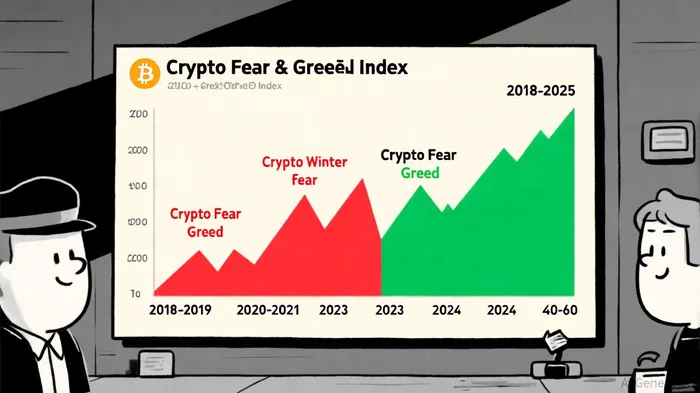
Historically, neutral phases often precede significant market shifts. The 2018–2019 "Crypto Winter" saw prolonged fear (86.2% of days in 2018), but the subsequent stabilization in 2019 laid the groundwork for the 2020–2021 bull run, according to a Coingecko report. Similarly, the four-month stretch without fear in late 2023–early 2024, noted by Coingecko, mirrored the pre-bull conditions of 2020–2021, when BitcoinBTC-- first broke $40,000. These patterns underscore the importance of recognizing neutrality as a potential inflection point.
Contrarian Strategies in Neutral Markets
Contrarian investing during neutral sentiment requires a blend of patience and tactical rigor. A 2023 study found that strategies leveraging the FGI outperformed passive buy-and-hold approaches in inefficient crypto markets. For instance, Dollar-Cost Averaging (DCA)-systematically buying fixed amounts at regular intervals-has proven effective during neutrality. MicroStrategy's Bitcoin accumulation since 2020 exemplifies this, as the company capitalized on neutral periods to build a $4.2 billion Bitcoin reserve (per the Coingecko report).
Another approach is value investing, which focuses on projects with strong fundamentals. Early investors in ChainlinkLINK-- (LINK) recognized its utility in solving oracle problems for smart contracts before its price reflected intrinsic value - an opportunity Coingecko highlights was more accessible during neutral sentiment. During neutral sentiment, such opportunities are more accessible, as the market's emotional noise diminishes.
Risk Management in Neutral Phases
While neutrality offers stability, it also demands caution. Data from 2018–2024 shows that during neutral FGI periods, traders recorded an average PnL of 0.5%, with a 52% win rate and 10.1x leverage, according to a GitHub analysis. These metrics suggest moderate risk but also highlight the need for conservative position sizing. For example, during the 2023–2024 neutral phase, investors who avoided over-leveraging and diversified across Bitcoin (40%), EthereumETH-- (30%), and mid/small-cap altcoins (30%) mitigated downside risks, as noted in the Coingecko report.
Tactical Entry: Lessons from History
The 2022 crypto winter, which saw 94% of days in fear per the Coingecko report, eventually gave way to a neutral phase in 2023. This period allowed investors to accumulate undervalued assets like Ethereum, which later surged as the market regained confidence. Similarly, the Winklevoss twins' long-term HODL strategy-buying Bitcoin in 2013 and holding through bear markets, a pattern documented by Coingecko-demonstrates the power of patience during neutrality.
For active traders, swing trading during neutral ranges can capitalize on 20–30% price swings in Bitcoin (Coingecko notes historical examples). Arbitrage opportunities, such as the historical "Kimchi Premium" in South Korean exchanges, also thrive in neutral markets where price discrepancies persist.
Conclusion: Positioning for 2025
As the FGI stabilizes in neutral territory, investors should prioritize disciplined accumulation, diversification, and risk management. The 2023–2024 example shows that neutrality can precede significant bull cycles, particularly when combined with on-chain metrics like Bitcoin halving events, as discussed in the Coingecko report. By treating the FGI as a contrarian tool rather than a standalone indicator, investors can navigate volatility with a strategic edge.
In a market where sentiment often drives outcomes, that 2023 study found neutrality is not a signal to sit idle-it's a call to act with intention.






Comentarios
Aún no hay comentarios