
Crypto Exchange Security Risks and Macroeconomic Implications: Geopolitical Vulnerabilities and Regulatory Arbitrage in Latin America
The TruBit hack of February 2025, in which $1.5 billion in EthereumETH-- was stolen from the Dubai-based exchange Bybit, marked a watershed moment in the crypto industry's security landscape. The attack, attributed to North Korea's state-sponsored Lazarus Group, exploited vulnerabilities in centralized custody models through front-end UI manipulation and multi-signature wallet deception. This incident not only exposed systemic weaknesses in crypto infrastructure but also underscored how geopolitical tensions are increasingly weaponized in the digital asset space. For Latin America-a region experiencing rapid crypto adoption and fragmented regulation-the implications are profound.
The Anatomy of the TruBit Hack and Systemic Vulnerabilities
The TruBit breach revealed critical flaws in centralized exchanges, particularly their reliance on third-party developers and multi-signature wallets. Hackers compromised a developer's machine to inject malicious JavaScript into the transaction signing process, disguising fraudulent transfers as legitimate ones. This method bypassed traditional security measures, highlighting the risks of over-centralized custody models. Such attacks are not isolated: in 2025, global crypto thefts reached $3.4 billion, with the Bybit hack alone accounting for 44% of losses.
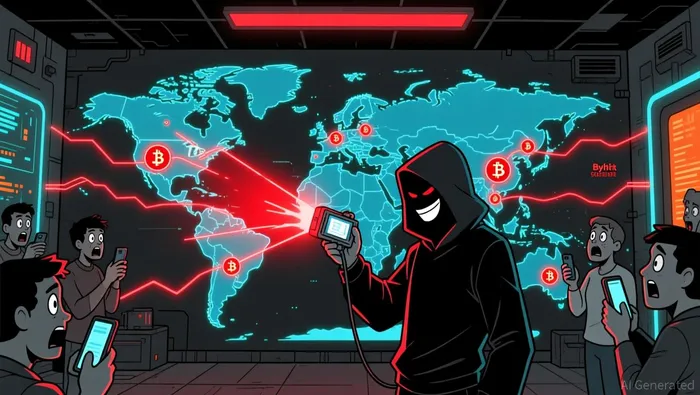
The geopolitical dimension is equally alarming. Lazarus Group's involvement ties the hack to North Korea's broader strategy of using cybercrime to circumvent sanctions and fund its regime. This blurs the line between criminal activity and state-sponsored aggression, creating a new frontier for geopolitical conflict. For regions like Latin America, where crypto adoption is driven by economic instability and capital controls, such attacks could erode trust in digital finance and destabilize emerging markets.
Latin America's Regulatory Fragmentation and the Rise of Arbitrage
Latin America's crypto ecosystem in 2025 is characterized by explosive growth and regulatory fragmentation. Between July 2022 and June 2025, the region recorded $1.5 trillion in crypto transaction volume, with Brazil leading the way at $318.8 billion in crypto value received-90% of which involved stablecoins. This surge is driven by inflation, currency volatility, and restrictive capital controls, which have pushed users to adopt stablecoins as a hedge and remittance tool.
However, the absence of a unified regulatory framework has created fertile ground for arbitrage. Ten countries in the region now have formal crypto laws, but these vary widely in scope and enforcement. Brazil, for instance, has emerged as a regulatory leader with its 2022/2023 Virtual Assets Law (BVAL), while others lag behind. This patchwork system allows businesses to exploit jurisdictional loopholes, relocating operations to less stringent environments or restructuring transactions to avoid oversight. The Financial Stability Board (FSB) has warned that such fragmentation exacerbates systemic risks, particularly in high-risk activities like lending and margin trading.
Macroeconomic Implications: Trust, Regulation, and Systemic Risk
The TruBit hack and similar incidents have forced Latin American regulators to accelerate their frameworks. Post-2025, countries like Brazil and Chile have introduced stricter oversight for stablecoin issuance, exchange licensing, and cross-border payments. These measures aim to balance innovation with consumer protection, but they also highlight the tension between fostering adoption and mitigating risks.
The macroeconomic implications are twofold. First, security breaches like TruBit could undermine trust in digital assets, particularly in regions where crypto adoption is still nascent. If users perceive crypto as a high-risk asset class, adoption rates could stall, limiting its potential to address economic challenges like inflation and capital flight. Second, regulatory arbitrage may lead to a "race to the bottom," where jurisdictions with lax rules attract illicit activity, further destabilizing the ecosystem.
Conversely, the post-hack regulatory momentum presents opportunities. Countries that implement robust frameworks-like Brazil's BVAL-could attract institutional investment and position themselves as global hubs for digital finance. Venture funding in blockchain startups reached $961 million in Q2 2025, reflecting growing confidence in the region's potential.
Investment Considerations: Navigating the New Normal
For investors, the key takeaway is to balance the risks and opportunities in Latin America's crypto landscape. On the risk side, the TruBit hack underscores the need for caution in centralized exchanges and the importance of decentralized custody solutions. On the opportunity side, the region's regulatory evolution and stablecoin-driven adoption offer long-term growth potential.
However, geopolitical vulnerabilities remain a wildcard. As state-sponsored cyberattacks become more sophisticated, investors must factor in the likelihood of regulatory crackdowns, sanctions, or even geopolitical spillovers. For example, if North Korea's cyber activities escalate, Latin American regulators might impose stricter anti-money laundering measures or restrict crypto mixers, as seen in global responses to the TruBit incident.
Conclusion
The TruBit hack of 2025 is a stark reminder of the fragility of crypto infrastructure and the geopolitical forces shaping its evolution. For Latin America, the challenge lies in harmonizing innovation with security while navigating the pitfalls of regulatory arbitrage. As the region's crypto ecosystem matures, investors must stay attuned to both the technical risks of hacks and the macroeconomic forces driving regulatory change. The future of digital finance in Latin America will be defined by how well it balances these competing priorities.







Comentarios
Aún no hay comentarios