
Crypto Exchange Risk Management and Token Stability: Navigating Systemic Risks in DeFi
In 2025, the decentralized finance (DeFi) ecosystem stands at a critical juncture. While innovations like tokenized assets and algorithmic stablecoins have expanded access to global financial systems, systemic risks remain a persistent challenge. The collapse of the Terra-Luna ecosystem in 2022-a $200 billion loss in 24 hours-exposed vulnerabilities in DeFi's interconnected protocols, including reflexivity-driven feedback loops and inadequate collateralization models, as highlighted by an Emerald study. As institutional adoption accelerates, investors and platforms must prioritize robust risk management frameworks to safeguard token stability and systemic resilience.
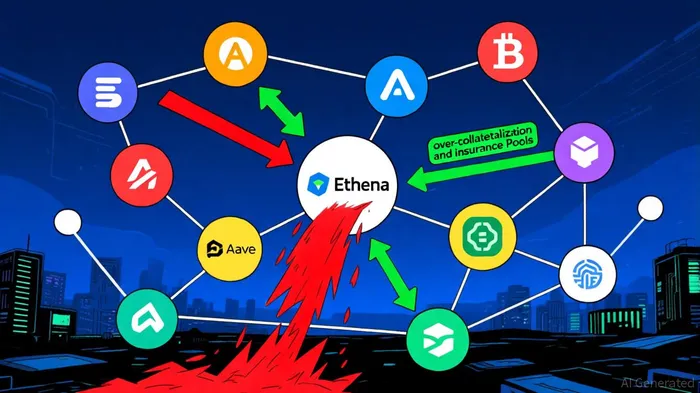
Systemic Risks in DeFi: Case Studies and Lessons Learned
The AaveAAVE-- and EthenaENA-- risk report of 2025 provides a stark example of how protocol interdependencies can amplify market shocks, as described in the Aave & Ethena report. The report identified reflexivity-a self-reinforcing cycle of low borrowing costs and pooled reserves-as a core risk. During upward trends, this dynamic boosts liquidity; during downturns, it triggers rapid unwinding, akin to a traditional bank run. For instance, when Ethena's synthetic stablecoin faced redemption pressure, its reliance on Aave's liquidity exacerbated the crisis, underscoring the need for soft governance mechanisms like "Redemption Priority" and hard safeguards such as "Whitelisted Redeemers." That report recommended these kinds of measures to limit contagion and improve protocol-level resilience.
Algorithmic stablecoins, meanwhile, continue to face scrutiny. Post-TerraUSD, newer models now prioritize full or over-collateralization with liquid reserves like USD. Smart contracts enforce these ratios and automatically liquidate under-collateralized positions, preventing devaluation, according to Elemental Markets' analysis. The analysis also notes that hybrid models, which blend algorithmic mechanisms with traditional asset backing, further diversify risk exposure.
Investor Protection Mechanisms: Insurance, Regulation, and Stability Solutions
DeFi's evolution in 2025 has seen the rise of insurance protocols and regulatory frameworks designed to mitigate systemic risks. Platforms like Nexus Mutual and Tidal Finance now offer cross-chain coverage for smart contract exploits, market swings, and regulatory changes, leveraging community-driven governance and on-chain verification, as described in a SmartLiquidity report. These protocols act as decentralized buffers, with claims processed automatically via smart contracts.
Regulatory clarity has also advanced. The U.S. GENIUS Act mandates stablecoins maintain 1:1 backing with low-risk assets and undergo third-party audits, while the EU's MiCA regulation provides a comprehensive framework for crypto-asset service providers. That report highlights these measures as efforts to align DeFi with traditional finance standards, though challenges persist in balancing privacy with compliance.
For token stability, over-collateralization has emerged as a preferred model. The Inter Stable Token (IST), for example, requires a 250% collateral ratio, ensuring users deposit 2.5 times the value of IST they mint. This approach reduces liquidation risks and fosters trust, particularly in volatile markets, according to CoinCodeCap analysis.
Exchange-Level Risk Mitigation: Centralized vs. Decentralized Strategies
Centralized exchanges (CEXs) face unique risks, including custodial vulnerabilities and regulatory scrutiny. The FTX and Celsius collapses highlighted the dangers of opaque reserve management and over-leveraged operations, as detailed in a TokenMetrics analysis. In response, CEXs are adopting hybrid models that integrate decentralized principles-such as multi-signature wallets and proof-of-solvency audits-with centralized liquidity. AI-driven analytics and decentralized identity (DID) systems further enhance transparency and compliance, which the TokenMetrics analysis also emphasizes.
Decentralized exchanges (DEXs), on the other hand, prioritize smart contract audits and automated market makers (AMMs) to manage liquidity risks. For example, DEXs like UniswapUNI-- and SushiSwapSUSHI-- now employ decentralized oracles to aggregate price data, reducing manipulation risks, as explained in a FoundersShield guide. The guide also highlights insurance products tailored for DeFi-such as cyber liability and errors-and-omissions coverage-that provide financial safeguards against exploits and governance failures.
The Path Forward: Balancing Innovation and Resilience
While DeFi's security has improved-exploit losses declined 90% since 2020-systemic risks persist during extreme market conditions. Tokens like ETHETH--, LINK, and UNI remain central to contagion pathways, while stablecoins like DAIDAI-- act as buffers, according to an MDPI study. To address this, protocols must adopt proactive monitoring frameworks, tracking metrics like price deviation and liquidity depth.
For investors, diversification and hedging strategies are critical. Dollar-cost averaging, cross-chain exposure, and options-based hedging can mitigate downside risks. Meanwhile, regulators and developers must collaborate to standardize risk metrics and enhance protocol transparency without stifling innovation, a point echoed by that MDPI study.
Conclusion
The DeFi landscape in 2025 is defined by a delicate balance between innovation and systemic resilience. While regulatory frameworks and technological advancements have bolstered token stability, the interconnectedness of protocols demands continuous vigilance. By integrating robust risk management strategies-ranging from over-collateralization to decentralized insurance-DeFi can evolve into a resilient infrastructure capable of supporting global finance.






Comentarios
Aún no hay comentarios