
Crypto Exchange Resilience Amid Network Congestion: Operational Risks and User Trust in DeFi Infrastructure
The Rise of Operational Risks in DeFi
Operational risks have emerged as the dominant threat in DeFi, surpassing traditional smart contract exploits. In 2023, the industry lost $1.95 billion to phishing attacks, rugpulls, and flash loan attacks, with EthereumETH-- bearing the brunt of $1.35 billion in losses, according to DeFi Security in 2025. By 2025, the focus shifted to off-chain vulnerabilities, such as compromised private keys and infrastructure flaws. The Bybit hack in 2025, which drained $1.5 billion from cold wallets, exemplifies this trend, as attackers exploited social engineering and off-chain services rather than on-chain code, according to a BeInCrypto report.
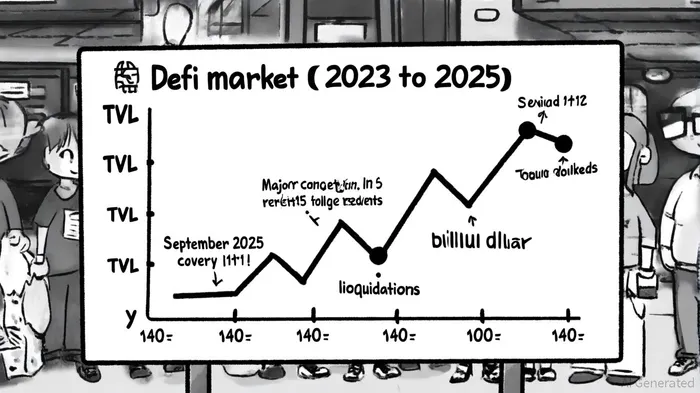
Network congestion further exacerbates these risks. For instance, the September 2025 liquidation cascades saw $1.7 billion in leveraged positions liquidated within 24 hours, overwhelming blockchain infrastructures and exposing gaps in risk management, as reported by BeInCrypto. Ethereum's $309 million in closed positions during this period highlighted the fragility of overleveraged positions and automated smart contracts, per BeInCrypto.
User Trust Erosion and Recovery Challenges
Network congestion directly impacts user trust, particularly when platforms lack proactive monitoring. The Base Network outage in August 2025, caused by a faulty sequencer transition, froze transactions for 33 minutes and raised concerns about centralized sequencer models, as noted in the DeFi Security in 2025 report. Similarly, the TON and Polygon outages in 2025 underscored the fragility of decentralized systems under high transaction volumes, as discussed in an OKX overview.
User sentiment analysis reveals the human cost of these events. A 2025 study found that 89% of newcomers abandon DeFi protocols within five minutes due to complex interfaces, while 78% cite unpredictable liquidations as a major concern, according to the DeFi Security in 2025 report. During the September 2025 crash, sentiment monitoring tools struggled to mitigate systemic liquidations, emphasizing the limitations of real-time analytics in high-leverage environments, as reported by BeInCrypto.
However, DeFi platforms are adapting. The Cetus ProtocolCETUS-- incident on SuiSUI-- Network demonstrated rapid recovery through decentralized governance. After a $60 million exploit, 114 validators froze stolen assets, and the Sui Foundation secured 100% user restitution while allocating $10 million for security audits, according to BeInCrypto. Such responses highlight the importance of transparent communication and collective action in rebuilding trust.
Technical and Governance Innovations
To address congestion and operational risks, DeFi projects are adopting advanced solutions. zkSpace's 2025 congestion mitigation strategy, which included parallelized proof generation and dynamic batch optimization, increased throughput from 500 to 3,200 transactions per second, as described in a zkSpace case study. Similarly, AaveAAVE-- and UniswapUNI-- have implemented automated pause mechanisms and AI-powered audits to detect anomalies, according to a DeFi metrics update.
Decentralized insurance models are also expanding to cover governance and oracle risks. For example, platforms now offer coverage for low-voter turnout attacks, such as the $17 million loss on ArbitrumARB-- in May 2025, as reported in the DeFi metrics update. These innovations reflect a shift toward holistic risk management, combining technical upgrades with governance resilience.
Future Implications for Investors
For investors, the key takeaway is that DeFi resilience hinges on balancing technical robustness with user-centric design. Platforms that prioritize off-chain security, decentralized infrastructure, and transparent governance-such as Sui and zkSpace-are better positioned to withstand congestion and operational risks. Conversely, projects reliant on centralized sequencers or inadequate audits face heightened exposure.
The September 2025 liquidations, while destabilizing, also served as a "cleansing" of excessive leverage, potentially paving the way for a more sustainable DeFi ecosystem, as reported by BeInCrypto. However, regulatory uncertainties and human error remain persistent challenges, per the DeFi metrics update.
Conclusion
DeFi's future depends on its ability to navigate network congestion and operational risks while maintaining user trust. As the industry matures, projects must adopt proactive measures-such as real-time monitoring, decentralized sequencers, and AI-driven audits-to ensure resilience. For investors, prioritizing platforms with robust infrastructure and transparent governance will be critical in a landscape where trust and technical excellence are inseparable.






Comentarios
Aún no hay comentarios