
Crypto Exchange Resilience Amid Market Fire Sales: ADL as a Survival Metric for Binance and Hyperliquid
In the volatile world of cryptocurrency, market resilience is not just a buzzword-it's a survival trait. As fire sales and liquidity crunches test the mettle of exchanges, one metric stands out as a critical barometer: Average Daily Volume (ADL). ADL reflects not only an exchange's ability to attract and retain traders but also its capacity to maintain liquidity and price discovery during systemic stress. This analysis examines how Binance and Hyperliquid, two titans in the crypto space, have navigated Q3 2025 and early October 2025, using ADL as a lens to assess their resilience.
Binance: The Unshakable Colossus
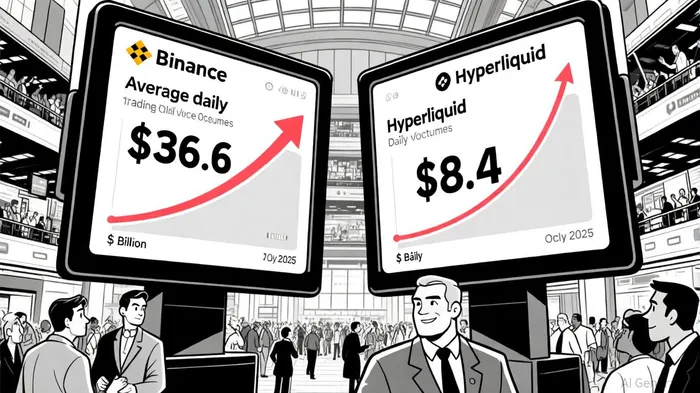
Binance's dominance in the crypto ecosystem is no accident. According to a report by CryptoDnes.bg, the exchange's average daily trading volume in October 2025 hit $36.6 billion, a figure that dwarfs its closest rivals combined[1]. This resilience is underpinned by Binance's robust infrastructure, which has processed over $65 billion in 24-hour trading volume in 2024[4]. The exchange's ability to maintain such high volumes during market stress is a testament to its deep liquidity pools and global user base-over 200 million registered users as of mid-2024[4].
Binance's ADL growth in Q3 2025 was further fueled by favorable macroeconomic conditions. A report by Smart Money Mindset notes that the exchange's net inflows surged to $14.8 billion during the quarter, far outpacing the combined inflows of the next ten largest centralized exchanges ($94 million)[5]. This inflow momentum, coupled with the speculative fervor around the memecoinMEME-- boom and BNBBNB-- Chain's organic growth, has solidified Binance's role as the crypto market's central hub[3].
Hyperliquid: The Decentralized Challenger
While Binance's scale is unmatched, Hyperliquid's meteoric rise in 2025 has turned heads. Data from RR2 Capital reveals that Hyperliquid's ADL in October 2025 ranged between $2–6 billion, with a record-breaking 24-hour volume of $8.4 billion[3]. By the end of 2025, the platform's derivatives volume ratio to Binance had climbed to 13.6%, up from 8% at the start of the year[6]. This growth is particularly striking given Hyperliquid's focus on decentralized perpetual futures, where it now captures 70% of on-chain trading volume[5].
Hyperliquid's resilience stems from its technical advantages: a custom-built blockchain optimized for high-performance trading, cross-chain support, and competitive fees[5]. An Oak Research report highlights that the platform has processed over $200 billion in cumulative volume, driven by its user-friendly design and deep liquidity[6]. Even during market stress, Hyperliquid's ADL has remained remarkably stable, with average weekly volumes hitting $47 billion in the first half of 2025[2].
The ADL Divide: Resilience vs. Scalability
The ADL gap between Binance and Hyperliquid underscores their differing strategies. Binance's $36.6 billion ADL in October 2025 reflects its role as a centralized, all-in-one trading hub, while Hyperliquid's $2–6 billion ADL highlights its niche focus on decentralized derivatives. However, Hyperliquid's rapid growth-its derivatives volume ratio to Binance increased by 67% year-to-date-suggests that decentralized platforms are gaining traction even during market stress[6].
This divergence raises a critical question: Can Hyperliquid scale to challenge Binance's dominance? While Binance's infrastructure and user base provide a moat, Hyperliquid's technical innovation and market share in perpetual futures indicate a platform poised for long-term resilience. As Coin Tribune notes, Hyperliquid's 70% market share in on-chain perpetual futures[5] is a direct threat to Binance's dominance in this segment.
Investor Implications
For investors, the ADL data paints a nuanced picture. Binance's sheer scale and liquidity make it a safe bet during market downturns, but its centralized model exposes it to regulatory risks. Hyperliquid, on the other hand, offers a glimpse into the future of decentralized trading, with its ADL growth and market share gains suggesting strong tailwinds. However, its smaller ADL compared to Binance means it may struggle to sustain volume during extreme market stress.
In a world where crypto markets are increasingly defined by fire sales and liquidity crises, ADL is more than a number-it's a survival metric. Binance and Hyperliquid have both demonstrated resilience in 2025, but their paths diverge: one bets on scale and centralization, the other on innovation and decentralization. For investors, the key is to balance exposure to both, hedging against the unpredictable nature of crypto's next crisis.






Comentarios
Aún no hay comentarios