
Crypto Exchange Cost Efficiency and Its Impact on Investor Returns: How Bitget's Lowest Trading Fees Create a Strategic Edge for Retail Traders and Institutional Capital
In the rapidly evolving landscape of cryptocurrency trading, cost efficiency has emerged as a critical determinant of investor returns. As of 2025, platforms like Bitget are redefining the competitive dynamics of the market by offering fee structures that cater to both retail and institutional traders. By slashing trading costs and introducing innovative incentives, Bitget has positioned itself as a formidable player in a sector where even marginal reductions in fees can significantly amplify profitability. This analysis explores how Bitget's strategic approach to cost efficiency not only enhances returns for individual traders but also attracts institutional capital, reshaping the broader crypto ecosystem.
Bitget's Fee Structure: A Retail and Institutional Magnet
Bitget's 2025 fee model is engineered to maximize accessibility and profitability. For spot trading, the platform charges a standard 0.1% fee, which drops to 0.08% for users who pay with its native token, BGB. This discount is further amplified for VIP users, who can leverage volume-based or token-holding incentives to reduce costs further according to Bitget's support. For futures trading, Bitget's makerMKR-- fees are 0.02%, and taker fees are 0.06%, with additional discounts for higher VIP tiers. These rates are among the lowest in the industry, particularly when compared to Coinbase's 0.40–0.60% spot fees, which can erode returns for active traders according to CoinMetrics analysis.
Institutional traders benefit from Bitget's aggressive liquidity incentives, including maker rebates of up to -0.012% on spot markets and -0.005% on futures, alongside taker fees as low as 0.02% (spot) and 0.025% (futures) according to liquidity program details. These rebates are designed to attract market makers and high-volume firms, deepening liquidity pools and reducing slippage-a critical advantage in volatile crypto markets. Additionally, Bitget's 90% reduction in stock futures fees (to 0.0065%) during a limited-time promotion underscores its commitment to expanding access to tokenized equity markets, a growing segment in 2025 as reported in their blog.
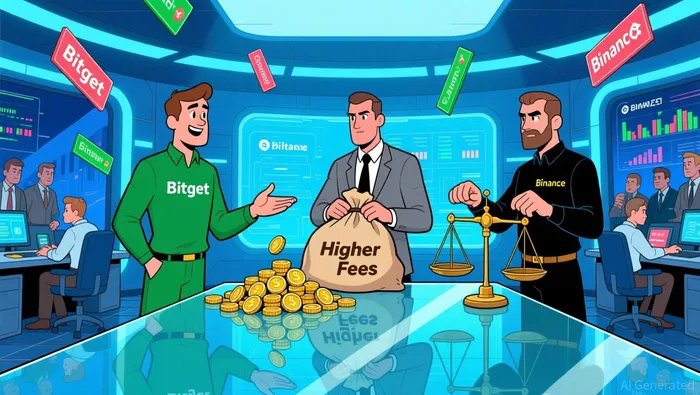
Cost Efficiency vs. Competitors: A Quantitative Edge
The impact of Bitget's fee structure becomes starkly evident when compared to rivals like Binance and CoinbaseCOIN--. For example, a $5,000 trade on Bitget or Binance costs $5.00, while the same transaction on Coinbase could incur fees of up to $120, depending on the platform used according to CoinCub analysis. Over time, these disparities compound, particularly for high-frequency traders. A study by TokenMetrics highlights that Bitget's 0.1% spot fee, combined with its zero-fee campaigns on major pairs like BTC/USDT, can reduce trading costs to zeroZBT-- during promotional periods-a feature absent on Binance and Coinbase according to Bitget's fee comparison.
For futures trading, Bitget's 0.02% maker fee is on par with Binance's 0.04% base rate but outperforms Coinbase, which does not offer retail futures trading in 2026 according to CoinCub analysis. This positions Bitget as a preferred venue for leveraged strategies, where even minor fee reductions can translate into substantial profit margins. Institutional investors, meanwhile, gain access to VIP fee matching, API integration, and custody solutions, further enhancing their operational efficiency as detailed in their liquidity program.
ROI Implications: From Active Traders to Long-Term Holders
The ROI benefits of Bitget's fee structure are multifaceted. For active traders, lower fees directly increase net returns. A hypothetical $100,000 portfolio trading 10 times monthly would incur $1,000 in fees on Bitget versus $6,000 on Coinbase, assuming average spreads and no discounts according to CoinMetrics analysis. Over a year, this represents a 500% cost advantage. For institutional players, the combination of maker rebates and liquidity incentives reduces the cost of market-making, enabling tighter spreads and higher turnover. CoinGlass data notes that Bitget's ETH futures market depth of $97.48 million at ±1% is significantly higher than competitors, underscoring its ability to support large-volume strategies according to Bitget's academy report.
Retail investors also benefit indirectly. Bitget's free crypto deposits and zero P2P trading fees lower entry barriers, while its copy trading platform-hosting over 200,000 elite traders-enables novices to replicate high-performing strategies with minimal overhead according to exchange comparison analysis. This democratization of access aligns with broader trends in 2025, where tokenization and regulatory clarity are driving mainstream adoption .
Strategic Positioning in a Regulated Future
Bitget's cost advantages are amplified by its alignment with macroeconomic and regulatory trends. As institutional adoption accelerates-driven by ETF approvals, tokenized treasuries, and MiCA compliance-exchanges with low fees and robust infrastructure gain a competitive edge. Grayscale's 2026 Digital Asset Outlook notes that BitcoinBTC-- and EthereumETH-- are increasingly viewed as hedges against fiat devaluation, a trend that favors platforms like Bitget, which offer cost-efficient access to these assets according to Grayscale research.
Moreover, Bitget's focus on multi-chain support (e.g., TRC20, BEP20, ERC20) and dynamic withdrawal fee mechanisms mirrors MEXC's strategies in 2026, addressing a critical pain point for traders who often overlook withdrawal costs as reported in MEXC's crypto pulse article. By optimizing both trading and operational expenses, Bitget caters to a diverse user base, from retail arbitrageurs to institutional portfolio managers.
Conclusion: A New Benchmark for Cost Efficiency
Bitget's 2025 fee structure represents more than a cost-cutting exercise-it is a strategic recalibration of the crypto trading value chain. By offering tiered discounts, liquidity incentives, and promotional campaigns, the platform not only enhances investor returns but also fosters a more inclusive and liquid market. As the industry matures, the ability to balance low fees with robust infrastructure will define the next generation of crypto exchanges. For traders seeking to maximize ROI in an increasingly competitive landscape, Bitget's model provides a compelling blueprint.





Comentarios
Aún no hay comentarios