
Crypto Exchange Compliance Risks and Investor Safeguards in 2025: Navigating KYC Enforcement and Account Freezes as Regulatory Indicators
The crypto industry in 2025 is no longer a Wild West of unregulated innovation. Regulatory scrutiny has intensified, with Know Your Customer (KYC) and Anti-Money Laundering (AML) enforcement emerging as central pillars of global oversight. For investors, this means heightened risks of account freezes and compliance-driven penalties-but also a clearer path to institutional-grade safeguards. Let's break down the data, the enforcement trends, and what this means for your portfolio.
Regulatory Crackdowns on KYC/AML Failures: A $1B+ Wake-Up Call
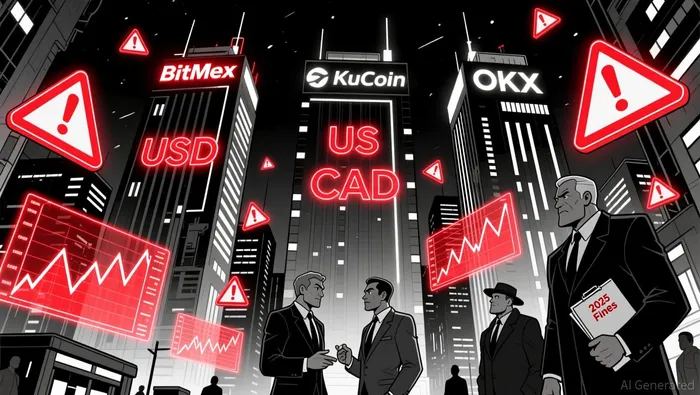
2025 marked a seismic shift in crypto enforcement. U.S. authorities alone doled out $927.5 million in penalties to exchanges for KYC/AML failures, signaling a zero-tolerance approach to non-compliance. BitMEX, KuCoin, and OKX became poster children for what happens when compliance is an afterthought:
- BitMEX: A $100 million fine for willfully neglecting AML/KYC protocols.
- KuCoin: A $297 million penalty for similar deficiencies, including unregistered operations.
- OKX: A staggering $504 million fine for running an unlicensed money transmission business.
These cases weren't isolated. Canada's FINTRAC hit KuCoin with a record C$19.6 million fine for failing to report suspicious transactions, as reported by KYC Chain, while the CVC Exchange faced a dual $7.5 million penalty after pleading guilty to BSA violations, according to Mayer Brown. The message is clear: regulators are no longer testing the waters-they're drowning non-compliant exchanges.
Account Freezes: The New Normal for Regulatory Scrutiny
As enforcement actions ramped up, so did the use of account freezes as a tool to enforce compliance. In 2025, crypto exchanges began freezing user assets at an alarming rate, often tied to KYC violations or suspected illicit activity.
Take OKX's recent freeze of $40,000 in stablecoins after a user admitted to purchasing verified accounts under false identities, as detailed by Cryptopolitan. The exchange's CEO, Star Xu, defended the move as a legal obligation to prevent fraud, emphasizing that transferring control of such accounts would "breach the duty to protect user assets." This case highlights a critical risk for investors: KYC violations by third parties can indirectly freeze your assets, even if you're innocent.
South Korea's regulatory approach offers another cautionary tale. In December 2025, the country's Supreme Court ruled that Bitcoin held on exchanges can be legally seized under criminal law, effectively giving authorities the green light to freeze accounts tied to fraud or money laundering. This decision aligns with global trends, as seen in the U.S. and EU, where law enforcement increasingly treats crypto assets as "seizable property," according to TradingView.
Meanwhile, the EU's DAC8 rules, effective January 1, 2026, introduced a 60-day grace period for users to provide Tax Identification Numbers (TINs). Failure to comply results in automatic account freezes, blocking withdrawals and trading. For investors, this means privacy is no longer a given-compliance is a non-negotiable cost of entry.
Investor Safeguards: The Silver Lining in a Risky Landscape
While the regulatory environment is undeniably harsher, 2025 also brought meaningful safeguards for investors. The U.S. introduced the GENIUS Act, mandating 1:1 backing for payment stablecoins and segregating reserves-a move to prevent another Terra/LUNA-style collapse, as Kroll reports. The SEC's Project Crypto initiative further clarified token classifications, offering much-needed clarity on what constitutes a security versus a utility token, according to Kroll.
On the enforcement front, the Beacon Network-a collaboration between over 75% of global crypto volume and 60+ law enforcement agencies-emerged as a game-changer. This real-time information-sharing platform helps exchanges detect and report suspicious activity, reducing the risk of fraud and market manipulation, as detailed by TrmLabs. For investors, this means greater transparency and faster resolution of disputes.
The EU's MiCA Regulation also deserves a spotlight. By standardizing crypto rules across 27 member states, MiCA enforces mandatory disclosures via machine-readable white papers and introduces a licensing regime for cross-border operations, according to ESMA. While enforcement has been inconsistent, the framework is a step toward institutional-grade protections.
The Balancing Act: Navigating Risks and Opportunities
For investors, the 2025 landscape demands a dual strategy: risk mitigation and proactive compliance. Here's how to adapt:
1. Stick to Regulated Exchanges: Platforms like OKX and KuCoin are now under intense scrutiny, but their survival hinges on compliance. Opt for exchanges with transparent AML/KYC protocols and a history of regulatory cooperation.
2. Legal Preparedness: If your account is frozen, seek counsel immediately. As noted in 2025 enforcement cases, disputes often require jurisdiction-specific legal strategies to resolve.
3. Diversify Jurisdictionally: South Korea's aggressive freezes and the EU's DAC8 rules highlight the importance of geographic diversification. Consider multi-jurisdictional wallets and exchanges to avoid overexposure to any single regulatory regime.
Conclusion: Compliance as a Competitive Advantage
The 2025 regulatory crackdown isn't just a threat-it's a reset button for the crypto industry. Exchanges that survive will be those that treat compliance as a core competency, not a checkbox. For investors, the lesson is clear: safeguards and risks are two sides of the same coin. By understanding KYC enforcement trends and leveraging institutional-grade protections, you can navigate this new era with confidence.
The future of crypto isn't about avoiding regulation-it's about thriving within it.






Comentarios
Aún no hay comentarios