
U.S. Crypto ETF Staking Regulatory Clarity and Yield Opportunities
Regulatory Clarity: A Safe Harbor for Staking
The new rules require ETPs to stake only on permissionless PoS networks, hold assets in qualified custodians, and adhere to liquidity plans approved by the SEC, according to a CryptoTimes analysis. These conditions ensure transparency while preserving the passive nature of ETPs, a critical factor for maintaining their favorable tax status as investment or grantor trusts, the report noted. For institutional investors, this framework eliminates the risk of staking activities being reclassified as active trading or securities offerings, which had previously deterred capital deployment. Treasury Secretary Scott Bessent emphasized that the guidance "creates a clear path for ETPs to stake digital assets and share staking rewards with retail investors," a move that aligns with broader efforts to integrate crypto into traditional finance, according to a The Block article.
Yield Opportunities: Staking ETFs Outpace Traditional Models
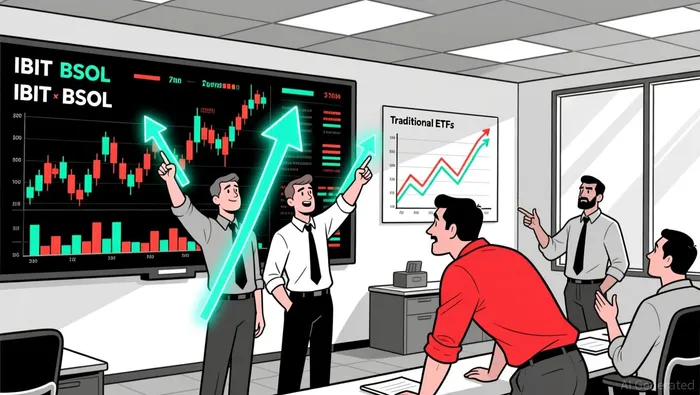
The regulatory shift has unlocked unprecedented yield opportunities. The Bitwise Solana Staking ETFBSOL-- (BSOL), launched in October 2025, exemplifies this trend. With a 7.20% net staking reward rate and a 0.20% expense ratio (waived on the first $1 billion in assets until January 2026), BSOLBSOL-- attracted $69.5 million in net inflows on its first day, according to a CoinSpeaker report. This performance dwarfs traditional ETFs, which typically offer yields below 1% in a low-interest-rate environment. BlackRock's IBITIBIT--, the dominant BitcoinBTC-- ETF with $50 billion in AUM, operates at a 0.25% expense ratio-six times more cost-efficient than Grayscale's 1.5% fees, as noted in a PowerDrill AI analysis. These metrics underscore the growing competitiveness of staking ETFs, particularly for institutions seeking passive income generation.
Competitiveness: U.S. ETFs Outpace Global Peers
The U.S. regulatory environment has accelerated institutional adoption, creating a stark contrast with international markets. BlackRock's IBIT commands 48.5% of the U.S. Bitcoin ETF market, while the SEC's 2024 approval of spot Bitcoin and Ethereum ETFs spurred a 400% surge in institutional flows, as noted in the PowerDrill AI analysis. In contrast, international staking ETFs lag in both AUM and fee efficiency, hindered by fragmented regulatory frameworks. For instance, the U.S. now ranks second on the 2025 Global Crypto Adoption Index, driven by streamlined SEC approvals and the Trump administration's crypto-friendly policies, including the Strategic Bitcoin Reserve initiative, according to a Chainalysis report.
Tax Compliance and Institutional Confidence
The IRS has reinforced its stance on tax reporting, requiring all staking rewards to be disclosed on federal returns, according to an IRS press release. However, the new guidance simplifies compliance for ETPs by aligning staking rewards with standard income tax rules, reducing administrative burdens for institutional investors. This clarity has spurred innovation, with legal experts like Consensys's Bill Hughes noting that staking is now "an acknowledged and compliant activity for regulated investment vehicles," as the Cryptobasic report observed.
Conclusion: A New Paradigm for Digital Assets
The Treasury and IRS's 2025 guidance has redefined the institutional crypto landscape, transforming staking from a speculative activity into a regulated, yield-generating asset class. With U.S. ETFs like BSOL and IBIT outpacing traditional models in both returns and cost efficiency, the nation's regulatory leadership is attracting billions in capital. As global markets catch up, the U.S. is poised to solidify its dominance in digital asset innovation-a testament to the power of regulatory clarity in unlocking financial potential.







Comentarios
Aún no hay comentarios