
Crypto ETF Outflows Signal Macro Risk Reassessment: Is Now the Time to Re-Enter?
The crypto market in 2025 has been a study in contrasts. Early in the year, U.S.-listed BitcoinBTC-- ETFs faced a wave of outflows, with over $7.2 billion withdrawn in a five-week span, signaling a sharp recalibration of institutional risk appetite. By late 2025, however, the narrative shifted: spot Bitcoin ETFs recorded a single-day net inflow of $457 million, driven largely by Fidelity's Wise Origin Bitcoin Fund (FBTC), which attracted $391 million alone. This volatility underscores a broader tension between macroeconomic headwinds and regulatory tailwinds, raising a critical question for investors: Is the current environment a buying opportunity or a cautionary signal?
The 2025 Outflows: A Macro-Driven Flight to Safety
The early 2025 outflows were not random but a direct response to macroeconomic pressures. The Federal Reserve's hawkish stance, which kept interest rates elevated to combat inflation, forced institutional investors to prioritize yield-generating assets over high-beta plays like Bitcoin. Compounding this was the aftermath of Bitcoin's 2024 rally, which had driven prices to record highs, prompting profit-taking and portfolio rebalancing. Meanwhile, the Trump administration's delayed progress on crypto-friendly legislation created regulatory uncertainty, further dampening institutional enthusiasm.
This flight to safety was emblematic of a broader risk-off sentiment. Geopolitical tensions and trade policy shifts added to the unease, with Bitcoin's role as a hedge against fiat devaluation becoming less compelling in a high-interest-rate environment. Yet, even during this period, long-term holders did not fully retreat. Instead, they adopted a wait-and-see approach, maintaining positions in anticipation of a potential macroeconomic pivot.
The Late 2025 Rebound: Regulatory Clarity and Rate Cut Hopes
By late 2025, the tide began to turn. The U.S. Securities and Exchange Commission's approval of spot Bitcoin ETFs and the passage of the GENIUS Act in July 2025 provided the regulatory clarity that had long been missing. These developments transformed Bitcoin from a speculative asset into a legitimate investment vehicle, attracting institutional capital seeking diversification.
Simultaneously, shifting macroeconomic expectations played a pivotal role. With inflation showing signs of moderation and the Fed hinting at rate cuts, Bitcoin's high-beta profile aligned with liquidity-driven portfolio strategies. Institutional investors, particularly those in traditional hedge funds, began reallocating capital to Bitcoin, with 55% of such funds now holding some form of digital asset exposure in 2025-up from 47% in 2024. This trend was further amplified by global regulatory momentum, including stablecoin frameworks and cross-border collaboration efforts, which reduced operational risks for institutional participants.
Technical and Market Dynamics: A Delicate Balance
Despite the renewed inflows, Bitcoin's technical outlook remains mixed. The asset is currently trading near $100,000, with a critical resistance band between $93,000 and $120,000 acting as a psychological barrier. Over 6.7 million BTC are still held at a loss, a testament to the market's fragility. Analysts argue that sustained inflows above $95,000 are necessary to establish a durable foundation for further gains.
Institutional caution persists, as investors weigh the risks of a potential Fed pivot against the long-term appeal of Bitcoin as a hedge against fiat devaluation. The market's uneven performance-marked by sharp inflows followed by consolidation-reflects this duality. While ETFs continue to attract steady capital, the broader crypto ecosystem remains sensitive to macroeconomic signals, with geopolitical tensions and trade policy shifts still capable of triggering volatility.
Is Now the Time to Re-Enter?
For institutional investors, the decision to re-enter the crypto market hinges on two factors: macroeconomic reassessment and regulatory alignment. The Fed's potential rate cuts and the maturation of crypto regulations-exemplified by the CLARITY Act and the SEC's updated framework-have created a more favorable environment. However, the path forward is not without risks.
A key consideration is the timing of the Fed's actions. If rate cuts materialize as expected, Bitcoin could benefit from a liquidity-driven rally. Conversely, a delay or reversal in monetary easing could reignite risk-off sentiment, pressuring ETFs and Bitcoin prices. Additionally, while regulatory clarity has improved, cross-border prudential rules remain a wildcard.
For now, the data suggests a cautious optimism. With total assets in U.S. spot Bitcoin ETFs surpassing $112 billion-6.5% of Bitcoin's total market capitalization-the asset has achieved a level of institutional acceptance that was unthinkable just a year ago. 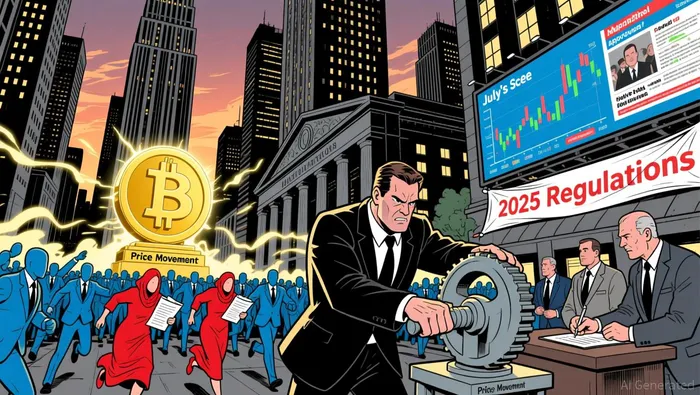 Yet, as history shows, macroeconomic cycles and regulatory shifts are not linear. Investors must remain agile, balancing long-term conviction with short-term pragmatism.
Conclusion
The 2025 crypto ETF outflows were a macroeconomic stress test for institutional investors, revealing both vulnerabilities and resilience. While early-year caution was warranted, the late-2025 rebound-driven by regulatory progress and shifting rate expectations-has rekindled interest in Bitcoin as a strategic asset. However, the market's technical fragility and macroeconomic uncertainties mean that re-entry should be approached with measured optimism. For those with a long-term horizon, the current environment offers a unique opportunity to capitalize on Bitcoin's evolving role in institutional portfolios-provided they remain attuned to the interplay of macro risk and regulatory momentum.





Comentarios
Aún no hay comentarios