
Crypto ETF Outflows and Market Sentiment: A 2025 Analysis of Investor Behavior and Risk Reallocation
The 2025 crypto market has been defined by a dramatic shift in institutional investor behavior, marked by significant outflows from BitcoinBTC-- and EthereumETH-- ETFs and a corresponding reallocation of capital toward safer assets. This trend, driven by macroeconomic uncertainties and regulatory ambiguity, underscores a broader recalibration of risk appetite across global markets.
The Outflow Phenomenon: Profit-Taking and Macro Risk Aversion
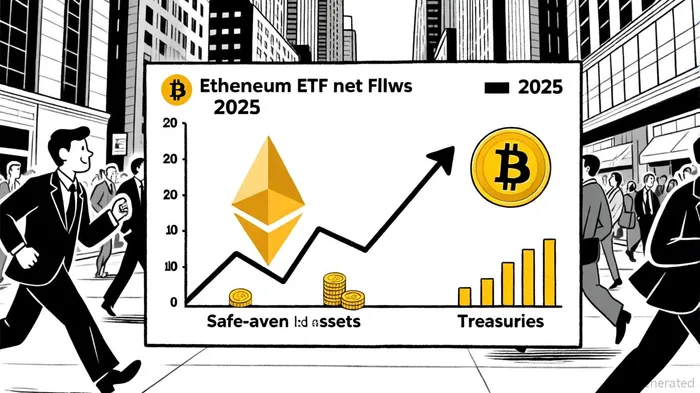
By late September 2025, U.S. Bitcoin spot ETFs recorded $903 million in net outflows, with Fidelity's ETFs bearing the brunt of the exodus, according to FinancialContent. Ethereum ETFs fared worse, losing over $800 million in the same period. These outflows reflect a combination of profit-taking after the 2024 bull run, portfolio rebalancing ahead of the fourth quarter, and a risk-off stance triggered by the Federal Reserve's hawkish pivot and persistent inflation concerns, according to Blockchain Council.
Institutional investors, particularly those managing large-cap portfolios, have increasingly viewed crypto as a volatile liability rather than a core holding. Regulatory delays-exacerbated by the re-election of Donald Trump and his administration's skepticism toward digital assets-have further eroded confidence, as noted by Blockchain Council. This environment has led to a deleveraging across the sector, with capital fleeing crypto ETFs to preserve liquidity and mitigate downside risks.
Safe-Haven Reallocation: Gold, Treasuries, and Low-Volatility Stocks
As crypto ETFs hemorrhaged assets, safe-haven assets surged in popularity. In April 2025 alone, ETFs tracking gold, ultra-short Treasuries, and low-volatility stocks attracted $18 billion in net inflows, the highest since March 2023, according to Blockchain.News. This shift aligns with historical patterns during periods of economic uncertainty, where investors prioritize capital preservation over growth.
Bitcoin itself has not been entirely excluded from this reallocation. On April 22, 2025, U.S. spot Bitcoin ETFs recorded their largest single-day inflow of $936 million, as institutions positioned the asset as a "digital gold" amid weak traditional markets, as reported by CryptoNews. However, this inflow was preceded by outflows in early April, highlighting the duality of Bitcoin's role as both a speculative asset and a hedge.
Bitcoin vs. Ethereum: Divergent Trajectories
The contrast between Bitcoin and Ethereum ETFs in 2025 reveals a nuanced shift in investor preferences. While Bitcoin has increasingly been embraced as a safe-haven asset-bolstered by purchases from entities like MicroStrategy and the UAE-Ethereum has struggled to maintain institutional interest. Despite its foundational role in smart contracts and staking yields, Ethereum ETFs faced cooling demand, with Fidelity's FETH experiencing the largest outflows in late September.
This divergence underscores Bitcoin's growing dominance in a risk-averse market. Its perceived stability and brand recognition have made it a more palatable option for institutions seeking exposure to crypto without the volatility associated with Ethereum's layer-2 innovations and regulatory scrutiny.
Institutional Behavior and Future Implications
The reallocation trends of 2025 highlight a maturing institutional approach to crypto. While BlackRock's Bitcoin ETF attracted inflows in late September 2025, Fidelity's products faced heavy redemptions, signaling a preference for liquidity and institutional credibility. This divergence suggests that market stability and trust in custodians will become critical factors in future ETF performance.
Looking ahead, the crypto market must navigate a delicate balance between regulatory clarity and macroeconomic stability. If the Fed softens its stance or new frameworks emerge to legitimize digital assets, a reversal of outflows could occur. However, until then, the 2025 trends indicate a prolonged period of risk reallocation, with crypto ETFs serving as both a barometer and a battleground for institutional capital.
Conclusion
The 2025 crypto ETF outflows and subsequent reallocation to safe-haven assets reflect a broader recalibration of investor priorities. As macroeconomic uncertainties persist and regulatory landscapes evolve, the interplay between risk aversion and digital asset adoption will remain a defining theme for the sector. For investors, understanding these dynamics is crucial to navigating the volatile yet transformative crypto market.





Comentarios
Aún no hay comentarios