
Crypto ETF Outflows and the Fed’s Inflation Dilemma: A Strategic Reassessment of Crypto Exposure
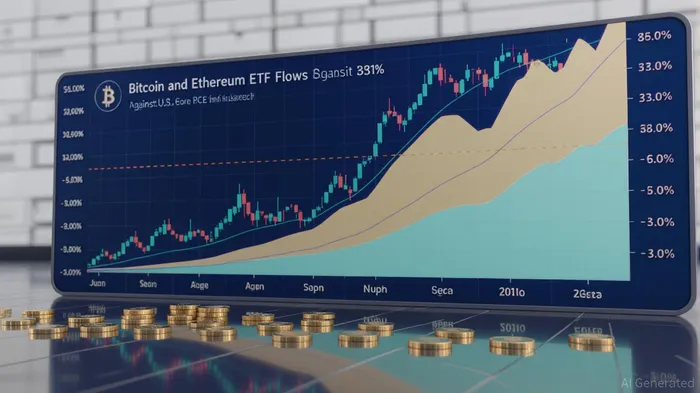
The recent $291 million outflows from BitcoinBTC-- and EthereumETH-- ETFs in late August 2025 underscore a critical inflection pointIPCX-- in the interplay between macroeconomic risks and asset reallocation. These outflows, driven by a 2.9% annualized surge in core PCE inflation—the highest since 1933—reflect investor anxiety over the Federal Reserve’s ability to balance price stability with employment goals [1]. The data also reveal a broader shift in risk appetite, as both crypto and gold ETFs experienced synchronized outflows, an anomaly given their typically inverse relationship [2]. This divergence from historical patterns demands a strategic reassessment of crypto exposure in portfolios.
The Fed’s Inflation Dilemma and Market Sentiment
The Federal Reserve’s August 2025 policy update reaffirmed a 2% inflation target but abandoned its controversial “average inflation targeting” (FAIT) framework, a move aimed at clarifying its commitment to price stability [3]. This shift came amid persistent inflationary pressures, including a 3.6% year-over-year rise in services-sector prices, attributed to President Trump’s tariffs on imports [1]. While the Fed’s revised stance signals a more hawkish tilt, markets remain fixated on the possibility of rate cuts if labor market data weakens—a duality that has left investors in limbo.
The resulting uncertainty has triggered a flight from risk assets. Bitcoin ETFs, which had enjoyed a multi-day inflow streak, saw their largest single-day outflow of $126.6 million on August 30, with Fidelity’s FBTC and Grayscale’s GBTC leading the exodus [1]. Gold ETFs, traditionally a safe haven, also lost $449 million in the same period, suggesting a broader aversion to assets perceived as inflation hedges [2]. This synchronized retreat highlights a key macroeconomic risk: investors are increasingly prioritizing liquidity and short-term stability over long-term speculative bets.
Divergent Paths: Bitcoin vs. Ethereum
Yet not all crypto ETFs are retreating. Ethereum ETFs bucked the trend, recording $4 billion in August inflows, driven by institutional demand for staking yields (4-6%) and optimismOP-- around the Dencun and Pectra hard forks [4]. This divergence underscores a strategic reallocation within crypto itself. While Bitcoin, often viewed as digital gold, faces outflows amid inflation fears, Ethereum’s utility-driven narrative—rooted in its role as a platform for decentralized finance (DeFi) and smart contracts—has insulated it from broader market jitters.
The contrast between the two assets raises a critical question: Is Ethereum’s resilience a temporary anomaly or a structural shift in how investors value crypto? The answer lies in the interplay between macroeconomic conditions and technological innovation. Ethereum’s staking yields, for instance, offer a tangible return in an environment where traditional fixed-income assets are losing ground to inflation [4]. This dynamic could redefine crypto’s role in portfolios, particularly as central banks grapple with the limits of monetary policy.
Strategic Implications for Investors
For investors, the current climate demands a nuanced approach. First, the synchronized outflows from Bitcoin and gold ETFs suggest that traditional safe-haven assets may no longer provide the same level of diversification. This could force a reevaluation of portfolio allocations, particularly for those relying on crypto as a hedge against inflation. Second, Ethereum’s performance highlights the importance of distinguishing between crypto assets based on their economic fundamentals. Investors with a longer time horizon may find value in Ethereum’s yield-generating capabilities, even as Bitcoin faces headwinds.
However, the Fed’s policy trajectory remains a wild card. While the central bank has signaled a commitment to price stability, its ability to engineer a “soft landing” without triggering a recession is uncertain. If inflation persists above 2%, further rate hikes could exacerbate outflows from risk assets, including crypto ETFs. Conversely, a surprise rate cut in response to weak labor data could reignite speculative flows.
Conclusion
The August 2025 crypto ETF outflows are not merely a market correction but a symptom of a deeper macroeconomic dilemma: How to reconcile inflation control with the Fed’s dual mandate of maximum employment. For investors, the lesson is clear—crypto exposure must be tailored to both macroeconomic conditions and the specific attributes of individual assets. While Bitcoin’s outflows reflect inflationary fears, Ethereum’s inflows signal a shift toward utility-driven value. In this environment, strategic reallocation is not just prudent—it is imperative.
Source:
[1] Bitcoin, Ether ETFs See Outflows as Fed Flags Inflation [https://cointelegraph.com/news/bitcoin-ether-etfs-see-outflows-fed-inflation-trump-tariffs]
[2] Bitcoin and Gold ETFs Experience Rare Synchronous Outflows [https://www.mexc.com/news/bitcoin-and-gold-etfs-experience-rare-synchronous-outflows/79950]
[3] 2025 Statement on Longer-Run Goals and Monetary Policy Strategy [https://www.federalreserve.gov/monetarypolicy/monetary-policy-strategy-tools-and-communications-statement-on-longer-run-goals-monetary-policy-strategy-2025.htm]
[4] Ethereum's Resilience Amid Crypto ETF Outflows and Macroeconomic Shifts [https://www.ainvest.com/news/ethereum-resilience-crypto-etf-outflows-macroeconomic-shifts-2508/]






Comentarios
Aún no hay comentarios