
Crypto ETF Outflows in Early 2026: Investor Sentiment Shifts and Asset Reallocation Dynamics
The early months of 2026 have delivered a mixed bag of signals for the crypto market, with U.S. spot BitcoinBTC-- ETFs experiencing sharp swings in inflows and outflows. These movements reflect evolving investor sentiment and broader cross-asset reallocation patterns, offering critical insights into the maturing institutional adoption of digital assets.
The ETF Flow Rollercoaster: A Tale of Two Weeks
The first week of January 2026 saw a surge in Bitcoin ETF inflows, with $385.9 million in net capital entering the space, led by BlackRockBLK-- and Fidelity according to Amber Data. This marked a reversal from prior outflows and signaled a constructive regime for Bitcoin, which rallied 8.5% during the period. However, by late January, the trend reversed sharply, with a $1.13 billion outflow over three days according to Bitget. BlackRock's IBIT was the sole ETF to attract inflows during this period ($231.89 million), while major players like Fidelity's FBTC, Grayscale's GBTC, and ArkARK-- Invest's ARKB faced significant redemptions as reported by MEXC.
These divergent flows highlight the dual forces at play: short-term profit-taking and macroeconomic headwinds. Rising U.S. treasury yields and a strengthening dollar have prompted institutional investors to rebalance portfolios, while quarterly-end dynamics added to the volatility according to Bitget. Yet, the long-term institutional buying trend remains intact, with Bitcoin ETF assets under management (AUM) surging $4.1 billion in 24 hours to reach $123.6 billion according to Phemex.
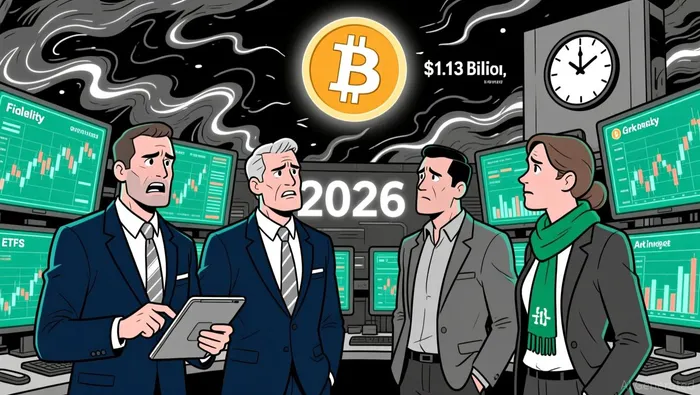
Investor Sentiment: Between Caution and Conviction
Institutional sentiment in early 2026 appears cautiously optimistic. While the $486.9 million outflow in early January 2026 according to CryptoRank and EthereumETH-- ETFs' $98.6 million single-day withdrawal as reported by MEXC suggest short-term hesitancy, broader data points indicate sustained confidence. For instance, 76% of global investors plan to increase their digital asset allocation in 2026, with nearly 60% expecting to allocate over 5% of their AUM to crypto according to B2Broker. This aligns with the approval of spot Bitcoin and Ethereum ETFs, which have provided regulated pathways for institutional capital as B2Broker notes.
Regulatory clarity is a key driver. The anticipated passage of U.S. crypto market structure legislation and the MiCA framework in Europe according to The Trade News are creating structured environments for stablecoin adoption and tokenized assets. These developments are encouraging institutions to treat crypto as a core asset class, not just a speculative play according to B2Broker. Additionally, tokenized treasuries and money-market funds are expanding at scale, signaling institutional readiness to integrate blockchain-based instruments as The Trade News reports.
Cross-Asset Reallocation: Crypto's Growing Portfolio Share
The Q1 2026 reallocation patterns underscore crypto's rising prominence. While Bitcoin ETFs attracted $385.9 million in net inflows according to Amber Data, U.S. equity funds showed a mixed picture. Large-cap growth ETFs like QQQ and IVV faced redemptions, while fixed-income assets dominated inflows, collecting $3.454 billion in a single day according to ETF Action. This suggests a rotation from equities to crypto and bonds, driven by macroeconomic uncertainty and the search for yield.
Commodities, however, tell a different story. Precious metals like gold and silver faced volatile positioning due to thin liquidity, while crypto-related assets continued to attract speculative flows as Investing.com reports. This divergence highlights crypto's unique role as both a speculative and strategic asset. Derivatives trading volume, which hit $1.41 trillion with $811 billion in open interest, further underscores the market's leverage and institutional participation according to Phemex.
Implications for Digital Asset Markets
The early 2026 ETF outflows and inflows signal a maturing market where institutional behavior is increasingly nuanced. Short-term volatility, driven by macroeconomic factors and quarterly rebalancing, does not negate the long-term trend of crypto adoption. Regulatory progress and product innovation-such as altcoin baskets and leveraged ETFs-are set to unlock $50+ billion in net inflows in 2026, reinforcing crypto's integration into global portfolios.
For investors, the key takeaway is to distinguish between cyclical corrections and structural shifts. While Bitcoin's ETF-driven rally in early January 2026 was bullish, the subsequent outflows reflect normal portfolio adjustments rather than a bearish reversal. The market remains in a "Neutral" sentiment phase according to Phemex, avoiding extremes of euphoria or panic-a sign of growing institutional discipline.
Conclusion
The Q1 2026 ETF outflows and inflows paint a picture of a market in transition. Institutional investors are navigating macroeconomic headwinds while deepening their crypto exposure through regulated products and infrastructure. As regulatory frameworks solidify and cross-asset reallocation trends take hold, digital assets are increasingly viewed as a core component of diversified portfolios. For now, the market's resilience-evidenced by BlackRock's IBIT outperforming peers according to MEXC-suggests that the institutional era of crypto is not just here, but accelerating.





Comentarios
Aún no hay comentarios