
Crypto ETF Market Resilience Amid U.S. Government Shutdown Uncertainty: A Deep Dive into Hedging and Institutional Signals
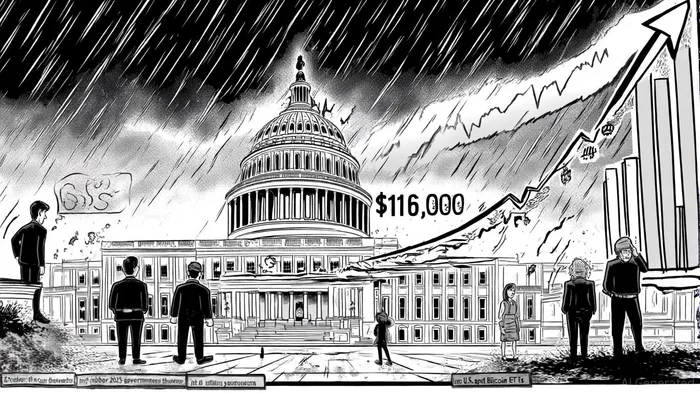
The U.S. government shutdown in October 2025 has created a regulatory vacuum, freezing over 90 crypto ETF applications at the SEC and halting critical rulemaking processes[1]. Yet, the crypto market has defied expectations, with BitcoinBTC-- surging past $116,000 and altcoins like SolanaSOL-- and XRPXRP-- rallying despite the uncertainty[2]. This resilience underscores a pivotal shift: crypto ETFs are no longer speculative gambits but strategic tools for portfolio hedging and institutional capital allocation.
Market Resilience: A Test of Conviction
The shutdown has turned the SEC into a ghost town, with less than 10% of its staff operational[3]. This has delayed approvals for spot crypto ETFs, including altcoin-focused products for Solana (10 pending applications) and XRP (9 pending applications)[4]. However, the market's response has been anything but panic. Bitcoin's price surge to a two-week high of $116,000[2] and the 15% rebound in EthereumETH-- and Solana[5] suggest investors view the regulatory pause as a temporary bottleneck rather than a systemic threat.
This resilience is driven by a "debasement trade," where capital flows into finite assets like Bitcoin and gold amid fiat currency devaluation fears[6]. According to a report by Coin Telegraph, Bitcoin's 12% weekly gain in early October 2025 outperformed traditional safe-havens like U.S. Treasuries, which saw yields plummet as the shutdown deepened[7].
Institutional Adoption: A $120B Bet on Crypto
While the SEC's inaction has stalled altcoin ETFs, institutional demand for Bitcoin ETFs has reached unprecedented levels. As of October 3, 2025, U.S. spot Bitcoin ETFs have amassed $110 billion in AUM, with BlackRock's iShares Bitcoin Trust (IBIT) alone holding $87.2 billion[8]. This growth is not speculative-it's structural. Over 130 public companies, including MicroStrategy, have allocated billions to Bitcoin as a corporate treasury asset[9], signaling a broader institutional acceptance of crypto as a core portfolio component.
The data is even more striking in the short term. During the first week of the shutdown, Bitcoin ETFs saw a record $3.24 billion in inflows, with $430 million added on September 30 alone[10]. These figures reflect a strategic shift: institutions are treating Bitcoin as a non-correlated asset to hedge against macroeconomic volatility. For example, a Kenson Investments analysis highlights how funds are allocating 1% to 3% of portfolios to Bitcoin ETFs as part of risk-parity models[11].
Hedging Strategies: Crypto as a Political Uncertainty Hedge
The shutdown has amplified demand for crypto as a hedge against political and economic instability. According to Financial Content, institutional investors are increasingly viewing Bitcoin as a "digital gold" play, with its price inversely correlated to U.S. Treasury yields[12]. This dynamic was evident in late September 2025, when Bitcoin's 12% rally coincided with a 200-basis-point drop in 10-year Treasury yields[13].
Moreover, the freeze in altcoin ETF approvals has not dampened institutional interest in diversified crypto exposure. VanEck and WisdomTreeWT-- have filed applications for Solana and XRP ETFs, with analysts estimating $5–8 billion in potential inflows once approved[14]. The delay has merely shifted capital to Bitcoin, accelerating its adoption as a de facto reserve asset.
Long-Term Outlook: A Temporary Pause, Not a Dead End
While the shutdown has created regulatory headwinds, the long-term trajectory for crypto ETFs remains unshaken. Prediction markets still price a 77%–82% chance of approvals for pending ETFs, including LitecoinLTC-- and XRP-focused products[15]. Analysts at Coin Pulse argue that the SEC's eventual resumption of operations will trigger a "catch-up" effect, with delayed approvals unlocking billions in institutional capital[16].
The broader lesson is clear: crypto ETFs are now a critical infrastructure for institutional portfolios. As Albion Crypto notes, the 2025 surge in AUM and hedging strategies demonstrates that crypto is no longer a niche asset but a foundational component of modern portfolio theory.
Conclusion
The October 2025 government shutdown has tested the crypto market's mettle, but the response has been one of resilience and innovation. Bitcoin's price surge, record ETF inflows, and institutional adoption signals all point to a market that views regulatory pauses as temporary hurdles rather than existential threats. For investors, this underscores crypto ETFs' dual role as both speculative vehicles and strategic hedges-a duality that will only strengthen as the SEC's backlog clears and altcoin ETFs gain traction.





Comentarios
Aún no hay comentarios