
Crypto Enforcement and Market Maturation: How Regulatory Crackdowns Signal Institutional Trust and Growth Opportunities
The Enforcement Surge: A New Era of Accountability
The U.S. Department of Justice (DOJ) and Securities and Exchange Commission (SEC) have led the charge in reshaping the crypto landscape. By 2025, the DOJ had secured convictions in high-profile cases such as the Celsius Network collapse, where executives were charged with defrauding investors by misrepresenting the platform's financial health according to a defense firm. Similarly, the SEC's enforcement actions against fraudulent initial coin offerings (ICOs) and Ponzi-like schemes-such as the $46 million default judgment against MCC International Corp.-underscored a relentless focus on investor protection. These actions, while disruptive in the short term, have forced exchanges and platforms to adopt robust anti-money laundering (AML) protocols and transparency measures.
Market Maturation: From Speculation to Institutional Adoption
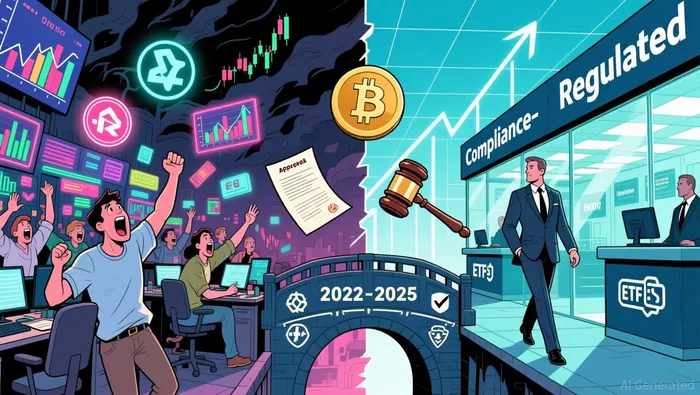
Regulatory clarity has also spurred innovation. The SEC's no-action letters, which clarified the legal status of crypto custody and token distributions, reduced uncertainty for market participants. Meanwhile, the EU's MiCA framework has attracted record inflows into crypto exchange-traded funds (ETFs), with global ETFs drawing $5.95 billion in a single week in October 2025. These developments reflect a broader trend: as regulators define boundaries, they also create safe harbors for innovation.
Compliance-Driven Exchanges: Capturing Market Share
The most compelling evidence of market maturation lies in the rise of compliance-driven exchanges. Platforms that prioritized Know-Your-Customer (KYC) and AML protocols-such as CoinbaseCOIN--, Kraken, and Consensys-have gained significant market share post-2023 enforcement actions. For example, Coinbase and Kraken received new licensing approvals under the U.S. GENIUS Act of July 2025, which established a federal framework for stablecoins and prohibited the Federal Reserve from developing a retail central bank digital currency (CBDC). These licenses not only legitimized their operations but also positioned them as gateways for institutional capital.
The data underscores this shift: 90% of centralized crypto exchanges in North America were fully KYC-compliant in 2025, up from 85% in 2024. This compliance has translated into trust. In Q2 2025, $6.7 billion in venture capital flowed into DeFi infrastructure and compliance-centered protocols, signaling investor confidence in the sector's long-term viability.
The Road Ahead: Balancing Innovation and Regulation
While enforcement actions have curtailed illicit activity, regulators are increasingly balancing oversight with innovation. The SEC's Cyber and Emerging Technologies Unit, established in 2025, is tasked with developing clear guidelines for emerging technologies like blockchain. Similarly, the DOJ's pivot from "regulation by prosecution" to targeting criminal misuse of crypto-such as terrorism financing-reflects a more nuanced approach.
For investors, the implications are clear. Compliance-driven exchanges and regulated products are no longer niche; they are the bedrock of a maturing market. As the U.S. and EU continue refining their frameworks, opportunities will arise for platforms that align with regulatory expectations. The rise of tokenized real-world assets and altcoin ETFs further illustrates how innovation and compliance can coexist.
Conclusion
The crypto market's journey from chaos to credibility has been paved by regulatory enforcement. While early crackdowns disrupted speculative excess, they also laid the groundwork for a more resilient, institutional-grade ecosystem. For investors, the lesson is straightforward: compliance is no longer optional-it is the key to long-term value. As the sector evolves, those who embrace regulatory alignment will not only survive but thrive in the next phase of crypto's growth.





Comentarios
Aún no hay comentarios