
Crypto-Enabled IBANs and the Future of Self-Custody Banking
The convergence of blockchain technology and traditional financial infrastructure has long been a holy grail for crypto enthusiasts. In 2025, Mt Pelerin's crypto IBAN emerged as a bold attempt to bridge this gap, offering users the ability to seamlessly integrate self-custodial crypto wallets with fiat banking systems. By enabling automatic conversion of bank transfers into cryptocurrencies and vice versa, the platform aimed to dissolve the friction between two worlds that have historically operated in silos. However, regulatory uncertainties and compliance complexities have cast a shadow over this innovation, raising critical questions about the future of self-custody banking and its alignment with evolving legal frameworks.
Mt Pelerin's Crypto IBAN: A New Frontier
Launched in December 2025, Mt Pelerin's personal crypto IBAN allows users to link self-custodial wallets-such as Ledger, Trezor, or MetaMask-to a euro- or Swiss franc-denominated IBAN. This integration enables users to receive and send traditional bank transfers that are automatically converted into cryptocurrencies, directly into their wallets. The service, available to individuals and organizations outside excluded jurisdictions like the U.S. and Russia, eliminates the need for intermediaries by allowing users to manage both fiat and crypto assets within a single interface. Notably, the IBAN itself incurs no direct costs, though conversion fees apply for currencies beyond euros and Swiss francs.
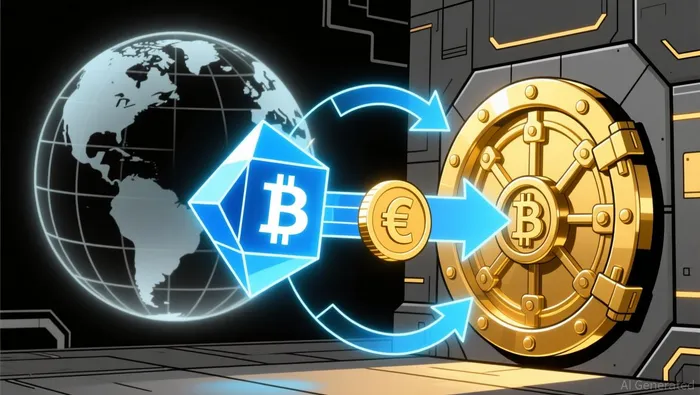
This innovation represents a significant leap toward financial autonomy. By linking self-custody with traditional banking, Mt Pelerin empowers users to transact with the fiat system without surrendering control of their crypto assets. For instance, a user could receive a euro payment from a traditional bank, have it instantly converted into BitcoinBTC--, and store it in a non-custodial wallet-all without relying on a centralized exchange. Such a model challenges the status quo, where crypto transactions often require users to navigate separate platforms for fiat and digital assets.
Regulatory Hurdles and the Project's Pause
Despite its promise, Mt Pelerin's crypto IBAN project was paused in 2025 due to regulatory uncertainties. The complexity of aligning such a service with compliance frameworks-particularly anti-money laundering (AML) and investor protection standards-proved insurmountable in the short term. The EU's Markets in Crypto-Assets Regulation (MiCAR), which distinguishes between stablecoins and other crypto-assets, imposes stringent requirements on service providers to ensure financial stability and market integrity. Similarly, the European Banking Authority (EBA) has emphasized the need for robust AML measures in the crypto space, especially for decentralized platforms.
The broader regulatory landscape further complicates matters. In 2025, 74% of cryptocurrency exchanges enhanced compliance protocols in response to stricter rules. AML non-compliance remains the top regulatory concern, with global enforcement penalties averaging $12 million. The U.S. alone saw $2.5 billion in penalties for crypto-related violations, including unregistered securities offerings. For Mt Pelerin, navigating these requirements while maintaining the decentralized ethos of self-custody likely proved untenable.
Comparative Landscape: Mt Pelerin vs. Bitstamp and Revolut
While Mt Pelerin's approach is unique in its focus on self-custody, other platforms like Bitstamp and Revolut have carved out their own niches in crypto-to-fiat integration. Revolut, for example, offers fee-free stablecoin transfers, allowing users to move between fiat and crypto without additional costs. Bitstamp, meanwhile, emphasizes low trading fees and a broad range of supported cryptocurrencies. However, neither platform fully replicates Mt Pelerin's model of linking self-custodial wallets to traditional banking systems.
The key distinction lies in control. Revolut and Bitstamp operate as custodial platforms, requiring users to entrust their assets to a third party. In contrast, Mt Pelerin's IBAN model preserves self-custody, aligning with the growing demand for non-custodial solutions. This is particularly relevant in 2025, where self-custody remains a protected and expanding area, supported by U.S. executive orders and the SEC's recent no-action letters regarding DePIN tokens.
Implications for the Future of Self-Custody Banking
The suspension of Mt Pelerin's crypto IBAN underscores the tension between innovation and regulation. Yet, it also highlights the enduring appeal of self-custody. As of 2025, regulatory frameworks are beginning to adapt to the realities of decentralized finance. The EU's MiCAR and the U.S.'s structured digital asset laws signal a shift toward pragmatic oversight, balancing innovation with risk mitigation. For instance, the SEC's no-action letters indicate a willingness to accommodate new models like DePIN tokens within existing legal boundaries.
Moreover, the rise of supervisory technology (SupTech) and blockchain forensics is enabling regulators to monitor transactions without stifling innovation. These tools could eventually provide the infrastructure needed to support services like Mt Pelerin's IBAN, ensuring compliance while preserving user autonomy.
Conclusion
Mt Pelerin's crypto IBAN represents both the potential and the perils of integrating blockchain with traditional finance. While regulatory challenges forced its suspension, the project's core idea-bridging self-custody with fiat banking-remains a compelling vision for the future. As regulatory frameworks evolve and SupTech matures, similar innovations may yet find their footing. For investors, the key takeaway is clear: the future of finance will be defined by platforms that can harmonize decentralization with compliance, and those that succeed will likely dominate the next era of financial infrastructure.






Comentarios
Aún no hay comentarios