
Why Is Crypto Down on December 9, 2025?
The cryptocurrency market's sharp decline on December 9, 2025, reflects a confluence of macroeconomic headwinds and regulatory pressures that have reshaped investor sentiment and asset valuations. BitcoinBTC-- (BTC) fell 1.1% to $90,480, while the broader market capitalization dropped 1.2% to $3.17 trillion, signaling a fragile equilibrium between optimism over central bank policy and lingering uncertainties about global regulatory frameworks according to market analysis. This analysis unpacks the interplay of interest rate expectations, evolving policy landscapes, and shifting risk appetites that defined the day's volatility.
Macroeconomic Headwinds: Fed Policy and Inflationary Pressures
The U.S. Federal Reserve's December 10 rate cut-lowering the federal funds rate to 3.50%-3.75%-was a pivotal event, but its impact on crypto markets was muted by pre-existing caution. While the cut marked the third consecutive reduction of 2025, traders had already priced in an 89% probability of the move, leaving limited upside for risk assets like Bitcoin. The Fed's dovish stance, however, contrasted with earlier hawkish signals in October, which had driven Bitcoin below $80,000 due to rising borrowing costs and reduced liquidity according to Reuters.
The broader macroeconomic context further complicated market dynamics. A cooling labor market, evidenced by weaker real personal spending and unexpectedly low jobless claims, left policymakers in a delicate balancing act between combating inflation and avoiding recessionary risks according to Gemini. Meanwhile, the U.S. Bureau of Labor Statistics' delayed release of December CPI data-scheduled for January 13-introduced uncertainty about future rate trajectories, amplifying crypto's sensitivity to macroeconomic news.
Regulatory Pressures: Clarity and Complexity in a Shifting Landscape
The 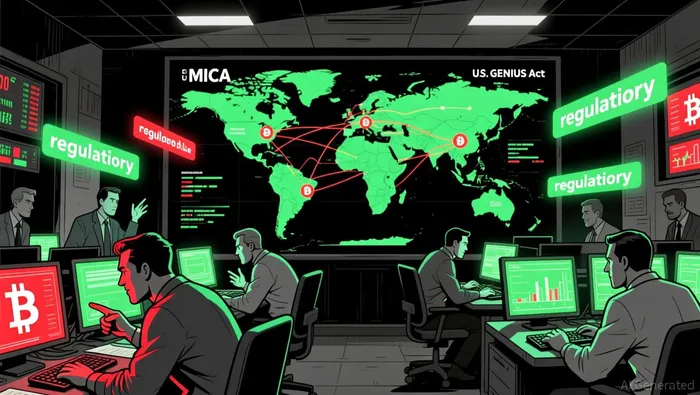 regulatory developments on December 9 added another layer of complexity. The Office of the Comptroller of the Currency (OCC) issued Interpretive Letter 1188, clarifying that national banks could engage in riskless principal crypto-asset transactions. While this move signaled a more technology-neutral approach to digital assets, it also underscored the fragmented nature of U.S. crypto regulation. The Trump administration's push for innovation-friendly frameworks, including the GENIUS Act, and international efforts like the EU's MiCA regime, created a patchwork of rules that institutions had to navigate.
Global coordination, such as the U.S.-UK Transatlantic Taskforce for Markets of the Future, highlighted the growing importance of harmonized standards. Yet, these efforts also introduced compliance costs and operational hurdles for market participants, particularly smaller players unprepared for stringent licensing and reserve requirements according to JDSupra. The result was a market caught between the promise of regulatory clarity and the reality of evolving obligations.
Market Sentiment and Correlation with Equities
Bitcoin's price action on December 9 also reflected its deepening correlation with traditional equities, particularly tech-heavy indices like the Nasdaq 100. This relationship, which intensified in 2025 due to institutional adoption and AI-driven investment flows, made crypto more susceptible to macroeconomic trends. For instance, concerns over overvalued AI stocks and potential Fed intervention weighed on risk appetite, dragging Bitcoin lower alongside equities.
The CMC Fear & Greed Index, which remained in "fear" territory, further illustrated the market's fragility. Despite institutional buying-such as Strategy's $962.7 million BTC purchase-retail participation waned, reducing liquidity and amplifying volatility. Traders fixated on the $91,000 resistance level as a critical inflection point, with outcomes hinging on the Fed's post-meeting guidance according to market analysis.
Conclusion: Navigating Uncertainty in a Transformed Market
The December 9 price drop underscores the crypto market's transformation into a barometer for macroeconomic and regulatory shifts. While the Fed's dovish pivot and regulatory clarity provided some tailwinds, these were offset by inflationary pressures, geopolitical uncertainties, and the asset's growing entanglement with traditional markets. For investors, the path forward hinges on monitoring two key variables: the pace of Fed rate cuts in 2026 and the implementation of global regulatory frameworks.
As Chair Jerome Powell emphasized, a "wait and see" approach remains prudent according to market analysis. For now, the market's resilience-evidenced by on-chain activity and institutional demand-suggests that crypto's long-term trajectory may yet outpace short-term turbulence. However, the December 9 selloff serves as a stark reminder that in 2025, digital assets are no longer a niche corner of finance but a mirror reflecting the broader economy's triumphs and trials.







Comentarios
Aún no hay comentarios