
Crypto Custody Compliance and Investment Risk Mitigation in 2026
The U.S. Securities and Exchange Commission's (SEC) 2025 guidance on broker-dealer custody of crypto asset securities has emerged as a pivotal catalyst for institutional adoption in 2026. By clarifying how firms can satisfy the "physical possession" requirement under Rule 15c3-3 of the Securities Exchange Act of 1934, the SEC has not only addressed a critical regulatory ambiguity but also laid the groundwork for a more robust and trustworthy crypto market infrastructure. This shift is reshaping how institutional investors approach digital assets, balancing innovation with compliance while mitigating systemic risks.
SEC Guidance: A Framework for Trust
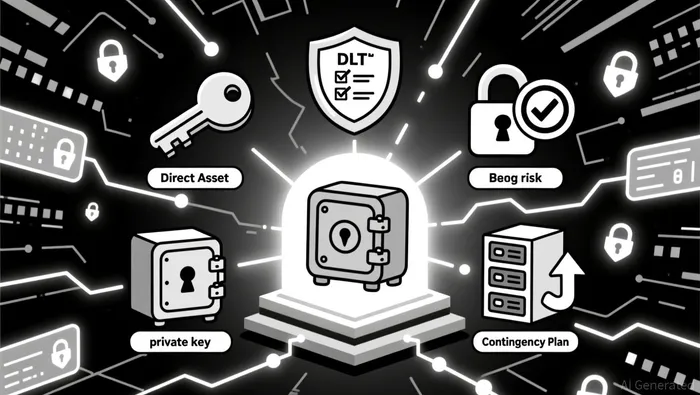
The SEC's December 2025 guidance outlines five key conditions for broker-dealers to demonstrate "physical possession" of crypto assets: direct access to assets and transfer capabilities on distributed ledger technology (DLT), written policies to assess DLT risks, avoidance of custody if material security flaws exist, robust private key protection, and contingency plans for blockchain disruptions like 51% attacks or insolvency according to the guidance. These requirements move beyond the earlier FAQ addressing the "control" prong of the Customer Protection Rule, creating a non-objection path for broader broker-dealer participation in crypto custody as detailed in Sidley's analysis.
This framework is particularly significant for non-special-purpose broker-dealers, which now have a clearer regulatory pathway to custody crypto asset securities. By emphasizing operational rigor-such as private key governance and network risk assessments-the SEC has signaled its intent to integrate crypto into traditional financial systems without compromising investor protection according to compliance risk analysis. This clarity has reduced enforcement risks for firms experimenting with tokenized assets and custody solutions, as evidenced by the SEC's no-action letters for projects like the Depository Trust Company's (DTC) tokenization pilot reported by legal trackers.
Institutional Adoption: A New Era of Confidence
The SEC's guidance has directly fueled institutional adoption in 2026. According to a report by B2Broker, 76% of global institutional investors plan to expand their digital asset exposure, with nearly 60% allocating over 5% of their assets under management (AUM) to crypto according to B2Broker data. This surge is driven by the approval of spot BitcoinBTC-- and EthereumETH-- exchange-traded funds (ETFs), which have attracted over $115 billion in combined assets as of 2025 according to B2Broker analysis. These vehicles provide regulated, transparent access to crypto markets, aligning with the SEC's emphasis on applying existing securities laws to digital assets as noted in compliance risk insights.
Moreover, the SEC's differentiation between asset types-such as digital commodities, collectibles, and tokenized securities-has clarified regulatory boundaries. For instance, only tokenized securities fall under SEC jurisdiction, reducing compliance burdens for firms handling non-security assets. This distinction has enabled institutional investors to allocate capital with greater precision, leveraging crypto's role as a hedge against fiat currency debasement and a vehicle for tokenized real-world assets according to SSGA insights.
Risk Mitigation: From Cold Storage to Compliance
Institutional crypto custody in 2026 is characterized by advanced risk mitigation strategies, many of which align with the SEC's guidance. Qualified custodians now offer cold storage, insurance, and third-party audits, mirroring the security standards of traditional asset classes according to B2Broker analysis. The SEC's permitting of state-chartered trusts for crypto custody has further expanded institutional options, removing prior barriers for venture capital firms and registered investment advisers as reported by legal trackers.
Operational compliance has also evolved. Broker-dealers are embedding crypto custody into core infrastructure, with written policies addressing access controls, transfer capabilities, and continuity planning according to compliance risk analysis. For example, contingency plans for blockchain malfunctions or 51% attacks are now standard, reflecting the SEC's emphasis on robust incident response protocols as detailed in compliance analysis. Additionally, board-level oversight of digital asset activities has become a norm, ensuring disciplined governance across compliance, IT, and operations according to compliance risk reports.
The Road Ahead: Regulatory Alignment and Market Legitimacy
Looking ahead, the institutional crypto custody landscape will benefit from continued regulatory alignment. In the U.S., initiatives like the SEC's "Project Crypto" and the pending GENIUS Act aim to resolve lingering ambiguities, while Europe's Markets in Crypto-Assets (MiCA) framework provides structured standards for stablecoins and tokenized assets according to B2Broker analysis. These developments are expected to further legitimize crypto as a core component of institutional portfolios, enhancing trust in the underlying infrastructure.
However, challenges remain. The SEC's guidance does not fully address financial responsibility rules or audit requirements, leaving firms to navigate evolving expectations as noted in Sidley's analysis. Additionally, the tokenization of real-world assets and on-chain settlement mechanisms will require ongoing regulatory scrutiny to ensure compliance with investor protection principles according to B2Broker insights.
Conclusion
The SEC's 2025 guidance has redefined the institutional crypto custody landscape in 2026, fostering trust through clarity and operational rigor. As firms adopt advanced risk mitigation strategies and leverage regulated investment vehicles, crypto is transitioning from a speculative asset to a mainstream component of institutional portfolios. While regulatory gaps persist, the alignment of global frameworks and the SEC's innovation-friendly stance suggest a future where crypto custody is as secure and transparent as traditional asset classes. For investors, this evolution represents not just a shift in compliance but a fundamental reimagining of trust in digital markets.







Comentarios
Aún no hay comentarios