
How the Recent Crypto Crash and Eased US-China Tensions Are Reshaping Global Tech and Capital Flows
The global investment landscape in 2025 is being reshaped by two seismic forces: the collapse of the crypto market and the normalization of U.S.-China trade relations. These developments are driving a strategic reallocation of capital toward emerging markets and tech-driven equities, as investors seek resilience, utility, and long-term growth. This analysis explores how these shifts are creating actionable opportunities in sectors like AI, semiconductors, and blockchain, while emerging markets position themselves as beneficiaries of geopolitical and technological realignment.
The 2025 Crypto Crash: A Catalyst for Capital Reallocation
The crypto market's 2025 crash, triggered by a confluence of macroeconomic pressures, geopolitical tensions, and liquidity crises, has forced a reevaluation of risk and reward in digital assets. A 100% tariff on Chinese imports by the U.S. Trump administration exacerbated trade tensions, triggering a 12% drop in BitcoinBTC-- and a 30% plunge in altcoins within days, according to an Upstanding Hackers analysis. Over $1.65 billion in leveraged positions were liquidated in 24 hours, exposing systemic weaknesses in the crypto ecosystem, as shown in a TechAnnouncer analysis.
In response, investors have shifted capital toward safer assets. Bitcoin, while no longer a short-term hedge, has retained its role as a long-term store of value, with family offices increasing cold-storage holdings, according to a Gov.Capital report. Meanwhile, institutional capital is flowing into tokenized real-world assets (RWAs), such as Ethereum-based stablecoins and tokenized real estate, which offer liquidity and transparency, per a CryptoRobotics analysis. The crash has also accelerated interest in blockchain infrastructure, with companies like Fireblocks and Securitize gaining traction by providing secure, utility-driven solutions, as detailed in a PitchBook report.
Eased U.S.-China Tensions and Emerging Market Capital Flows
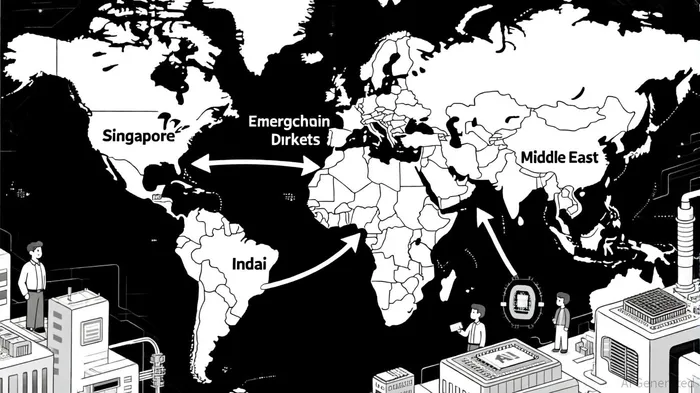
The easing of U.S.-China trade tensions in 2025 has created a ripple effect across global capital flows. The temporary pause on Chinese retaliatory tariffs and the reduction of U.S. export restrictions on semiconductors have reduced geopolitical uncertainty, encouraging foreign direct investment (FDI) into emerging markets, according to a Triodos IM article. Countries like India, Singapore, and the United Arab Emirates are attracting capital due to their strategic positioning in global trade and policy reforms, as the World Economic Forum explains.
For example, India's manufacturing sector has seen a surge in investment as companies diversify supply chains away from China. The country's focus on AI-driven infrastructure and semiconductor manufacturing aligns with global demand for high-performance computing, as noted in a Goldman Sachs note. Similarly, Taiwan and South Korea are benefiting from renewed interest in AI-driven semiconductors, with capital expenditures in the sector projected to reach $185 billion in 2025, according to an Infosys outlook.
The U.S. dollar's strength has also played a role in shaping capital flows. A weaker dollar in Q3 2025 made it easier for emerging markets to service dollar-denominated debt, contributing to a 20%+ return in markets like Egypt, Peru, and South Africa, a Schroders review found. This trend is expected to continue as U.S.-China trade negotiations progress, with the MSCI Emerging Markets index outperforming global benchmarks, according to a Finestel report.
Strategic Reallocation Opportunities in Tech-Driven Equities
The normalization of U.S.-China relations and the post-crypto crash environment are converging to create opportunities in tech-driven equities. Hyperscalers like Amazon, Google, and MicrosoftMSFT-- are investing over $250 billion in AI infrastructure, signaling confidence in long-term returns, as a Goldman Sachs analysis shows. Software and IT services firms with access to proprietary data are also gaining traction, as they partner with AI model providers for secure training datasets, according to a State Street note.
Semiconductors remain a critical sector, with demand for AI-specific chips driving growth. Companies like NVIDIANVDA-- are dominating the market, offering end-to-end AI solutions for cloud services and enterprises, as reported in a Forbes article. Meanwhile, startups like Nanotronics and Positron are redefining chip design and manufacturing, leveraging modular AI-powered facilities and specialized processors for AI inference, as highlighted in the Forbes Fintech 50.
Defensive sectors are also attracting attention. High-dividend stocks in telecommunications and cybersecurity are seen as resilient against geopolitical volatility, with companies like China Mobile and AT&T benefiting from sustained demand, a Baiguan piece suggests.
Emerging Market Tech Companies Capitalizing on the Shift
Emerging market tech firms are leveraging the post-crypto crash environment and eased U.S.-China tensions to attract investment. For instance, Dell Technologies and Lenovo are poised to benefit from reduced tariffs on Chinese-manufactured goods, which lower production costs and stabilize supply chains, as noted in a Morningstar piece.
Blockchain and AI integration is another area of growth. The blockchain x AI market is projected to grow from $448.5M in 2023 to $3.4B by 2032, with companies like Fetch AI and Ocean Protocol leading the charge in decentralized machine learning and data marketplaces, according to a 51AI list. Startups in this space are also gaining traction by addressing AI bottlenecks, such as compute access and data ownership, as described in an Analytics Insight article.
In the semiconductor sector, non-China emerging markets are expanding manufacturing capacity. The industry's projected $697 billion valuation in 2025 is driven by demand for AI chips and advanced packaging technologies, according to a Fidelity outlook. Investors are prioritizing firms that leverage government incentives, such as the U.S. CHIPS Act, to strengthen supply chains, as covered in a Deloitte report.
Conclusion: Navigating the New Investment Landscape
The 2025 crypto crash and U.S.-China trade normalization are reshaping global capital flows, creating opportunities in emerging markets and tech-driven equities. Investors must adopt a diversified strategy that balances high-growth sectors like AI and semiconductors with defensive assets in telecommunications and cybersecurity. Emerging markets, particularly those with strong fundamentals and policy clarity, offer a compelling case for long-term capital reallocation.







Comentarios
Aún no hay comentarios