
U.S. Crypto Bill Delayed to 2026, Weighing on Market Clarity
The U.S. Senate has officially delayed the Crypto Market Structure Bill to early 2026, pushing back hopes of passing comprehensive federal crypto legislation before the end of the year. Lawmakers cited limited legislative time, budget deadlines, and internal negotiations as key reasons for the postponement according to reports. The delay extends regulatory uncertainty for crypto exchanges, token issuers, and financial institutions operating in the U.S.
Industry leaders had been cautiously optimistic about the bill's prospects after the House passed its version of the CLARITY Act in July according to reports. However, Senate Banking Committee Chair Tim Scott confirmed that no markup hearing would occur in 2025, effectively shifting the timeline to the new year. 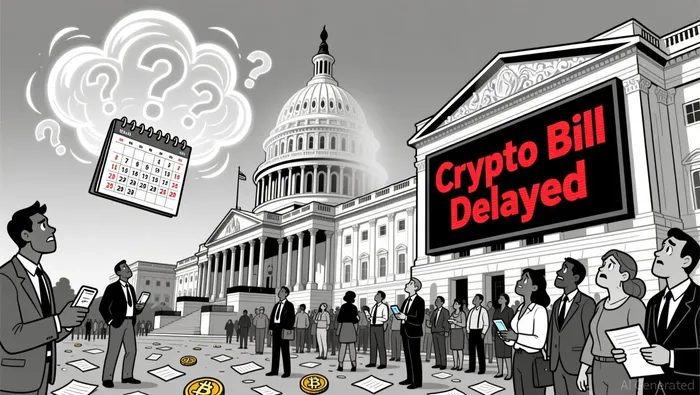 The bill aims to define oversight between the SEC and CFTC while setting clearer rules for digital asset markets.
The decision reflects broader procedural challenges. With Congress now focused on avoiding a government shutdown and preparing for the 2026 midterms, crypto legislation has taken a back seat. Analysts warn that the delay could complicate negotiations, especially as political dynamics shift and lobbying efforts intensify on both sides of the industry debate according to reports.
Why the Standoff Happened
The Senate's schedule has played a major role in the delay. The Banking Committee reached the end of its 2025 workable calendar without finalizing key provisions. Earlier, Scott had aimed for a December vote but acknowledged that negotiations had not advanced enough to meet the goal according to reports. Meanwhile, bipartisan discussions have continued, but progress remains incomplete.
Partisan dynamics also contribute to the delay. Senate Democrats are reportedly extending negotiations to balance their relationships with both crypto advocates and traditional banking interests according to reports. This strategy allows them to avoid alienating influential financial institutions while appearing to engage with the industry. However, experts warn that prolonged negotiations risk pushing the bill beyond the 2026 midterms, where political priorities are likely to shift further.
How Markets Reacted
Crypto markets have shown mixed reactions to the news. While some analysts say the delay was expected and did not cause immediate volatility, others warn of long-term implications according to reports. Regulatory uncertainty continues to deter institutional investment and innovation, with some firms already shifting operations to jurisdictions with clearer crypto rules.
The delay also impacts smaller projects. Without a clear regulatory framework, many are considering moving token listings or development efforts to countries with defined crypto laws, such as the European Union according to reports. Larger financial institutions are reportedly pausing new U.S. crypto product launches until clarity emerges in early 2026 according to reports.
What Analysts Are Watching
Experts are closely monitoring how the bill's structure will evolve in 2026. Key disputes include DeFi regulation, stablecoin oversight, and ethics rules involving political figures according to reports. Traditional finance players are pushing for stricter controls on DeFi platforms, while the industry seeks exemptions to preserve innovation according to reports. These tensions highlight the broader challenge of balancing regulation with technological growth.
Prediction markets offer a cautiously optimistic outlook. Platforms like Kalshi indicate a 77% chance of the bill passing before 2027, though experts caution that this does not account for potential political shifts according to reports. Analysts suggest that the bill's success will depend on compromise between DeFi advocates and traditional finance, as well as the banking sector's influence during the 2026 election cycle according to reports.
Risks to the Outlook
The 2026 midterms pose a significant risk to the bill's passage. Senate Democrats may face pressure from both banking and crypto lobbies, which are expected to intensify their spending on political campaigns according to reports. The banking sector, for instance, is reportedly allocating $100 million to support pro-regulation candidates according to reports. This spending could shift the political landscape and affect the bill's chances.
Another risk is the potential for regulatory arbitrage. Without clear U.S. rules, more crypto activity may move to jurisdictions with established frameworks, such as the UK or EU according to reports. The UK's Financial Conduct Authority (FCA) has already launched its own consultation on crypto rules, aiming to finalize them by 2027 according to reports. This creates a competitive environment for U.S. regulators and lawmakers.
What This Means for Investors
For investors, the delay means continued uncertainty and caution. Crypto firms are likely to rely on state-level regulations and existing enforcement precedents until federal clarity emerges according to reports. This patchwork system increases compliance risks and limits the ability to scale operations.
Institutional investors are also watching closely. Many are hesitant to commit large sums without a clear regulatory framework, especially as the industry faces higher scrutiny from both regulators and investors. This caution is likely to persist until early 2026, when the Senate Banking Committee is expected to revisit the bill according to reports.
The bill's outcome will shape the future of the U.S. crypto market. A favorable outcome could position the U.S. as a global leader in digital finance, while delays or unfavorable provisions may push innovation elsewhere. As negotiations continue, industry stakeholders are advised to stay engaged and prepared for potential shifts in the political and regulatory landscape.







Comentarios
Aún no hay comentarios