
Crypto Assets with High Growth Potential in Late 2025: Institutional Adoption and Market Positioning
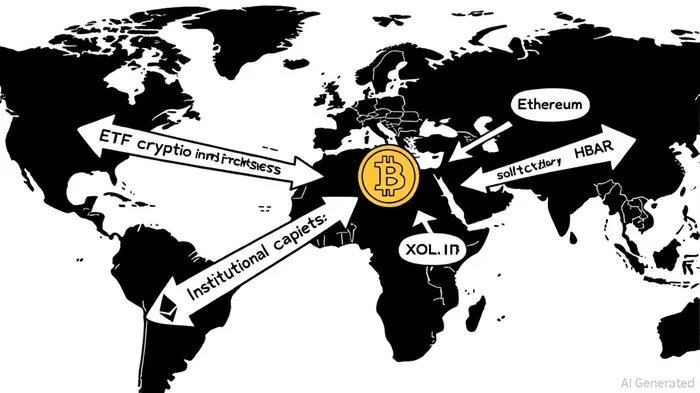
The crypto market in late 2025 is undergoing a seismic shift, driven by institutional adoption that is reshaping asset allocation, regulatory frameworks, and technological innovation. With the approval of spot BitcoinBTC-- ETFs and the emergence of thematic crypto funds, traditional financial institutionsFISI-- are no longer on the sidelines. This article analyzes the most compelling crypto assets positioned for growth in late 2025, focusing on their institutional adoption drivers, market positioning, and performance metrics.
The Institutionalization of Crypto: A New Paradigm
Institutional adoption has accelerated due to three key factors: regulatory clarity, product innovation, and macroeconomic tailwinds. The U.S. Securities and Exchange Commission (SEC)'s streamlined approval process for crypto ETFs has normalized digital assets as a core institutional asset class. By mid-2025, U.S.-listed Bitcoin ETFs alone have amassed over $179.5 billion in assets under management, with BlackRockBLK-- and Fidelity leading the charge [1]. These ETFs have created liquid, regulated markets aligned with traditional trading hours, reducing friction for institutional entry [2].
Regulatory frameworks like the EU's Markets in Crypto-Assets (MiCA) have further legitimized crypto as a mainstream asset, enabling cross-border participation. Meanwhile, macroeconomic factors—such as inflation hedging and portfolio diversification—have pushed corporate treasuries (e.g., MicroStrategy, Trump Media) to allocate Bitcoin as a strategic reserve asset [3].
Beyond Bitcoin: EthereumETH-- and Altcoins in the Institutional Spotlight
While Bitcoin remains the cornerstone of institutional portfolios, Ethereum and altcoins are gaining traction. Nearly half of institutional asset managers are now researching or planning Ethereum allocations, driven by its role in DeFi and smart contract innovation [1]. Thematic ETFs, such as Web3 Infrastructure or DeFi Index funds, are enabling nuanced exposure to these ecosystems [3].
Ripple (XRP): The Cross-Border Payment Powerhouse
XRP is the most institutional-ready altcoin in 2025, with a 83% approval probability for a U.S. spot ETF [4]. Brazil's approval of its first XRPXRP-- ETF in March 2025 has set a precedent, and WisdomTree's ETF filing is under SEC review [4]. XRP's utility in cross-border payments—processing 2.14 million daily transactions and serving 300+ financial institutions—makes it a critical infrastructure asset [5]. Analysts project $4 billion in ETF inflows could push XRP's market cap to $800 billion, with a price target of $15 (a 597% gain from $2.13) [5].
Solana (SOL): High-Throughput DeFi and NFTs
Solana's institutional appeal lies in its 65,000 TPS capacity and low fees, making it a backbone for DeFi and NFT platforms. Despite bearish technical indicators (e.g., RSI at 45.52), institutional interest remains strong, with major asset managers building products on the chain [6]. However, SOLSOL-- faces volatility risks, and its price range of $196–$215 reflects mixed sentiment [6].
Cardano (ADA): Governance and U.S. Government Partnerships
Cardano's recent network upgrade has enhanced its governance system, positioning it as one of the most decentralized smart contract platforms. Institutional interest is bolstered by a proposed U.S. government collaboration and a 70% ETF approval probability [7]. ADA's slower adoption compared to XRP and SOL is offset by its long-term infrastructure focus [7].
Hedera (HBAR): Enterprise Adoption and Regulatory Clarity
HBAR's hashgraph consensus algorithm (10,000 TPS, $0.001/transaction) and governance by a council of global enterprises (Google, IBM) make it a unique institutional play. Nasdaq's spot HBARHBAR-- ETF filing and Grayscale's approval reinforce its credibility [8]. HBAR's low fees and enterprise partnerships (e.g., tokenization initiatives) position it for steady adoption [8].
Mutuum Finance (MUTM): DeFi's Whale-Backed Innovator
Mutuum Finance's decentralized lending model has attracted whale investors, with its presale raising $6.9 million and a projected post-launch price of $2.50 [9]. Smart contract audits by Certik and a growing token holder base further solidify its institutional appeal [9].
The U.S. National Crypto Reserve: A Game Changer?
The U.S. government's proposed National Crypto Reserve, including altcoins like XRP, SOL, and ADAADA--, could catalyze institutional adoption. While JPMorganJPM-- has expressed skepticism about volatility risks, the reserve aims to diversify the U.S. digital asset portfolio and legitimize altcoins as strategic assets [10].
Data Visualization: ETF Approval Odds and Institutional Metrics
Conclusion: Navigating the 2025 Crypto Landscape
The late 2025 crypto market is defined by institutional adoption that transcends speculative trading. Assets like XRP, HBAR, and MUTM are not just benefiting from ETF speculation but are being integrated into global financial infrastructure. While risks like regulatory shifts and volatility persist, the alignment of technological utility, regulatory progress, and macroeconomic demand creates a compelling case for these assets. Investors should prioritize projects with clear institutional partnerships, real-world use cases, and regulatory momentum.







Comentarios
Aún no hay comentarios