
Crypto Adoption in Europe and Search-Driven Investor Behavior: A Shift Toward Quality Content and Regulated Platforms
The European crypto market in 2025 is undergoing a profound transformation, driven by regulatory clarity under the Markets in Crypto-Assets (MiCA) framework and a surge in user adoption. As ownership rates double since 2022 and EUR-denominated stablecoins dominate transaction volumes, the interplay between search-driven behavior and regulatory alignment is reshaping the landscape. This analysis explores how rising European crypto ownership, coupled with a 46% reliance on search engines for platform discovery, signals a critical shift toward quality content and regulated infrastructure-offering actionable insights for investors and content creators navigating this evolving ecosystem.
MiCA and the Rise of Trust in a Regulated Ecosystem
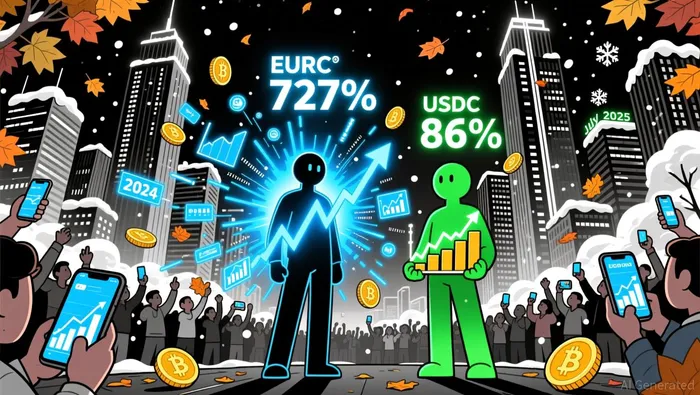
The implementation of MiCA in 2025 has been a cornerstone in legitimizing crypto assets across the European Economic Area (EEA). By mandating 100% reserve backing for stablecoins and imposing strict anti-money laundering (AML) and know-your-customer (KYC) requirements, the regulation has fostered institutional trust and consumer confidence. For instance, EURC-a euro-pegged stablecoin- experienced a staggering 2,727% growth in transaction volume between July 2024 and June 2025, far outpacing USDC's 86% growth during the same period. This shift reflects not only regulatory alignment but also a broader geopolitical pivot toward euro-centric financial instruments.
However, MiCA's benefits come with trade-offs. Compliance costs for crypto service providers have risen sixfold, from ~€10K to €60K, leading to a 70% decline in EU crypto venture capital funding since 2022. Only 12 Crypto-Asset Service Providers (CASPs) and 10 E-money Token issuers were licensed by mid-2025, signaling a consolidation of the market toward larger, well-capitalized players. While this reduces fragmentation, it also raises concerns about innovation stifling-a challenge regulators must balance against the need for stability.
Search-Driven Behavior: The New Gateway to Crypto Discovery
Search engines have emerged as the dominant channel for European crypto users seeking platforms and information. According to a Q3 2025 report, 46% of European crypto users rely on search engines for platform discovery, a figure that underscores the decline of traditional methods like social media amid regulatory crackdowns. This trend is amplified by MiCA's enforcement of clearer disclaimers and compliance measures, which have reduced traffic for crypto-native media outlets by 82% in early 2025.
The demand for quality content has surged in tandem with regulatory complexity. For example, Finland and Italy saw a 400% and 313.3% increase in search activity related to stablecoins, respectively, as users sought to understand MiCA-compliant assets. This surge is not merely informational but transactional: 64% of European crypto holders use digital assets as investments, with institutional participation in NFT markets growing to 15% of revenue. The result is a market where content must not only educate but also align with regulatory expectations, creating opportunities for platforms that prioritize compliance and transparency.
Stablecoins and the EURCEURC-- Dominance
The rise of EURC exemplifies how MiCA has reshaped the stablecoin landscape. By restricting non-compliant tokens and promoting euro-pegged alternatives, the regulation has accelerated the adoption of EURC, which now dominates cross-border transactions and DeFi lending in the EEA. This shift is further reinforced by geopolitical factors, including U.S. tariff policy changes and the decline of USDT's dominance. For investors, EURC's growth highlights the importance of aligning with region-specific stablecoins that benefit from regulatory tailwinds.
Actionable Insights for Content Creators and Investors
- Content Creators: Prioritize MiCA-compliant educational resources. With 65%+ of EU crypto businesses achieving compliance by December 2024, content must address AML/KYC requirements, stablecoin mechanics, and institutional-grade use cases. Platforms that integrate jurisdictional labeling and transparent disclaimers will retain traffic amid regulatory scrutiny.
- Investors: Focus on EUR-denominated stablecoins and regulated infrastructure. EURC's 2,727% growth and the EEA's 65% increase in DeFi bridge transactions indicate strong demand for compliant, utility-driven assets. Additionally, institutional-grade BitcoinBTC-- (BTC) products-bolstered by U.S. spot ETF approvals-present opportunities in markets with mature regulatory frameworks.
- Platform Operators: Optimize for search-driven discovery. Given the 46% reliance on search engines, SEO strategies must emphasize keywords like "MiCA-compliant stablecoins" and "regulated crypto exchanges" to capture high-intent users.
Conclusion
Europe's crypto market in 2025 is defined by a duality: regulatory rigor under MiCA and the democratization of access through search-driven discovery. As ownership rates climb and EURC solidifies its dominance, the demand for quality content and compliant platforms will only intensify. For investors and content creators, the path forward lies in aligning with these twin forces-leveraging regulatory clarity to build trust and harnessing search behavior to drive adoption. The result is a market where innovation and compliance coexist, offering long-term value for those who navigate it strategically.






Comentarios
Aún no hay comentarios