
Cryogenic Fueling in Space: Unlocking NewSpace Growth Through Orbital Refueling Innovations
The LOXSAT Mission: A Catalyst for Cryogenic Innovation
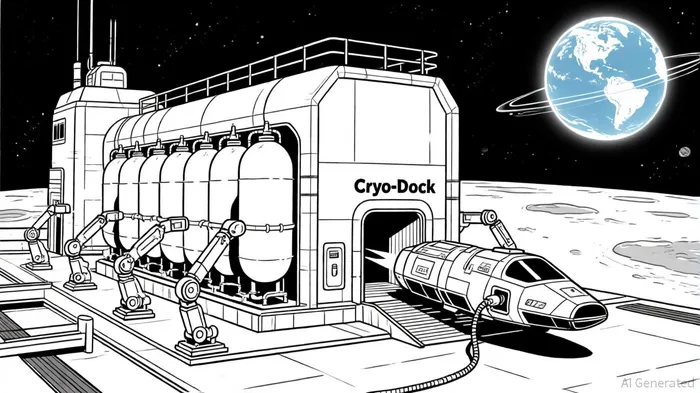
Rocket Lab, in partnership with Eta Space and NASA, is developing the LOXSAT mission to demonstrate zero-loss storage of liquid oxygen (LOX) in orbit. This technology is critical for overcoming the challenge of cryogenic boil-off, a persistent issue that has historically limited the viability of long-term propellant storage in space. By testing cryogenic pressure control and fluid transfer mechanisms, LOXSAT aims to validate the feasibility of Cryo-Dock, a full-scale cryogenic propellant depot in LEO slated for operational deployment by 2030, according to a GlobeNewswire release.
The mission leverages Rocket Lab's Photon spacecraft platform, which has already proven its reliability in missions like CAPSTONE. LOXSAT will remain in orbit for nine months, gathering data essential for designing future depots that could refuel spacecraft stages, transfer vehicles, and even satellites, extending their operational lifespans and reducing mission costs, as described on Eta Space's LOXSAT page. Eta Space, founded by former NASA engineers, has demonstrated ground-based success with its cryogenic storage systems, achieving zero losses over 18 months of testing-a breakthrough that underscores the potential for scalable in-orbit applications, as reported in a Cold Facts article.
Market Dynamics: A Booming Orbital Refueling Sector
Intel Market Research projects the global orbital spacecraft refueling market is expected to grow from $725 million in 2025 to $1.976 billion by 2032, reflecting a compound annual growth rate (CAGR) of 18.2% (Intel Market Research). Similarly, Strategic Market Research forecasts the space in-orbit refueling market to reach $1.12 billion by 2030, driven by the proliferation of mega-constellations and the need for sustainable satellite operations.
These figures highlight a growing demand for technologies that reduce the cost of deep-space missions. For instance, orbital refueling could cut the fuel mass required for interplanetary travel by enabling spacecraft to launch with lighter payloads and refuel in orbit. This aligns with broader industry trends, as companies like Orbit Fab and Northrop Grumman have already demonstrated early-stage commercial viability in the sector, as noted by Satellite Today.
Strategic Implications for NewSpace Investors
Rocket Lab's role in the LOXSAT mission positions it as a key player in the cryogenic fueling ecosystem. By leveraging its Electron launch vehicle and Photon platform, the company is not only advancing its own capabilities but also contributing to a foundational infrastructure that could benefit the entire sector. Eta Space's expertise in cryogenic fluid management further strengthens this partnership, with its technology poised to address a critical bottleneck in space logistics.
For investors, the collaboration signals a maturing NewSpace sector where private-public partnerships are accelerating technological adoption. The success of LOXSAT could catalyze follow-on investments in cryogenic depots, satellite servicing, and interplanetary infrastructure, creating a ripple effect across the supply chain. Additionally, Eta Space's expansion into terrestrial applications-such as hydrogen storage for energy and defense-adds another layer of diversification to its value proposition, as covered by Gasworld.
Conclusion: A High-Stakes Bet on the Future of Space
The development of cryogenic fueling technology is not merely a technical milestone but a strategic enabler for the next phase of space exploration. As Rocket LabRKLB--, Eta Space, and NASA push the boundaries of orbital refueling, they are laying the groundwork for a future where space missions are no longer constrained by launch mass limitations. For investors, this represents a high-conviction opportunity to capitalize on a sector that is rapidly transitioning from experimental to operational.
The coming years will test the resilience of these technologies, but the potential rewards-measured in both market growth and humanity's reach into the cosmos-are immense. As the NewSpace sector continues to evolve, those who invest in cryogenic innovation today may well find themselves at the forefront of a new era in space exploration.





Comentarios
Aún no hay comentarios