
Crusoe's Strategic Leadership Shift and Implications for AI Infrastructure Scaling
The AI infrastructure market is undergoing a seismic shift, driven by the exponential demand for compute power and the urgent need for sustainable solutions. At the forefront of this transformation is Crusoe Energy, a vertically integrated provider leveraging stranded energy and renewable resources to power its AI data centers. Recent leadership changes and strategic expansions in 2023 have positioned Crusoe to capitalize on this growth, but the long-term viability of its model hinges on its ability to navigate capital intensity, supply chain constraints, and competition from legacy cloud providers.
Strategic Leadership and Operational Expansion
Crusoe's 2023 leadership reshuffle, including the appointment of a new COO and CFO, underscores its commitment to scaling AI infrastructure while maintaining operational discipline according to recent reports. These moves align with the company's broader strategy to accelerate deployment of its Crusoe Cloud platform, a GPU-as-a-Service offering powered by Digital Flare Mitigation (DFM™) technology and 100% renewable energy. By repurposing flared gas from oil fields and underutilized renewables, Crusoe has reduced its carbon footprint while achieving cost advantages over traditional data center operators. In 2023 alone, the company prevented 5.4 billion cubic feet of natural gas from being flared and avoided 680,000 metric tons of greenhouse gas emissions.
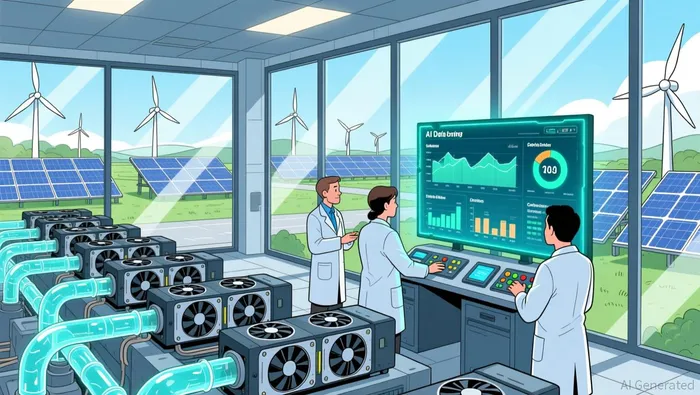
The company's vertically integrated approach-bringing energy sourcing, hardware, and software in-house-has enabled rapid deployment of AI infrastructure. For instance, Crusoe's 1.2 gigawatt Lancium Clean Campus in Texas, featuring direct-to-chip liquid cooling and a Power Usage Effectiveness (PUE) of 1.2–1.3, exemplifies its ability to build high-density GPU clusters at scale. Such projects are critical as global AI infrastructure demand is projected to require $5.2 trillion in data center investment by 2030 to meet 156 gigawatts of AI-specific capacity.
Vertical Integration and Market Positioning
Crusoe's energy-first model differentiates it in a market dominated by legacy cloud providers like AWS and Azure, which face bottlenecks from aging power grids and lengthy construction timelines. By vertically integrating its value chain, Crusoe controls costs and ensures reliability, a critical factor for AI workloads that demand consistent high-performance computing. For example, Crusoe Cloud's use of DFM™ technology for one-third of its energy needs, combined with renewable sources for the remaining two-thirds, offers a sustainable and scalable solution.
The company's strategic partnerships further bolster its market position. Collaborations with AMD to integrate AI cloud solutions powered by Instinct GPUs and potential ties with Oracle and Google highlight Crusoe's ability to attract industry leaders. Additionally, its expansion into Europe with a Norway-based data center and plans for geothermal-powered infrastructure in Iceland underscore its global ambitions.
Long-Term Viability and Risks
Despite its strengths, Crusoe faces significant challenges. The capital intensity of hyperscale data center construction-requiring upfront investments in energy infrastructure, GPUs, and cooling systems-poses a risk, particularly as AI GPU supply chains remain constrained. Moreover, regulatory shifts in energy markets or fluctuations in flared gas availability could disrupt its cost advantages.
However, Crusoe's focus on sustainability aligns with investor and client demand for low-carbon solutions. Its 2023 Impact Report, which detailed 635,000 MWh of electricity generated from stranded energy, reinforces its ESG credentials. Analysts project that Crusoe's model could capture a meaningful share of the $100 billion AI infrastructure market by 2030, driven by its ability to deploy data centers 50% faster than traditional providers.
Investment Outlook
For investors, Crusoe represents a high-conviction bet on the convergence of AI and clean energy. Its leadership changes and strategic expansions in 2023 have strengthened its operational foundation, while its vertically integrated model addresses a critical gap in the AI infrastructure ecosystem. However, success will depend on its ability to secure long-term energy contracts, navigate supply chain bottlenecks, and maintain cost discipline.
The company's recent $600 million Series D funding round, valuing it at $2.8 billion, signals confidence from institutional investors like Founders Fund and NVIDIA. Yet, as the AI infrastructure race intensifies, Crusoe must continue innovating to outpace competitors and deliver on its promise of sustainable, scalable compute power.





Comentarios
Aún no hay comentarios