
U.S. Crude Oil's Contrarian Rebound Play: Bearish Technicals vs. Bullish Catalysts
The U.S. crude oil market (WTI) finds itself at a critical juncture, with prices hovering near $73 per barrel as of June 19, 2025, after a sharp dip to $65.07 by month-end. While bearish technical indicators and macroeconomic headwinds dominate headlines, a contrarian analysis reveals a compelling short-term buying opportunity. This article dissects how weakening U.S. dollar dynamics, OPEC+ supply uncertainty, and Fed policy ambiguity could catalyze a rebound—despite stubbornly bearish moving averages.
Current Market Dynamics: A Bearish Tape, Bullish Fundamentals?
Crude oil prices have been pressured by a confluence of factors:
- Bearish Technicals: WTI's 50-day moving average (DMA) has trended downward since March 2025, while its 200-day moving average (DMA) remains bearish, signaling prolonged weakness.
- Geopolitical Easing: Reduced tensions between Iran and Israel, along with U.S. sanctions concessions, have alleviated fears of supply disruptions.
- Supply Overhang: China's record Iranian crude imports (peaking in June 2025) and OPEC+'s delayed production cuts have flooded global markets.
Yet, beneath this bearish surface, three macroeconomic catalysts are aligning for a rebound:
1. Weakening USD: A Tailwind for Dollar-Denominated Commodities
The U.S. dollar index (DXY) has lost 3.5% year-to-date amid Fed rate-cut expectations, creating a favorable backdrop for oil. Historically, crude prices exhibit a strong inverse correlation with the USD—every 1% decline in the DXY lifts oil by ~$0.70/barrel.
A further DXY decline could provide critical support for oil, especially if the Fed pivots toward easing later this year.
2. OPEC+ Supply Hikes: Overdue, Overdone, or Overhyped?
While OPEC+ pledged to boost output by 1 million barrels per day (mb/d) in July 2025, execution risks loom large.
- Compliance Challenges: Key members like Saudi Arabia and Russia may prioritize price stability over volume, limiting actual supply growth.
- Geopolitical Risks: Ongoing U.S.-Iran tensions and disputes over production quotas could delay or reverse planned increases.
A delayed or scaled-back OPEC+ hike would tighten balances, particularly if summer demand from the U.S. and China outperforms expectations.
3. Fed Policy Uncertainty: A Goldilocks Scenario for Risk Assets
The Federal Reserve's pause-and-assess stance has kept bond yields rangebound, reducing the USD's appeal and supporting commodity prices. A Fed rate cut by year-end—now priced at 60% probability—could accelerate oil's recovery by weakening the dollar and boosting global demand.
Technical Contrarian Setup: Support Levels and Resistance Breakouts
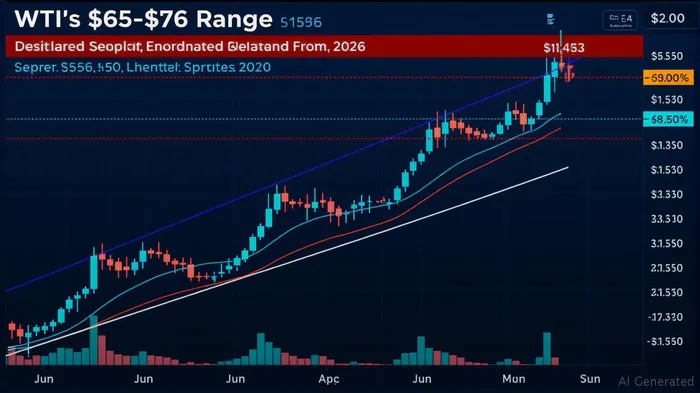
Despite bearish moving averages, WTI's chart offers a classic contrarian setup:
Key Support Levels:
- $65.00: The June 27 low represents critical support. A hold here could trigger a short-covering rally.
- $63.00: The 200-day moving average (currently at $63.50) acts as a final defensive line.
Key Resistance Levels:
- $73.43: The June 19 price marks the nearest psychological resistance. A close above this level could target:
- $76.62: The 2025 high (Brent's June 19 level) and a key Fibonacci retracement level.
Investment Strategy: A Short-Term Contrarian Play
Buy Signal: Enter long positions at $65.00–$66.00, targeting $73.43 with a stop-loss below $63.00.
- Risk Management: Allocate 10–15% of a speculative portfolio.
- Catalyst Watch: Monitor OPEC+ compliance data (July 10) and Fed minutes (July 17).
Exit Strategy:
- Profit Target: $73.43 (13% upside).
- Protective Sell: If WTIWTI-- breaches $63.00, exit immediately.
Risks to the Thesis
- OPEC+ Overcompliance: If members exceed production targets, oversupply could push prices below $60.
- Fed Hawkish Shift: A sudden inflation scare or jobs report could revive USD strength.
- Geopolitical Flare-ups: Renewed Iran-Israel hostilities or Strait of Hormuz blockages could disrupt flows.
Conclusion: A High-Reward, High-Risk Contrarian Bet
While WTI's technicals remain bearish, the alignment of USD weakness, OPEC+ uncertainty, and Fed policy ambiguity creates a compelling short-term buying opportunity. Investors willing to accept volatility may find value in a $65–$66 entry, with a $73.43 target. However, this is a tactical play—exit strategies and risk management are paramount.
As the adage goes: “The trend is your friend, but the contrarian is your profit.” In this case, the contrarian setup may just be worth the gamble.







Comentarios
Aún no hay comentarios