
Cross-Chain Liquidity Expansion and Solana's Role in Web3 Ecosystem Growth: Strategic Entry Points for Investors in the Multi-Chain Revolution
The blockchain landscape in 2025 is defined by a seismic shift toward cross-chain liquidity expansion, driven by the urgent need for interoperability and the maturation of decentralized finance (DeFi). As institutional capital floods the space, protocols and blockchains that can scale liquidity across ecosystems are emerging as critical infrastructure. SolanaSOL--, with its high-throughput architecture and strategic partnerships, has positioned itself at the forefront of this evolution. For investors, understanding the mechanics of cross-chain liquidity and Solana's unique advantages offers a roadmap to capitalize on the multi-chain revolution.
The Cross-Chain Liquidity Landscape: A New Era of Interoperability
Cross-chain liquidity has become the lifeblood of Web3, enabling seamless asset transfers between blockchains. According to a report by Panewslab, cross-chain bridge transaction volumes surged from $18.6 billion in September 2024 to $50 billion by November 2024, a 188% increase. This growth reflects a shift from retail-driven, high-frequency transactions to institutional-grade capital flows, with Ethereum maintaining dominance as the primary liquidity hub, recording $10.1 billion in net inflows year-to-date.
Protocols like LayerZero and Stargate are reshaping the landscape. LayerZero, handling nearly half of total cross-chain transaction volume, provides a messaging infrastructure that underpins interoperability. Stargate, built on LayerZero, has introduced the Hydra mechanism, which extends liquidity from core chains to emerging networks, enabling native asset transfers without wrapped tokens. 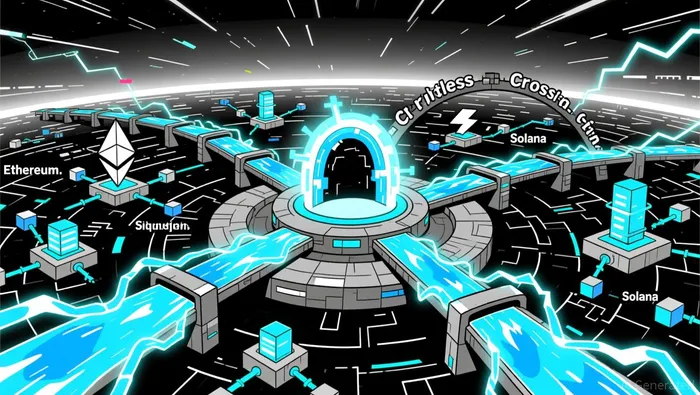 Meanwhile, Eco Portal and THORChain cater to niche markets, with Eco PortalPORTAL-- optimizing stablecoin transfers and THORChain enabling trustless, native asset swaps.
However, challenges persist. The 2025 crypto liquidity crisis exposed vulnerabilities in the system, with regulatory shifts and cyberattacks triggering sharp sell-offs. Additionally, Asian equity markets' structural liquidity issues-such as low free float and operational frictions-pose risks to cross-chain ecosystems reliant on global capital flows.
Solana's Strategic Position in the Multi-Chain Ecosystem
Solana's ascent in 2025 is a testament to its ability to balance scalability with institutional adoption. The launch of the Base-Solana bridge, powered by ChainlinkLINK-- CCIP and Coinbase infrastructure, has been a pivotal development. This bridge not only facilitates seamless token transfers between Ethereum's Base and Solana but also leverages dual verification to mitigate risks. By Q3 2025, the economic value of this bridge reached $222.3 million, while Solana's DeFi TVL hit $11.5 billion, driven by protocols like SerumSRM-- and JupiterJUP--.
Real-world adoption has further solidified Solana's relevance. A partnership with Western Union for blockchain-based remittances highlights its potential to channel massive transaction volumes. Additionally, Solana hosts over $13 billion in tokenized real-world assets (RWAs), including treasuries and private credit, a 350% year-over-year increase. Institutional players like BlackRock, Apollo Global, and VanEck have also issued tokenized funds on the network, signaling a bridge between traditional finance and Web3.
Strategic Entry Points for Investors: Balancing Growth and Risk
For investors, Solana's cross-chain ecosystem presents both opportunities and risks. Key metrics to consider include:
TVL and Staking Growth: Solana's staking TVL grew by over 50% in Q3 2025, driven by institutional-grade products like Marinade Select, which surpassed $436 million in TVL by November 2025. This trend is further amplified by the proposed SIMD-0411 protocol change, which could double the network's disinflation rate to 30%, increasing token scarcity.
DEX Performance: Despite a decline in daily active addresses to 3.3 million in late 2025, Solana's DEXs, such as Raydium and Orca, maintain efficiency, with median fees below $0.001 and throughput averaging 3.65k TPS. The chain's dominance in prediction markets and remittances underscores its utility.
Institutional Momentum: The launch of ETFs like the REX-Osprey Solana + Staking ETF (SSK) and Bitwise Solana Staking ETF attracted $417 million in initial capital, reflecting growing confidence in Solana's infrastructure.
Risks to Monitor: While Solana's price reached $140 in late November 2025, it remains below its all-time high, with a 19.35% gap as of September 2025. Prolonged declines in user activity, validator consolidation, and competition from application-specific chains could test the ecosystem's resilience.
Conclusion: Navigating the Multi-Chain Future
The cross-chain liquidity revolution is in full swing, with Solana emerging as a linchpin due to its scalability, institutional partnerships, and innovative protocols. For investors, strategic entry points lie in protocols that facilitate liquidity expansion (e.g., Stargate, LayerZero) and Solana's ecosystem, particularly in staking and tokenized assets. However, prudence is essential: macroeconomic volatility, regulatory shifts, and technical risks must be factored into any investment thesis.
As the multi-chain era matures, those who align with protocols and blockchains that prioritize interoperability, security, and institutional adoption will be best positioned to capitalize on the next phase of Web3 growth.






Comentarios
Aún no hay comentarios