
**Cross-Border Travel and Leisure Spending: How Economic Shifts and Retail Innovations Are Reshaping Holiday Consumption in Australia and India**
India's Economic Ascendancy and the Rise of the Travel-Ready Consumer
India's economic trajectory is a cornerstone of this transformation. As the fastest-growing major economy globally, India is projected to become the world's third-largest by 2030. This growth has fueled rising disposable incomes, particularly among the young, aspirational middle class. According to a report by Tourism Australia, Indian outbound travel is expected to reach 50 million by 2030 and 90 million by 2040, driven by generational shifts and a growing appetite for global experiences.
The Indian travel market is also being reshaped by technological and behavioral trends. Online travel agencies like Ease My Trip are displacing traditional agents, while social media platforms inspire "wanderlust" among younger generations. Indian travelers now prioritize personalized, immersive experiences-such as cultural exploration and adventure tourism-over mass tourism, with Australia's natural beauty and wildlife making it a top destination.
Retail Innovations: From Digital Platforms to Bespoke Experiences
Retail innovations in both countries are amplifying these trends. In India, travel agencies such as KFT Holidays and Harmony Tours are offering curated packages that blend luxury, adventure, and cultural immersion, catering to the demand for unique experiences. Meanwhile, Australian retailers are leveraging digital tools to enhance the travel journey. KPMG's Australian Retail Outlook 2025 highlights the rise of omnichannel retailing, with Gen Z consumers driving demand for seamless digital interactions.
 Artificial intelligence (AI) is another game-changer. BCG notes that AI-powered platforms are enabling hyper-personalized itineraries and conversational interfaces, replicating the depth of traditional travel agent services. While only 17% of Australian travelers currently use AI tools, the global travel industry's rapid adoption of these technologies suggests a growing need for Australian providers to innovate.
Australia's Strategic Response to Indian Demand
Australia has proactively tailored its offerings to Indian travelers. The Australian government's India Economic Strategy emphasizes expanding direct air connectivity, training an "India-ready" tourism workforce, and promoting niche markets such as luxury and business travel. For instance, the Aussie Specialist Program (ASP) trains frontline travel sellers to better market Australia to Indian consumers.
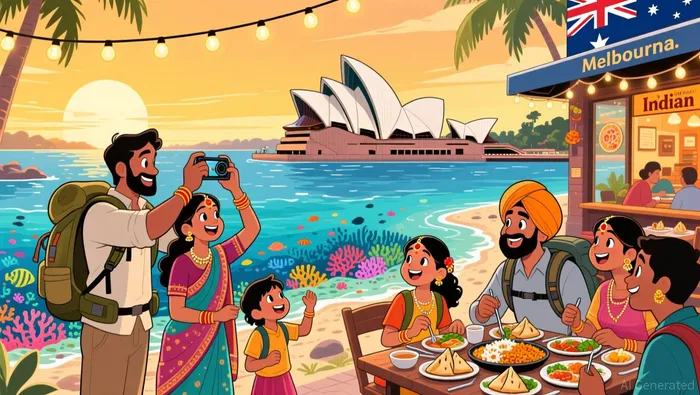
Cultural integration is also a priority. Indian food brands like Food Earth have expanded into Australia, offering organic, plant-based meals in major retail chains. This not only caters to Indian dietary preferences but also enhances Australia's appeal as a culturally inclusive destination. Such strategies align with the World Travel & Tourism Council's projection that Australia's travel sector will contribute $314.4 billion to its economy in 2025, with international visitor spending reaching $39 billion.
Investment Implications and Future Outlook
The interplay of economic and retail trends presents compelling opportunities for investors. In India, the outbound tourism market is projected to grow at a CAGR of 12.3%, reaching $61.7 billion by 2033. This growth is underpinned by India's economic expansion and the digitalization of travel retail. In Australia, the focus on AI-driven personalization and purpose-driven travel (e.g., wellness and culinary tourism) positions the sector for sustained demand.
However, challenges remain. Macroeconomic pressures such as inflation could temper spending, as seen in the U.S. retail sector's mixed performance. Yet, Australia and India's strategic alignment-through improved connectivity, tailored retail offerings, and a shared emphasis on experiential travel-suggests resilience.
Conclusion
The Australia-India travel corridor is a microcosm of a broader global shift: economic growth and technological innovation are converging to redefine leisure consumption. For investors, this means opportunities in travel agencies, digital platforms, and tourism infrastructure that cater to the next generation of travelers. As India's middle class grows and Australia refines its offerings, the two nations are not just reshaping holiday consumption-they are setting a blueprint for the future of global tourism.







Comentarios
Aún no hay comentarios