
Cronos Token's Market Reaction to Cybersecurity Allegations and Long-Term Investment Implications
In the volatile world of cryptocurrency, cybersecurity risks have emerged as a critical determinant of asset valuation. The recent turbulence surrounding Cronos (CRO) in late September 2025 offers a case study in how unsubstantiated allegations and governance controversies can destabilize even well-established tokens. As the market grapples with the intersection of security, trust, and tokenomics, investors must dissect the broader implications for crypto's long-term resilience.
The September 2025 Crisis: A Volatility Catalyst
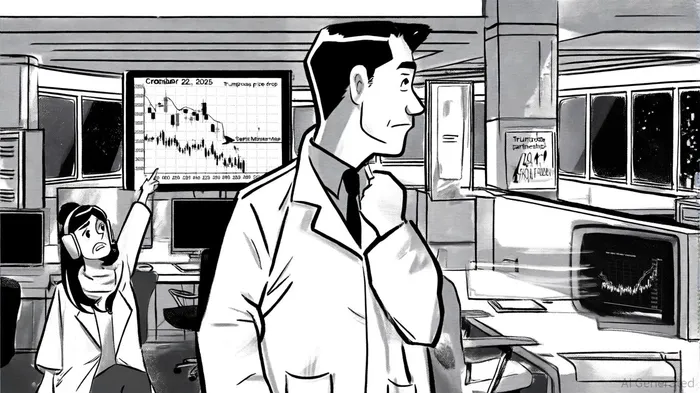
On September 22, 2025, Cronos (CRO) plummeted 11.45% amid rumors of a cyberattack, despite CEO Kris Marszalek's swift denial of any breach[1]. The CEO attributed the incident to a neutralized phishing attempt and emphasized compliance with regulatory standards[2]. However, the market's immediate reaction—driven by speculative fears and a $150M token burn—highlighted the fragility of investor confidence in the face of cybersecurity uncertainty[1]. This volatility mirrored broader trends: a 2025 report by Coinledger noted that 63% of crypto users perceive the asset class as unsafe, with breaches like ByBit's $1.5B cold wallet theft in 2025 exacerbating skepticism[3].
The reissuance of 70 billion CRO tokens in March 2025 further compounded concerns. Initially burned in 2021 as a supply-reduction strategy, the reversal drew accusations of manipulation and eroded trust in Crypto.com's governance model[4]. Blockchain sleuth ZachXBT criticized the move as “no different from a scam,” while critics argued it diluted token value and contradicted decentralization principles[4]. This governance controversy, paired with the September allegations, created a perfect storm of bearish sentiment, with sell-side pressure intensifying as traders questioned the platform's transparency[1].
Historical Precedents: Cybersecurity and Valuation Erosion
The Cronos saga is not an isolated incident. Historical data underscores a clear correlation between cybersecurity breaches and long-term valuation declines. For instance, the 2024 DMM BitcoinBTC-- exchange hack—where 4,502.9 BTCBTC-- were stolen—triggered a 12-month price correction of 22% for Bitcoin, despite the asset's broader market resilience[5]. Similarly, the 2025 ByBit breach, which saw $1.5B in stolen funds laundered through privacy coins like Monero, led to a 15% drop in Ethereum's market cap within a week[3].
A 2025 study by Forbes emphasized that cybersecurity incidents erode trust not only in the affected platform but across the entire crypto ecosystem[2]. This “spillover effect” was evident during the FTX collapse in 2022, which caused abnormal negative returns for the top ten cryptocurrencies by market cap[6]. The aftermath of FTX also revealed a shift in investor behavior: while the initial panic led to mass withdrawals, subsequent breaches (e.g., BlockFi's 2023 collapse) elicited muted reactions, suggesting a gradual normalization of risk[6].
Cronos's Security Framework: Strengths and Gaps
Cronos employs a multi-layered cybersecurity strategy, including a Proof of Stake (PoS) consensus mechanism, third-party smart contract audits, and ZK-rollups to mitigate cross-chain vulnerabilities[7]. The platform's partnership with Crypto.com has also bolstered regulatory compliance, a critical factor in institutional adoption[7]. However, the reissuance of burned tokens and the September controversy exposed governance weaknesses. Critics argue that centralized control over token supply—such as the 10-year vesting schedule for reissued CRO—undermines decentralization and creates inflationary risks[4].
Moreover, the September incident revealed a disconnect between technical security and user trust. While Marszalek denied a breach, the lack of public evidence (e.g., third-party verification of phishing attempts) left room for speculation[1]. This aligns with broader industry trends: a 2025 Chainalysis report found that 45% of stolen Bitcoin is converted into privacy coins, complicating recovery efforts and amplifying reputational damage[3].
Market Recovery and Long-Term Implications
Despite the short-term turmoil, technical indicators suggest a potential bullish reversal for CRO. Active addresses on the Cronos network hit a three-year high of 32,000 in September 2025, signaling growing engagement[8]. The token's formation of a bullish pennant pattern, coupled with an oversold Money Flow Index (MFI), hints at a possible rebound above $0.32—a level that could drive the price toward $0.39 in a best-case scenario[8].
However, long-term investors must weigh these technical positives against structural risks. The reissuance of 70 billion CRO tokens, while defended as a strategic move to align with U.S. regulatory conditions, has raised questions about supply management and dilution[4]. Additionally, the platform's reliance on centralized governance—evidenced by Marszalek's unilateral decisions—contrasts with the decentralized ethos that underpins much of the crypto space[4].
Strategic Considerations for Investors
For investors, the Cronos case underscores the importance of scrutinizing both technical security and governance practices. Key questions include:
1. Transparency: Will Crypto.com provide verifiable evidence of the September incident's resolution?
2. Supply Dynamics: How will the reissued tokens impact long-term inflation and token value?
3. Regulatory Alignment: Can Cronos maintain compliance while preserving decentralization?
Historical data suggests that projects with robust cybersecurity frameworks and transparent governance recover faster from crises. For example, Ethereum's post-2024 DeFi hacks saw a 18-month recovery period, driven by upgrades like the London hard fork and EIP-1559[5]. Cronos's adoption of ZK-rollups and its 10-year token vesting plan may similarly position it for resilience, but only if trust is restored through consistent action.
Conclusion
Cronos's September 2025 volatility is a microcosm of the broader challenges facing crypto assets: balancing innovation with security, decentralization with governance, and growth with trust. While the token's technical indicators and on-chain activity suggest a potential rebound, the long-term outlook hinges on Crypto.com's ability to address governance controversies and reinforce cybersecurity transparency. For investors, the lesson is clear: in an industry where trust is currency, even the most robust technology cannot compensate for lapses in integrity.







Comentarios
Aún no hay comentarios