
Crocs: A Discounted Growth Opportunity in a Tariff-Scarred World
Crocs (CROX) has long been a footwear outlier, blending quirky style with functional comfort. Yet its stock sits at a 12-month low of $107.34—nearly 25% below its 2023 peak—despite recent earnings that underscore margin resilience, brand strength, and a strategy to navigate tariff headwinds. For investors willing to look past near-term noise, this could be a rare entry point into a company that's undervalued relative to its earnings power and growth trajectory.
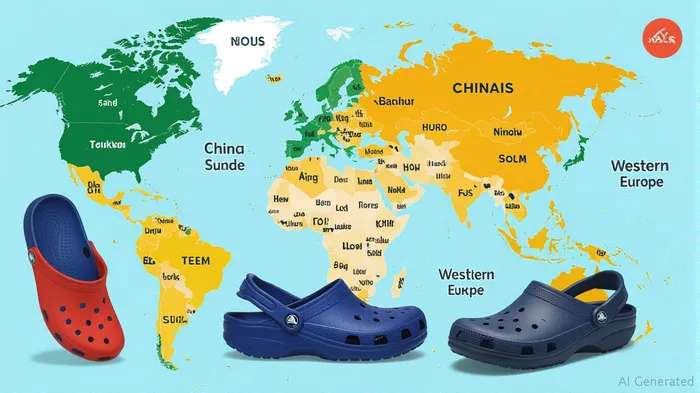
The Undervalued Growth Case: Why CROX Is a Bargain
Crocs trades at a price-to-earnings (P/E) ratio of just 6.26x and a price-to-sales (P/S) multiple of 1.46x, both near decade lows. These metrics starkly contrast with its robust financial performance:
- Adjusted EPS rose 20% to $3.00 in Q1 2025, driven by a 23.8% operating margin—well above guidance.
- Free cash flow remains strong, supported by a $166 million cash balance and $679 million in borrowing capacity.
- Analysts estimate an intrinsic value of $137.88 per share, implying a 22% upside from current levels.
The market's skepticism is misplaced. While tariffs and Heydude's struggles weigh on sentiment, the core CrocsCROX-- brand is thriving, and management has proven adept at mitigating risks.
Margin Resilience: Cost Cuts, Pricing Power, and Sourcing Shifts
Crocs' Q1 results highlight a rare combination of top-line growth (4% revenue rise) and margin expansion (57.8% gross margin). This defies the broader footwear sector's struggles with inflation and trade barriers:
- Cost Discipline:
- $50 million in annualized cost savings were identified in 2025, with plans for further cuts.
A shift to Vietnam and Indonesia for production—now 64% of sourcing—avoids escalating China tariffs.
Pricing Leverage:
Management signaled willingness to raise prices selectively, a move analysts say competitors would likely follow, preserving Crocs' 34% DTC (direct-to-consumer) growth.
Brand Momentum:
- The Crocs brand grew 12% globally, fueled by 30% revenue jumps in China and TikTok-driven sales. New sandal lines attracted 54% of new customers via digital channels.
The key risk—tariffs—remains manageable. Even a worst-case scenario (145% China tariffs + 10% elsewhere) would cost ~$130 million annually, but Crocs' $957 million TTM net income provides ample buffer.
Heydude's Struggles: Overlooked, but Not Overwhelming
Heydude, Crocs' sandal-focused subsidiary, dragged down Q1 results with a 17% wholesale revenue drop and margin compression. Yet this segment's issues are overstated:
- DTC Turnaround: Heydude's digital sales grew 8%, aided by celebrity partnerships (e.g., Sydney Sweeney) and the Wally Stretch Socks program, which boosted retention.
- Cost Adjustments: Heydude's reliance on Chinese-sourced goods is fading, with Vietnam/Indonesia production ramping up.
Crucially, Heydude represents just 13% of Crocs' total revenue. The core brand's dominance ensures that even if Heydude stagnates, Crocs remains profitable.
The Investment Thesis: Buy the Dip, Own the Long Game
The market is pricing in worst-case scenarios—tariff escalation, consumer spending collapse, and Heydude's failure—that are far from certain. Meanwhile, Crocs' financials and strategy suggest:
- Valuation Safety Net:
- A 6.26x P/E leaves little room for error, even if earnings dip.
A $1.3 billion buyback authorization (with $1.9B total capacity) signals confidence in the stock's undervaluation.
Margin Sustainability:
Crocs' 23.8% operating margin is structurally higher than peers like Deckers (16%) or NikeNKE-- (12%), thanks to its direct-to-consumer focus and low debt (1.0x–1.5x leverage target).
Global Growth Tailwinds:
- China's rebound in luxury goods spending and Western Europe's shift toward “comfortable luxury” align with Crocs' strengths.
Conclusion: A Rare Value Play in a Growth Stock World
Crocs is a paradox: a company with $4.1 billion in annual revenue, $957 million in net income, and a fortress balance sheet, yet it trades at a valuation typically reserved for distressed companies. Analysts' average price target of $129.77 (21% upside) and the $137 intrinsic value estimate suggest the market has mispriced risks.
Investors should view dips below $100 as a buying opportunity. While tariffs and Heydude's recovery are valid concerns, they're already priced into the stock. Crocs' core brand dominance, margin resilience, and disciplined capital allocation make it a compelling long-term hold—even if the path to $150+ is bumpy.
Recommendation: Buy CROXCROX-- near current levels. Set a 12-month target of $130, with a stop-loss below $90. This is a stock to own, not trade.
Disclosure: The author holds no position in CROX at the time of writing.





Comentarios
Aún no hay comentarios