
The U.S. Critical Minerals Push: Strategic Opportunities in Mining and Midstream Processing
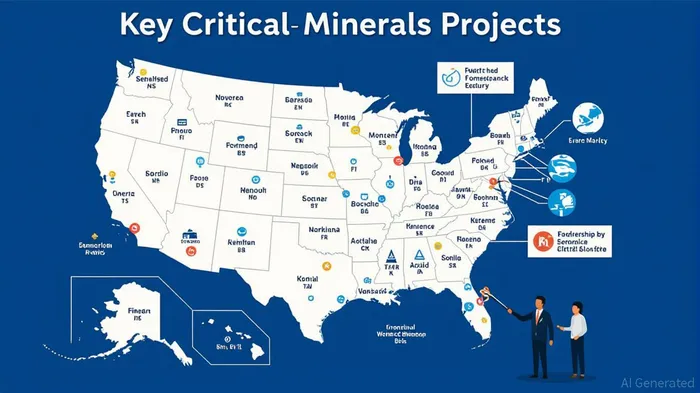
The U.S. critical minerals landscape is undergoing a seismic shift, driven by a confluence of geopolitical urgency, technological demand, and strategic policy interventions. As the Biden administration (or, in this case, the Trump administration's 2025 agenda) doubles down on securing supply chains for energy, defense, and advanced manufacturing, the role of government-private partnerships has become indispensable. These collaborations are not merely about filling gaps—they are about redefining the architecture of U.S. industrial resilience.
The Federal Playbook: Funding, Streamlining, and Strategic Alignment
The Department of Energy's (DOE) recent $1 billion investment in critical minerals programs exemplifies this new era of intervention. Four flagship initiatives—spanning battery materials processing, rare earth element (REE) demonstration, byproduct recovery, and technology acceleration—target late-stage projects poised for commercialization[1]. These programs are designed to reduce reliance on foreign adversaries while accelerating domestic production. For instance, the Battery Materials Processing and Battery Manufacturing and Recycling Grant Program, with up to $500 million in funding, directly addresses the bottleneck in lithium, graphite, and nickel processing—a sector where U.S. capabilities lag behind China's dominance[1].
Equally significant is the administration's push to streamline regulatory and bureaucratic hurdles. A presidential memorandum issued in June 2025 mandates harmonized application processes across federal agencies, aiming to cut redundant reviews and fast-track funding decisions[4]. This is a critical step, as delays in permitting and interagency coordination have historically stifled private-sector investment in midstream processing.
The Midstream Gap: Rare Earths and the Path to Resilience
The U.S. faces a stark challenge in midstream processing—a segment where China controls 87% of global rare earth element (REE) refining[2]. This gap is not just a technical or economic issue; it is a national security vulnerability. As a report by Johnson and Jacobs underscores, the U.S. lacks the infrastructure to convert raw ores into the high-purity materials needed for magnets, semiconductors, and green technologies[2].
Enter the Department of Defense (DoD) and MP MaterialsMP--. Their 2025 partnership—a $550 million blend of equity, loans, and warrants—has become a blueprint for how government intervention can catalyze private-sector action. The DoD's 10-year price floor guarantee of $110/kg for neodymium-praseodymium (NdPr) and its offtake commitment for magnet manufacturing provide the financial stability needed to justify capital expenditures[1]. This model, leveraging the Defense Production Act (DPA) Title III authorities, demonstrates how public policy can mitigate market risks and align private incentives with national priorities[1].
Byproduct Recovery and Recycling: The Circular Economy's Untapped Potential
Beyond primary mining, the U.S. is increasingly turning to byproduct recovery and recycling to meet demand. The Office of Fossil Energy and Carbon Management's $250 million allocation for pilot-scale facilities that extract minerals from industrial waste and mine tailings is a case in point[1]. This approach not only diversifies supply but also aligns with environmental goals, as highlighted in the 2025 State of Critical Minerals Report from the Payne Institute[3].
Companies like Phoenix Tailings are pioneering zero-waste technologies, extracting rare earths from electronic scrap and mining waste[4]. Such innovations are critical, as the U.S. seeks to reduce its reliance on primary ores while addressing the environmental legacy of past mining operations.
Strategic Partnerships: MINVEST and the Global Dimension
The U.S. Department of State's MINVEST Partnership, a public-private initiative, adds a global dimension to this push. By collaborating with entities like the SAFE Center for Critical Minerals Strategy, MINVEST aims to attract investment in responsible projects while adhering to high ESG standards[2]. This initiative dovetails with the Minerals Security Partnership (MSP) and its Finance Network, which de-risks projects through development finance institutions and export credit agencies[4].
These efforts reflect a broader trend: governments worldwide are recognizing that securing critical minerals is as much about diplomacy and capital as it is about geology. The U.S. is positioning itself not just as a producer but as a convener of global supply chain resilience.
Challenges and the Road Ahead
Despite these strides, challenges persist. Feedstock scarcity, immature markets, and price volatility remain hurdles[2]. Moreover, the success of these initiatives hinges on sustained political will and cross-sector collaboration. The 2025 List of Critical Minerals, which includes 54 commodities, underscores the scale of the task[3].
Yet the momentum is undeniable. With the DOE's Critical Minerals and Materials Accelerator and the Bipartisan Infrastructure Law providing further tailwinds, the U.S. is building a framework where strategic investment can thrive. For investors, the message is clear: the critical minerals sector is no longer a niche play—it is a linchpin of the 21st-century economy.





Comentarios
Aún no hay comentarios