
The Critical Need for Institutional-Grade Cybersecurity in the Crypto Ecosystem: A 2025 Risk Assessment
The cryptocurrency ecosystem's 2025 security landscape has underscored a stark reality: without institutional-grade cybersecurity infrastructure, the sector remains vulnerable to systemic risks that threaten both capital preservation and investor confidence. According to Chainalysis, over $3.4 billion in crypto assets were stolen in 2025 alone, with North Korean hackers emerging as the most prolific threat actors, responsible for $2.02 billion in thefts-a 51% year-over-year increase. These figures, coupled with the October 2025 market crash that erased $19 billion in leveraged positions in a single day, highlight an urgent need for robust security frameworks tailored to the unique vulnerabilities of crypto infrastructure.
The Escalating Scale and Sophistication of Attacks
The February 2025 Bybit breach, in which $1.5 billion was stolen, exemplifies the growing scale of attacks. This incident alone accounted for nearly half of the year's total losses, illustrating a trend toward fewer but more catastrophic breaches. North Korean hackers, now responsible for $6.75 billion in all-time crypto thefts, have shifted tactics to include embedding IT workers within crypto services or deploying sophisticated impersonation campaigns targeting executives. These methods bypass traditional perimeter-based security models, exploiting human and operational weaknesses rather than purely technical vulnerabilities.
Moreover, the post-theft laundering process has become increasingly opaque. Stolen funds are funneled through Chinese-language money laundering services, bridge protocols, and mixing tools, with a 45-day cycle typically required to obscure their origins. 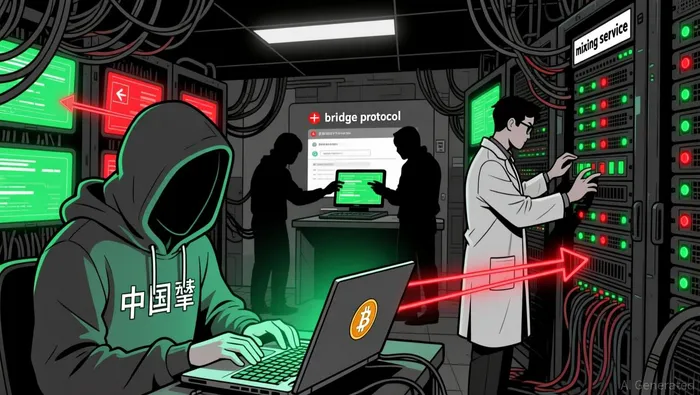 This complexity not only complicates recovery efforts but also enables bad actors to evade regulatory scrutiny, further incentivizing large-scale attacks.
Systemic Risks Beyond Direct Theft
While direct thefts dominate headlines, the October 2025 crash revealed deeper systemic vulnerabilities. Triggered by a geopolitical shock (a 100% China tariff threat), the collapse exposed flaws in leveraged trading systems and unified margin models. Exchanges with interconnected margin accounts amplified liquidation cascades, eroding liquidity and triggering a self-reinforcing downward spiral. This event underscores that cybersecurity risks extend beyond hacking to include operational and liquidity risks inherent in crypto's leverage-driven ecosystems.
The Paradox of DeFi and Centralized Weaknesses
Despite a 2025 decline in decentralized finance (DeFi) hack losses-a sign of improved smart contract security-the sector's overall risk profile has not diminished. Instead, breaches are becoming more concentrated, with a handful of high-impact incidents dominating the damage. Centralized exchanges (CEXs) remain prime targets, as seen with Bybit and Phemex, where poor key management and insufficient threat intelligence left billions exposed. This paradox-stronger DeFi security coexisting with fragile CEX infrastructure-highlights the need for a holistic approach to security that addresses both technical and organizational shortcomings.
Implications for Investors and the Path Forward
For institutional investors, the 2025 data paints a clear picture: crypto assets are increasingly exposed to risks that cannot be mitigated by diversification alone. The average cost of a breach now exceeds $200 million, with recovery rates for stolen funds hovering below 5%. This reality demands a reevaluation of risk models, with a particular emphasis on security audits, multi-layered defense mechanisms, and partnerships with cybersecurity firms specializing in blockchain infrastructure.
Investors must also prioritize projects and platforms that adopt zero-trust architectures, real-time threat detection, and geographically distributed cold storage solutions. Regulatory compliance, while necessary, is insufficient on its own; proactive security measures must be baked into the design of crypto protocols and exchange systems.
Conclusion
The 2025 security breaches and market crash serve as a wake-up call for the crypto industry. As North Korean actors and other malicious entities continue to refine their tactics, the window for implementing institutional-grade security solutions is rapidly closing. For investors, the cost of inaction-measured in lost capital, regulatory backlash, and eroded trust-far outweighs the cost of adopting advanced security protocols. The future of crypto depends on building infrastructure that can withstand not just today's threats, but the evolving challenges of tomorrow.







Comentarios
Aún no hay comentarios