
Cricut's Strategic Momentum: Can a 24% 3-Year Return Signal a Higher Beta Play in a Slow-Growth Economy?
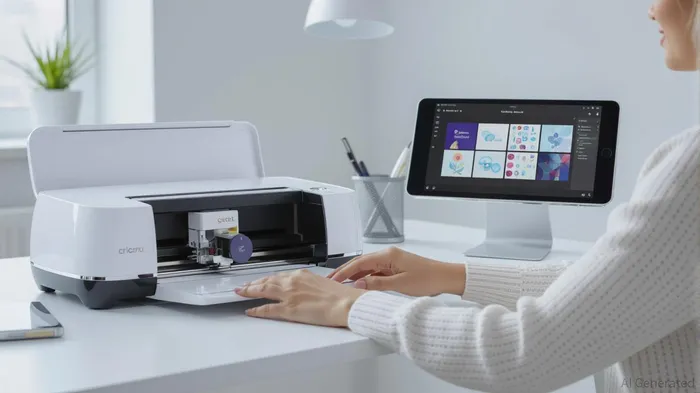
In an era of tepid economic growth and volatile markets, investors are increasingly drawn to companies that combine operational resilience with disciplined capital allocation. CricutCRCT--, Inc. (NASDAQ: CRCT), a leader in the creative technology space, has emerged as a compelling case study. Over the past three years, the company has navigated macroeconomic headwinds while delivering a 24% total return to shareholders, driven by margin expansion, strategic reinvestment, and a hybrid SaaS-hardware business model. But does this performance justify a higher beta play in a slow-growth environment?
Revenue Resilience: A Hybrid Model's Edge
Cricut's dual revenue streams—hardware and platform subscriptions—have proven remarkably resilient. While products revenue declined by 12% in FY 2024, platform revenue grew by 1%, reflecting a shift toward recurring, high-margin income. This transition is critical: platform revenue now accounts for 44% of total revenue, up from 39% in 2022. The company's 3.01 million paid subscribers, a 7% year-over-year increase, underscore the stickiness of its digital ecosystem.
The hybrid model also insulates Cricut from pure-play hardware volatility. For instance, while connected machine sales dipped 10% in Q2 2025, accessories and materials revenue grew 12%, driven by international expansion. This diversification has allowed Cricut to maintain a 2% revenue increase in Q2 2025, even as global consumer spending remains cautious.
Margin Expansion: A Catalyst for Profitability
Cricut's gross margin has surged from 44.9% in FY 2023 to 59.0% in Q2 2025, a 14-point improvement. This expansion stems from two key factors:
1. Platform Monetization: Higher-margin subscriptions now dominate the revenue mix, with platform ARPU rising 2% to $53.84.
2. Hardware Efficiency: Optimized inventory management and a shift toward premium materials (e.g., the Cricut Value line) have boosted product margins.
Operating income followed suit, climbing 14% to $30.1 million in Q2 2025, while net income jumped 24% to $24.5 million. These metrics highlight Cricut's ability to convert operational improvements into shareholder value—a hallmark of high-ROI businesses.
Capital Return Discipline: Balancing Growth and Shareholder Rewards
Cricut's financial discipline is another standout. The company ended Q2 2025 with $377 million in cash and no debt, enabling aggressive shareholder returns. In the past year alone, it repurchased $4.7 million in shares and distributed $181 million in dividends. This capital allocation strategyMSTR--, combined with a 24% net income growth, has rewarded investors while funding strategic initiatives like the Cricut Explore 4 and international market penetration.
Beta and Risk: A Calculated Trade-Off
Cricut's beta of 1.03 suggests slightly higher volatility than the S&P 500, but this risk is mitigated by its hybrid model. Unlike pure SaaS companies, which face intense competition and customer acquisition costs, Cricut's hardware component provides a stable revenue base. Meanwhile, its platform's recurring revenue offers the scalability of software. This duality creates a unique risk-reward profile: Cricut's beta is modest, but its margin expansion and capital returns amplify returns in a slow-growth economy.
Investment Thesis: A High-ROI Hybrid in a Low-Growth World
Cricut's 24% 3-year return is not a fluke—it reflects a strategic pivot toward high-margin platform growth, disciplined cost management, and prudent capital allocation. While the company faces challenges (e.g., stagnant active user growth and 90-day engagement declines), its focus on international expansion and product innovation positions it to outperform peers.
For investors, Cricut offers a rare combination: a beta of 1.03 with the operational resilience of a hybrid model. In a slow-growth economy, where traditional high-beta plays struggle, Cricut's ability to balance innovation with shareholder returns makes it a compelling long-term bet. However, caution is warranted: monitor user engagement trends and the impact of tariffs on hardware margins.
In conclusion, Cricut's strategic momentum—driven by margin expansion, hybrid model advantages, and disciplined capital returns—positions it as a higher-beta play with the potential to deliver outsized returns in a constrained economic environment. For those seeking a blend of growth and stability, Cricut's SaaS-hardware hybrid model is worth a closer look.





Comentarios
Aún no hay comentarios