
Credo Technology (CRDO) Falls 3.57% as Bearish Engulfing Pattern and Death Cross Signal Potential Drop to $134.13 Support Level
Credo Technology (CRDO) fell 3.57% in the most recent session, extending a volatile downward trend observed over the past two weeks. This decline aligns with bearish candlestick patterns, including a bearish engulfing formation on December 26, where the body of the 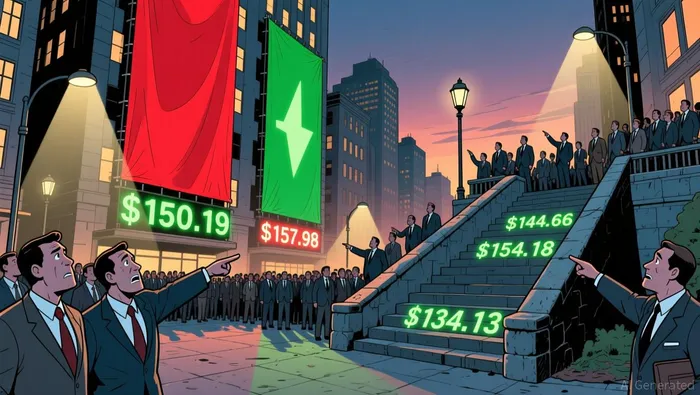 candle completely subsumed the prior session’s bullish pattern. Key support levels are evident at $144.66 (a recent low) and $134.13 (a prior swing low), while resistance clusters form around $150.19 and $157.98 (a prior peak). The price action suggests a potential breakdown from a descending channel, with a target near $134.13 if the trend continues.
Moving Average Theory
The 50-day, 100-day, and 200-day moving averages are likely in a bearish alignment, with the 50-day (approximately $148–$150) below the 200-day (around $155–$157). This “death cross” configuration reinforces the downtrend. However, the 50-day MA has recently approached the 100-day MA, suggesting potential short-term consolidation. Traders should monitor a crossover above the 50-day MA as a tentative bullish signal, though the 200-day MA remains a critical threshold for trend reversal.
MACD & KDJ Indicators
The MACD line has likely crossed below the signal line, confirming bearish momentum, while the histogram’s narrowing width suggests easing short-term selling pressure. The KDJ (Stochastic) indicator shows the stock is in oversold territory (K at ~20, D at ~25), which may indicate a near-term bounce. However, a bearish divergence is present: while the K line is rising, the price remains below key support levels, reducing the probability of a sustained reversal.
Bollinger Bands
Volatility has contracted recently, with the bands narrowing to a range of ~$144–$152. This “calm before the storm” pattern often precedes a breakout or breakdown. The current price near the lower band ($144.66) suggests oversold conditions, but without a clear reversal signal, the bias remains bearish. A break below the lower band could target the next support at $134.13.
Volume-Price Relationship
Trading volume surged on the December 26 session (2.7 million shares), validating the bearish breakdown. However, volume has since declined, which may indicate waning momentum. If the price tests the $134.13 level with increasing volume, it could confirm a sustainable downtrend. Conversely, a surge in volume during a rebound might signal short-covering or a reversal attempt.
Relative Strength Index (RSI)
The RSI is likely in the oversold zone (<30), given the 3.57% drop and recent volatility. While this suggests a potential rebound, the RSI’s failure to form higher lows despite the price making lower lows indicates bearish divergence. Traders should treat the RSI as a cautionary indicator rather than a reversal signal, as the broader trend remains intact.
Fibonacci Retracement
Key Fibonacci levels (38.2% at $148.6, 50% at $151.3) coincide with prior resistance areas. A rebound toward $148.6 could face selling pressure, but a break above $151.3 would invalidate the bearish case. The 61.8% retracement level at $154.5 is a critical test for trend continuation.
Conclusion
The technical landscape for Credo TechnologyCRDO-- is bearish, with confluence between candlestick patterns, moving averages, and Fibonacci levels. While the RSI and Bollinger Bands hint at oversold conditions, bearish divergence in the KDJ and RSI reduces the likelihood of a sustained reversal. A break below $134.13 with rising volume would confirm the downtrend, whereas a rebound above $151.3 could signal a trend reversal. Traders should prioritize risk management, given the high volatility and mixed momentum signals.





Comentarios
Aún no hay comentarios