
Credit Card Rate Caps: Navigating Risks and Opportunities in Financial Services and Alternative Lending
The global financial landscape is witnessing a seismic shift as regulators and policymakers increasingly target credit card interest rates to protect consumers and stabilize economies. From the U.S. to the EU and beyond, proposals to cap these rates are reshaping the banking sector and fueling growth in alternative lending. For investors, understanding the macroeconomic and sector-specific implications of these changes is critical to identifying both risks and opportunities in a rapidly evolving market.
The U.S. Case Study: A High-Stakes Regulatory Experiment
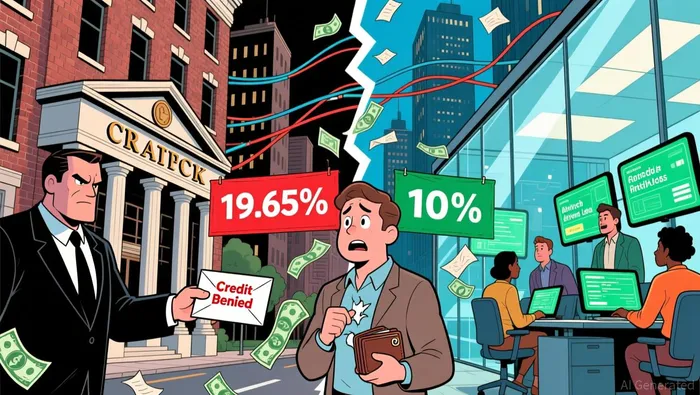
President Donald Trump's proposed 10% cap on credit card interest rates for a one-year period has ignited fierce debate. According to a report by , the policy aims to save American consumers an estimated $100 billion annually by curbing the average 19.65% interest rate. However, major banks like JPMorgan ChaseJPM-- and CitigroupC-- warn that such a cap would force them to tighten credit availability, particularly for subprime borrowers, or scale back rewards programs to offset lost revenue according to CNBC analysis. The American Bankers Association has labeled the proposal "devastating for millions of American families," arguing it could push consumers toward predatory alternatives like payday loans as stated in their press release.
For investors, the U.S. scenario highlights a dual-edged sword: while consumer relief could boost short-term spending, the long-term profitability of traditional banks may suffer. Analysts at Barclays note that card issuers might respond by canceling accounts or exiting the market entirely if margins become unsustainable. This creates a vacuum that alternative lenders-such as BNPL providers or fintechs-could exploit, though they too face regulatory scrutiny.
Global Perspectives: EU and UK/Canada Regulatory Frameworks
In the European Union, credit card regulations have already reshaped the financial ecosystem. The ECB's recent interest rate cuts and the implementation of interchange-fee caps under the Consumer Credit Directive II have constrained banks' transaction revenue, prompting a 4.29% CAGR growth in the credit card market to $1.19 trillion by 2030. Meanwhile, the alternative lending sector in Europe is booming, projected to expand at a 14.1% CAGR to $133 billion by 2025. This growth is driven by BNPL services and AI-driven credit assessments, though stricter lending standards under CCD II require compliance-by-design strategies as reported.
Canada and the UK offer contrasting dynamics. Canada's alternative lending market, fueled by embedded finance platforms like Shopify and Square Loans, is expected to grow at 14.3% annually. In the UK, SME borrowing has surged, with interest rates on new loans dropping to 6.41% in July 2025. However, trade tensions with the U.S. threaten to dampen Canada's GDP growth by 2.2%, underscoring the macroeconomic volatility investors must navigate according to market analysis.
Macroeconomic Implications: Inflation, Consumer Behavior, and Systemic Risks
The macroeconomic effects of rate caps are complex. In the U.S., a 10% cap could reduce banks' net interest margins, potentially slowing GDP growth if credit contraction outpaces consumer savings as CNBC reports. Conversely, the ECB's rate cuts have had limited near-term growth impact, illustrating the lagged effects of monetary policy according to Capital Economics. Inflationary pressures remain a wildcard: while lower interest rates might stimulate spending, they could also exacerbate inflation if alternative lenders raise fees to compensate for regulatory constraints as noted in market analysis.







Comentarios
Aún no hay comentarios