
U.S. Credit Card Debt Nears $1.33 Trillion: A Ticking Time Bomb for Consumer Spending and a Goldmine for Financial Firms
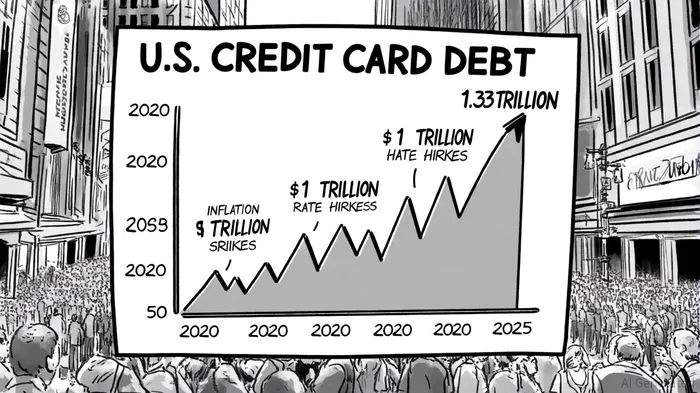
The U.S. credit card debt juggernaut is accelerating. As of Q2 2025, total balances hit $1.21 trillion, a 5.87% year-over-year surge, according to a CNBC report. While this falls short of the $1.33 trillion projection, WalletHub's May 2025 report pegs debt at $1.31 trillion, suggesting a plausible path to the $1.33 trillion mark by year-end. This trajectory is driven by a toxic mix of 21.91% average APRs, per Forbes Advisor, resumed federal student loan payments, and inflation eroding purchasing power. The result? A bifurcated consumer landscape where high-income households maintain spending while low-income borrowers face a debt cliff.
The Consumer Spending Divide: Resilience vs. Strain
Consumer spending remains stubbornly resilient, but the cracks are widening. High-income households (top 20%) account for two-thirds of all consumption, buoyed by lower debt-to-income ratios compared to pre-pandemic levels, according to the Boston Fed. Meanwhile, the bottom 80% of households are pulling back: revolving debt (primarily credit cards) fell 5.5% in August 2025 as financial stress mounted, according to a KPMG report.
Delinquency rates tell a darker story. 7.18% of balances transitioned to delinquency over the past year, according to a Federal Reserve note, with subprime borrowers (credit scores ≤600) bearing the brunt. Younger consumers (Gen Z and Millennials) are particularly vulnerable, with 14.1% of debt 30+ days delinquent in Q1 2025, per an Equifax report. This isn't just a consumer issue-it's a systemic risk.
Financial Sector Implications: Winners and Losers
The debt crisis is reshaping financial markets. Banks face rising loan losses, but high-yield sectors and debt-adjacent fintechs are thriving.
- Debt Relief Fintechs:
- Upstart and Human Interest are scaling AI-driven lending and student loan refinancing solutions, with Upstart securing $600M in August 2025 funding, according to a GreenFlag analysis.
- Aven, offering home equity-backed credit cards, raised $142M in 2024, per an Omnius list.
Debt settlement platforms are booming. The industry, valued at $6.1B in 2024, is projected to grow at 6.2% CAGR through 2034, according to a GM Insights report.
Alternative Lenders:
0% APR balance transfer cards and personal loans for consolidation are surging. In early 2025, 18% of personal loans were used for debt consolidation, totaling $257B, per Coinlaw data.
AI-Powered Financial Wellness Tools:
- Platforms like Imprint and Agentic AI-driven collectors are optimizing repayment plans and reducing delinquency risks through predictive analytics, according to a Shepherd Outsourcing post.
Investment Case: Capitalizing on the Debt Cycle
The $1.33 trillion debt milestone isn't just a problem-it's an opportunity. Here's how to position for it:
- Debt Relief Fintechs: Prioritize companies with scalable tech (e.g., Upstart's AI underwriting) and partnerships with major credit bureaus.
- High-Yield Consumer Lenders: Target firms catering to nonprime borrowers, where demand for credit is rising despite higher delinquency risks.
- Financial Infrastructure: Invest in platforms enabling real-time debt tracking and automated repayment tools, which are critical as 37% of Americans rely on credit cards to "make ends meet," according to a Debt.com survey.
Risks and Mitigations
While the debt crisis is a tailwind for fintechs, regulatory scrutiny and economic downturns could disrupt growth. However, the Federal Reserve's tightening cycle has already priced in much of the risk, and delinquency rates remain below historical peaks (7.3% YoY increase vs. 2008's 12%+), according to a CardRates article. Diversified portfolios across debt management, AI tools, and alternative lending can hedge against sector-specific shocks.
Conclusion
The U.S. credit card debt juggernaut is a double-edged sword: it strains consumers but fuels innovation in financial services. For investors, the key is to back firms that turn pain into profit-those leveraging AI, data, and alternative credit models to navigate the debt-driven economy. As the $1.33 trillion threshold looms, the winners will be those who see the storm not as a threat, but as a catalyst for reinvention.





Comentarios
Aún no hay comentarios