
Cramer's Warning: The 10% Rate Cap as a Market Catalyst
The immediate catalyst is clear. On Friday evening, President Trump announced a proposed one-year cap on credit card interest rates at 10%, effective January 20, 2026, via Truth Social. He framed it as a populist move to stop card companies from "ripping off" the public. The market's reaction was swift and severe. On Monday, shares in major banks and credit card firms fell sharply, with Capital One down 6.3%, American ExpressAXP-- off 4.4%, and VisaV-- and MastercardMA-- both down over 1%. This wasn't a broad market selloff; it was a targeted repricing of risk.
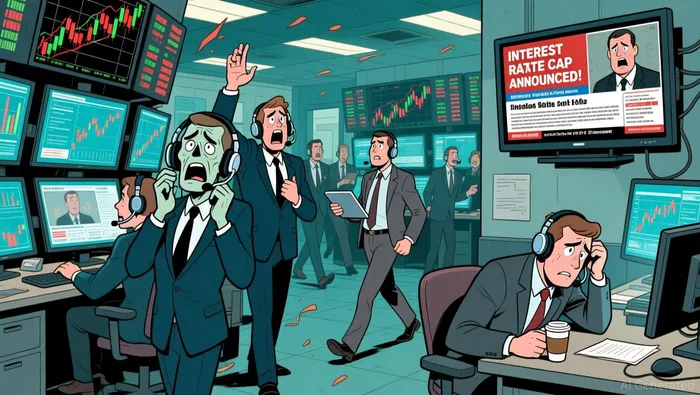
The core tension here is the warning from banking groups. They argue the cap would be "devastating" for millions of families and small businesses, not because it helps them, but because it reduces credit availability. As a coalition of major banking associations stated, if enacted, this cap would only drive consumers toward less regulated, more costly alternatives. That's the tactical setup Cramer would focus on: a policy that appears to lower costs for some cardholders but threatens to shrink the entire credit card market, pushing vulnerable borrowers into riskier, more expensive products.
The mechanism is straightforward. As one analyst noted, forcing rates down to 10% would "upend the basic economics of the industry". Banks would likely respond by cutting credit limits, closing riskier accounts, and scaling back rewards-actions that directly reduce access. The warning isn't hypothetical; it's the industry's forecast of the policy's direct, negative consequence. For now, the market is pricing in that risk of reduced availability, not the potential benefit of lower rates.
The Tactical Setup: Winners, Losers, and the Immediate Risk/Reward
The market's reaction lays out the immediate financial battleground. The core profit engine for banks and card issuers-interest income from revolving credit-is directly threatened. With the average rate in the US hovering around 20%, a mandated cap to 10% slashes that revenue stream in half. For companies like Capital One and American Express, which rely heavily on this income, the impact is a direct hit to earnings. The industry's warning that this would "upend the basic economics of the industry" is now being priced into their stock prices, which fell sharply on Monday.
Payment networks like Visa and Mastercard are in a different position. They earn transaction fees, not interest income, which provides a partial insulation. Their stock moves were more muted, with Visa down just 1.3% and Mastercard off 1.8%. The risk for them is indirect. If banks respond to the cap by cutting credit limits and scaling back rewards-as analysts predict-they could see lower transaction volumes. Yet, there's a counter-current: lower rates might boost consumer spending, potentially offsetting some volume loss. This creates a mixed, near-term effect that the market is still weighing.
The setup for traders is clear. The immediate risk is concentrated on the issuers. Their business model is directly rewritten by the proposal. The reward, if the cap is blocked or delayed, could be a sharp rebound as the threat recedes. For the networks, the risk is more about volume and the potential for a broader credit market contraction. The reward is relative stability, but they are not immune to the fallout if the policy chokes off credit availability.
The bottom line is a binary event. This isn't about a small policy tweak; it's about a fundamental shift in the cost of capital for a massive consumer credit segment. The market is pricing in the high probability of negative impact on issuers and the uncertainty for networks. The catalyst is the warning itself, and the immediate risk/reward is defined by which companies are most exposed to the direct hit on interest income.
The Path Forward: Scenarios and Key Catalysts to Watch
The immediate market reaction has priced in the threat, but the real story is the path to implementation. The proposal's fate hinges on a critical procedural fork: will the administration move via executive order or seek legislation? The former would be a direct, unilateral action, while the latter requires navigating a divided Congress. The industry's joint statement, issued just yesterday, underscores the urgency for dialogue, but the administration's authority to enforce a cap without congressional approval remains legally murky. This uncertainty creates a volatile setup where the next official move will be the primary catalyst.
For now, the market is watching for concrete signals of preparation. The first tangible test will be bank earnings guidance in the coming quarters. If major issuers like Capital One and American Express begin to flag "potential regulatory impacts" or adjust their credit card portfolio strategies in their outlooks, it will confirm the policy is being treated as a near-term business risk. Regulatory filings may also reveal early signs of increased risk provisioning or shifts in credit underwriting standards, as banks start to model the new economics.
Beyond the balance sheet, the real-world impact will be measured in consumer credit data. The industry's warning that two-thirds of revolving cardholders could lose access is a stark forecast. Traders should monitor data on card usage, delinquency rates, and new account approvals for early signs of reduced credit availability. A spike in delinquencies or a sudden drop in card balances would signal the policy is already pushing consumers toward less regulated alternatives, validating the industry's "devastating" warning and likely triggering further repricing.
The bottom line is a high-stakes game of timing and legal maneuvering. The market's initial selloff was a reaction to the proposal's announcement. The next catalysts-the administration's chosen path, bank guidance, and early consumer data-will determine whether this is a fleeting political noise or a permanent, damaging shift for the credit card industry.







Comentarios
Aún no hay comentarios